












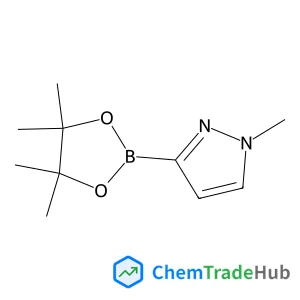
1-Methyl-3-(4,4,5,5-tetramethyl-1,3,2-dioxaborolan-2-yl)-1H-pyrazole
CAS Number:
1020174-04-2
Molecular Formula:
C10H17BN2O2
Colin S. Swenson, Hershel H. Lackey, Eric J. Reece, Joel M. Harris, Jennifer M. Heemstra, Eric M. Peterson
Peptide nucleic acid (PNA) is a unique synthetic nucleic acid analog that has been adopted for use in many biological applications. These applications rely upon the robust Franklin–Watson–Crick base pairing provided by PNA, particularly at lower ionic strengths. However, our understanding of the relationship between the kinetics of PNA:DNA hybridization and ionic strength is incomplete. Here we measured the kinetics of association and dissociation of PNA with DNA across a range of ionic strengths and temperatures at single-molecule resolution using total internal reflection fluorescence imaging. Unlike DNA:DNA duplexes, PNA:DNA duplexes are more stable at lower ionic strength, and we demonstrate that this is due to a higher association rate. While the dissociation rate of PNA:DNA duplexes is largely insensitive to ionic strength, it is significantly lower than that of DNA:DNA duplexes having the same number and sequence of base pairing interactions. The temperature dependence of PNA:DNA kinetic rate constants indicate a significant enthalpy barrier to duplex dissociation, and to a lesser extent, duplex formation. This investigation into the kinetics of PNA:DNA hybridization provides a framework towards better understanding and design of PNA sequences for future applications.
DOI: 10.1039/C7CP01455D
Chun Du, Jun Wang, Xiao Liu, Jie Yang, Kun Cao, Yanwei Wen
DOI: 10.1039/C7CP01588G
B. V. Nazarchuk, V. V. Golovanova, N. V. Tkachenko, T. T. Rantala
DOI: 10.1039/C7CP00833C
Jianbo Ma, Sunting Xuan, Abby C. Guerin, Tianyi Yu, Donghui Zhang, Daniel G. Kuroda
DOI: 10.1039/C6CP08536A
DOI: 10.1039/C7CP02158E
Houyang Chen
DOI: 10.1039/C6CP08621G
Chang Zhou, Qiang Zhang, Saiyue Liu, Bingcheng Luo, Eongyu Yi, Enke Tian, Guowu Li, Longtu Li, Gaohui Wu
DOI: 10.1039/C7CP00676D
Jorge Royes, Víctor Polo, Santiago Uriel, Luis Oriol, Milagros Piñol, Rosa M. Tejedor
DOI: 10.1039/C7CP01739A
DOI: 10.1039/C7CP01750B
Lhoussain Khrouz, Yi Zhou, Bin Shen, Chunyang Dong, Mingyang Xing, Shashank Mishra, Stéphane Daniele, Jinlong Zhang
DOI: 10.1039/C7CP01212H
Waste containing N-Methoxy-N-methyl-1,3-thiazole-5-carboxamide (CAS: 898825-89-3...
N-(4-Biphenylyl)dibenzo[b,d]furan-4-amine should be stored in a tightly sealed c...
The market for 3-Acetamido-5-amino-2,4,6-triiodobenzoic acid (CAS: 1713-07-1) is...
Benzyl 2-O-acetyl-3,4,6-tri-O-benzyl-beta-D-galactopyranoside (CAS: 61820-03-9) ...
2-Ethylpiperazine dihydrochloride (CAS: 438050-52-3) is regulated under the Glob...
1,1'-[1,3-Phenylenebis(methylene)]bis(3-methyl-1H-pyrrole-2,5-dione) (CAS: 11946...
Several alternatives can be used in the synthesis of 5-Fluoro-2-(1-pyrrolidinyl)...
Proper personal protective equipment (PPE) must be worn when handling this compo...
When handling 6-Bromoimidazo[1,2-a]pyridin-8-amine, it is important to wear appr...
Alternatives to (2S,4R)-4-(4-Nitrobenzyl)pyrrolidine-2-carboxylic acid hydrochlo...
![5-Acetyl-2,3-dihydrobenzo[b]furan structure](https://static.chemtradehub.com/structs/908/90843-31-5-eea4.webp "5-Acetyl-2,3-dihydrobenzo[b]furan structure")





