



Rapid detection of airborne protein from Mycobacterium tuberculosis using a biosensor detection system†
Literature Information
Publication Date
2022-01-13
DOI
10.1039/D1AN02104D
Impact Factor
4.616
Authors
Qingqing Ma
View Original
Abstract
Tuberculosis (TB), caused by infection with airborne Mycobacterium tuberculosis (MTB), seriously threatens human health and has become a public health problem of worldwide concern. To achieve effective control of TB, rapid and sensitive detection of MTB is particularly important. At present, the common detection methods for MTB cannot meet the requirements of speed, flexibility and portability simultaneously. In this work, a multichannel microfluidic chip was developed and packaged with an ultra-sensitive silicon nanowire field-effect-transistor biosensor. The fluid system was tested and optimized through simulation, and the best conditions were determined: the flow rate was 0.3 mL min−1 and the flow direction was perpendicular to a silicon nanowire. A one-way valve, a switching valve and a peristaltic pump were combined to establish a biosensor detection system to realize the automatic detection of TB samples. Then we systematically explained the factors affecting simulated exhaled breath condensate (SEBC) collection, and established and optimized the method for collection of SEBC from the perspective of collection volume and biological activity. The best collection conditions were determined for a 5 mm pipe diameter at 0 °C, and a sufficient sample volume was obtained in only 2 minutes for microfluidic detection. Then, the actual application value of the established collection method was further evaluated. Volunteers were recruited and this method was used to collect their exhaled breath condensate to analyze the collection effect. The system detected MTB in SEBC with good sensitivity (∼4 × 10⁴ particles per mL). It is expected to be further integrated and miniaturized in the future to realize point-of-care testing.
Recommended Journals

Helvetica Chimica Acta

European Journal of Wood and Wood Products

Organic Preparations and Procedures International

Journal of Catalysis

Science Progress

Journal of Medicinal Chemistry

Fibre Chemistry

Proceedings of the National Academy of Sciences of the United States of America

Israel Journal of Chemistry

Russian Chemical Reviews
Related Literature
Amine elimination synthesis of a titanium(IV) N-heterocyclic carbene complex with short intramolecular Cl⋯Ccarbene contacts
Colin D. Abernethy
2004-01-15
Communication
DOI: 10.1039/B314558A
Thioglycosynthases: double mutant glycosidases that serve as scaffolds for thioglycoside synthesis
Jennifer Marles, R. Antony J. Warren
2004-01-05
Communication
DOI: 10.1039/B313155F
Electrochemical wiring of α,ω-alkanedithiol molecules into an electrical circuit
Renata Bilewicz, Krzysztof Slowinski
2004-01-23
Communication
DOI: 10.1039/B314815G
Exploration of the pentacyano-cyclo-pentadienide ion, C5(CN)5−, as a weakly coordinating anion and potential superacid conjugate base. Silylation and protonation
Christopher Richardson, Christopher A. Reed
2004-02-16
Communication
DOI: 10.1039/B316122F
Synthesis and characterization of novel chiral sulfonato–salen–manganese(iii) complex in a zinc–aluminium LDH host
Samiran Bhattacharjee, James A. Anderson
2004-02-04
Communication
DOI: 10.1039/B315325H
Interactions between a surfactant and cavitand in water blur distinctions between host and guest
Laurent Trembleau, Julius Rebek Jr
2003-11-28
Communication
DOI: 10.1039/B311424D
Time dependent size and shape control of germanium nanocrystals
2003-11-04
Communication
DOI: 10.1039/B310770A
Use and recovery of a homogeneous catalyst with carbon dioxide as a solubility switch
Christopher D. Ablan, Jason P. Hallett, Kevin N. West, Rebecca S. Jones, Charles A. Eckert, Charles L. Liotta, Philip G. Jessop
2003-11-03
Communication
DOI: 10.1039/B311146F
Construction of porphyrin–cyclodextrinself-assembly with molecular wedge
Ken Sasaki, Hiroki Nakagawa, Xiaoyong Zhang, Shinichi Sakurai, Koji Kano, Yasuhisa Kuroda
2004-01-19
Communication
DOI: 10.1039/B311079F
Synthesis and structural characterization of an azatitanacyclobutene: the key intermediate in the catalytic anti-Markovnikov addition of primary amines to α-alkynes
Benjamin D. Ward, Aline Maisse-François, Philip Mountford
2004-02-13
Communication
DOI: 10.1039/B316383K
You might also like
Compound Q&A
How should waste containing 2-Ethyl-4-Methyl-1H-Imidazole-5-Carbaldehyde (CAS: 88634-80-4) be handled?
Waste containing 2-Ethyl-4-Methyl-1H-Imidazole-5-Carbaldehyde (CAS: 88634-80-4) ...
88634-80-42-Ethyl-4-Methyl-1H-...
Compound Q&A
What industries use Triethoxy(octyl)silane (CAS: 1385031-14-0)?
Triethoxy(octyl)silane (CAS: 1385031-14-0) is widely used in the pharmaceuticals...
1385031-14-0Triethoxy(octyl)sila...
Compound Q&A
Are there alternatives to 3-iodo-7-nitro-1H-indazole (CAS: 864724-64-1) in synthesis?
Several alternatives to 3-iodo-7-nitro-1H-indazole (CAS: 864724-64-1) exist in t...
864724-64-13-iodo-7-nitro-1H-in...
Compound Q&A
Are there alternatives to Benzene, bis[(trimethoxysilyl)ethyl] (CAS: 266317-71-9) in synthesis?
Yes, there are alternatives to Benzene, bis[(trimethoxysilyl)ethyl] (CAS: 266317...
266317-71-9Benzene, bis[(trimet...
Compound Q&A
Is Isothiazole-3-carbonitrile (CAS: 1452-17-1) safe?
Isothiazole-3-carbonitrile (CAS: 1452-17-1) is generally considered safe when us...
1452-17-1Isothiazole-3-carbon...
Compound Q&A
Is (3-Chlorophenyl)methanol (CAS: 873-63-2) safe?
(3-Chlorophenyl)methanol (CAS: 873-63-2) is considered low to moderately toxic. ...
873-63-2(3-Chlorophenyl)meth...
Compound Q&A
How is (2S,3S)-2-Hydroxy-3-({[(2-methyl-2-propanyl)oxy]carbonyl}amino)-3-(2-naphthyl)propanoic acid (CAS: 959583-98-3) typically synthesized?
(2S,3S)-2-Hydroxy-3-({[(2-methyl-2-propanyl)oxy]carbonyl}amino)-3-(2-naphthyl)pr...
959583-98-3(2S,3S)-2-Hydroxy-3-...
Compound Q&A
What precautions should be taken when handling Methyl 2-(bromomethyl)-5-methoxybenzoate (CAS: 788081-99-2)?
Proper handling of methyl 2-(bromomethyl)-5-methoxybenzoate requires the use of ...
788081-99-2Methyl 2-(bromomethy...
Compound Q&A
What is 6,8-Dibromoimidazo[1,2-a]pyridine-2-carboxylic acid (CAS: 904805-36-3)?
6,8-Dibromoimidazo[1,2-a]pyridine-2-carboxylic acid (CAS: 904805-36-3) is an aro...
904805-36-36,8-Dibromoimidazo[1...
Compound Q&A
Is 3-Amino-5-bromo-2-pyridinecarbonitrile (CAS: 573675-27-1) safe?
3-Amino-5-bromo-2-pyridinecarbonitrile is considered safe when handled under pro...
573675-27-13-Amino-5-bromo-2-py...
Source Journal
Analyst

CiteScore:
7.8
Self-citation Rate:
5.6%
Articles per Year:
653
Analyst publishes analytical and bioanalytical research that reports premier fundamental discoveries and inventions, and the applications of those discoveries, unconfined by traditional discipline barriers.
Recommended Compounds
![2,2'-[(Abieta-8,11,13-trien-18-ylimino)bis(2,1-ethanediyloxy)]diethanol structure](https://static.chemtradehub.com/structs/513/51344-62-8-8518.webp "2,2'-[(Abieta-8,11,13-trien-18-ylimino)bis(2,1-ethanediyloxy)]diethanol structure")
2,2'-[(Abieta-8,11,13-trien-18-ylimino)bis(2,1-ethanediyloxy)]diethanol
CAS Number:
51344-62-8
Molecular Formula:
C28H47NO4
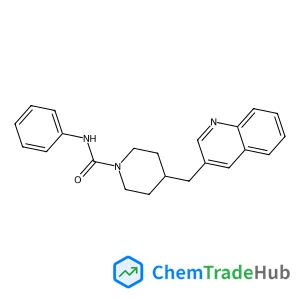
N-phenyl-4-(quinolin-3-ylmethyl)piperidine-1-carboxamide
CAS Number:
959151-50-9
Molecular Formula:
C22H23N3O

Recommended Suppliers




Disclaimer
This page provides academic journal information for reference and research purposes only. We are not affiliated with any journal publishers and do not handle publication submissions. For publication-related inquiries, please contact the respective journal publishers directly.
If you notice any inaccuracies in the information displayed, please contact us at support@chemtradehub.com. We will promptly review and address your concerns.