













Dual-functioning porous catalysts: robust electro-oxidation of small organic molecules and water electrolysis using bimetallic Ni/Cu foams
Literature Information
Publication Date
2020-12-26
DOI
10.1039/D0SE01835J
Impact Factor
6.367
Authors
Mohamed R. Rizk, Muhammad G. Abd El-Moghny, Amina Mazhar, Mohamed S. El-Deab, B. E. El-Anadouli
View Original
Abstract
In this work, we report a single-step preparation of porous Ni-based thin layer foams atop a Cu substrate via the facile dynamic hydrogen bubble template (DHBT) technique. As-prepared porous Ni-based foams were characterized by various electrochemical measurements, namely, scanning electron microscopy (SEM), energy-dispersive X-ray spectroscopy (EDS), X-ray diffraction (XRD), and X-ray photoelectron spectroscopy (XPS). The prepared Ni foam has a cauliflower morphology, whereas the Ni/Cu foam obtained upon doping with Cu has a dendritic morphology. The latter foam layer possesses a higher exposed electroactive surface area and electrocatalytic performance than the undoped Ni foam, which depends on the percentage of Cu content. Additionally, the porous Ni/Cu foam shows marked performance as a dual catalyst towards cathodic and anodic reactions, i.e., hydrogen evolution reactions (HERs), oxygen evolution reactions (OERs), urea oxidation reactions (UORs), and glycerol oxidation reactions (GORs) in an alkaline medium. The co-deposition of Cu within the matrix of the Ni foam increases its intrinsic catalytic activity as evidenced by the enrichment of the Ni surface by electro-active species (catalytic mediators) as well as increasing the dispersion (and thus active surface area) of Ni within the porous foam layer. This Ni/Cu foam catalyst layer requires reduced overall energies of 1.71, 1.46, and 1.44 V to support 10 mA cm−2 during overall water splitting, urea electrolysis, and glycerol electrolysis, respectively. Oxalate is the main byproduct resulting from glycerol electrolysis as revealed by the FTIR analysis.
Related Literature
Regioregular poly(3-hexyl)selenophene: a low band gap organic hole transporting polymer
Martin Heeney, Weimin Zhang, David J. Crouch, Michael L. Chabinyc, Sergey Gordeyev, Rick Hamilton, Simon J. Higgins, Iain McCulloch, Peter J. Skabara, David Sparrowe, Steve Tierney
2007-10-01
Communication
DOI: 10.1039/B712398A
Recent advances in polymer protected gold nanoparticles: synthesis, properties and applications
Jun Shan, Heikki Tenhu
2007-07-09
Feature Article
DOI: 10.1039/B707740H
Synthesis of AgBiS2 microspheres by a templating method and their catalytic polymerization of alkylsilanes
Jiaqiang Wang, Xikung Yang, Wenbing Hu, Bin Li, Jiangmei Yan, Jinjin Hu
2007-09-19
Communication
DOI: 10.1039/B710832J
Ionic strength mediated hydrophobic force switching of CF3-terminated ethylene glycol self-assembled monolayers (SAMs) on gold
Nelly Bonnet, David O'Hagan, Georg Hähner
2007-10-03
Communication
DOI: 10.1039/B712968H
Construction of di-scFv through a trivalent alkyne–azide 1,3-dipolar cycloaddition
Arutselvan Natarajan, Wenjun Du, Cheng-Yi Xiong, Gerald L. DeNardo, Sally J. DeNardo, Jacquelyn Gervay-Hague
2006-11-28
Communication
DOI: 10.1039/B611636A
New insights into the enantioselectivity in the hydrogenation of prochiral ketones
Samuel A. French, Devis Di Tommaso, Antonio Zanotti-Gerosa, Fred Hancock
2007-03-12
Communication
DOI: 10.1039/B616210J
Facile transformation of hydrophilic cellulose into superhydrophobic cellulose
Shenghai Li, Haibo Xie, Suobo Zhang, Xianhong Wang
2007-09-21
Communication
DOI: 10.1039/B712056G
Icosahedral galloxane clusters
Robert M. McKinlay, Scott J. Dalgarno, Peter J. Nichols, Stavroula Papadopoulos, Jerry L. Atwood, Colin L. Raston
2007-03-15
Communication
DOI: 10.1039/B700984D
Nucleophilic aromatic substitution using Et3SiH/cat. t-Bu-P4 as a system for nucleophile activation
Masahiro Ueno, Misato Yonemoto, Masahiro Hashimoto, Andrew E. H. Wheatley, Hiroshi Naka, Yoshinori Kondo
2007-02-28
Communication
DOI: 10.1039/B700140A
Molecular oxygen activation by a molybdenum(iv) monooxo bis(β-ketiminato) complex
Ganna Lyashenko, Gerald Saischek, Aritra Pal, Regine Herbst-Irmer, Nadia C. Mösch-Zanetti
2007-01-09
Communication
DOI: 10.1039/B617199K
You might also like
Compound Q&A
What regulatory guidelines apply to 4-Amino-3-bromophenol (CAS: 74440-80-5)?
4-Amino-3-bromophenol (CAS: 74440-80-5) falls under the classification of a haza...
74440-80-54-Amino-3-bromopheno...
Compound Q&A
How should (17beta)-3-Oxoestr-4-en-17-yl acetate (CAS: 1425-10-1) be stored?
(17beta)-3-Oxoestr-4-en-17-yl acetate should be stored in a cool, dry place away...
1425-10-1(17beta)-3-Oxoestr-4...
Compound Q&A
What are the physical and chemical properties of 2-[(2,2-Diethoxyethyl)disulfanyl]-1,1-diethoxyethane (CAS: 76505-71-0)?
2-[(2,2-Diethoxyethyl)disulfanyl]-1,1-diethoxyethane (CAS: 76505-71-0) is a colo...
76505-71-02-[(2,2-Diethoxyethy...
Compound Q&A
What is the market or research trend for 1-(β-D-ribofuranosyl)-1H-imidazo[4,5-c]pyridin-4-amine?
The market and research for 1-(β-D-ribofuranosyl)-1H-imidazo[4,5-c]pyridin-4-ami...
6736-58-91-(beta-D-Ribofurano...
Compound Q&A
How should waste containing Conjugated Estrogen (CAS: 12126-59-9) be handled?
Waste containing Conjugated Estrogen (CAS: 12126-59-9) should be collected and d...
12126-59-9Conjugated Estrogen
Compound Q&A
What is the market or research trend for Bis(2,2,2-trifluoroethyl) (methoxycarbonylmethyl)phosphonate?
The market for Bis(2,2,2-trifluoroethyl) (methoxycarbonylmethyl)phosphonate (CAS...
88738-78-7Bis(2,2,2-trifluoroe...
Compound Q&A
Are there alternatives to 3,4'-Di-O-methylellagic acid (CAS: 57499-59-9) in synthesis?
There are several alternatives to 3,4'-Di-O-methylellagic acid (CAS: 57499-59-9)...
57499-59-93,4'-Di-O-methylella...
Compound Q&A
What regulatory guidelines apply to 2-Chloro-N,N-dimethylpyridin-4-amine (CAS: 59047-70-0)?
2-Chloro-N,N-dimethylpyridin-4-amine (CAS: 59047-70-0) is regulated under the Gl...
59047-70-02-Chloro-N,N-dimethy...
Compound Q&A
What is cerium(3+);oxygen(2-);vanadium(5+) (CAS: 13597-19-8)?
Cerium(3+);oxygen(2-);vanadium(5+) (CAS: 13597-19-8) is a complex inorganic comp...
13597-19-8cerium(3+);oxygen(2-...
Compound Q&A
Is 7-Chloro-1-iodoisoquinoline (CAS: 1203579-27-4) safe?
7-Chloro-1-iodoisoquinoline (CAS: 1203579-27-4) is generally considered safe whe...
1203579-27-47-Chloro-1-iodoisoqu...
Source Journal
Recommended Compounds
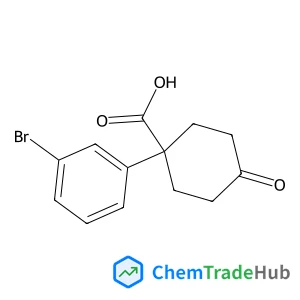
1-(3-Bromophenyl)-4-oxocyclohexanecarboxylic acid
CAS Number:
1385694-53-0
Molecular Formula:
C13H13BrO3
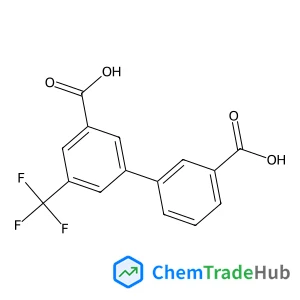
3-(3-Carboxyphenyl)-5-(trifluoromethyl)benzoic acid
CAS Number:
1261930-96-4
Molecular Formula:
C15H9F3O4
![2-Methyl-2-propanyl 4-[3-(aminomethyl)phenyl]-1-piperazinecarboxylate structure](https://static.chemtradehub.com/structs/889/889948-55-4-5c12.webp "2-Methyl-2-propanyl 4-[3-(aminomethyl)phenyl]-1-piperazinecarboxylate structure")
2-Methyl-2-propanyl 4-[3-(aminomethyl)phenyl]-1-piperazinecarboxylate
CAS Number:
889948-55-4
Molecular Formula:
C16H25N3O2
Recommended Suppliers






Disclaimer
This page provides academic journal information for reference and research purposes only. We are not affiliated with any journal publishers and do not handle publication submissions. For publication-related inquiries, please contact the respective journal publishers directly.
If you notice any inaccuracies in the information displayed, please contact us at support@chemtradehub.com. We will promptly review and address your concerns.