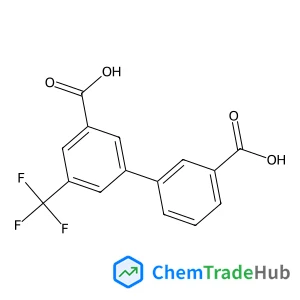
3-(3-Carboxyphenyl)-5-(trifluoromethyl)benzoic acid
CAS Number:
1261930-96-4
Molecular Formula:
C15H9F3O4
Na Yu, Guang Jiang, Tong Liu, Xi Chen, Mengyu Miao, Yanxiang Zhang, Yao Wang
Metallic nanoparticles structured perovskite oxides prepared by the in situ exsolution method are widely utilized as alternative anodes for solid oxide fuel cells. In this work, SrxFe1.3Ni0.2Mo0.5O6−δ (SFNMx, x = 1.90, 1.95, 2.00, and 2.05) materials are prepared to construct Ni–Fe alloy nanoparticles structured SFNMx anodes. It is found that the microstructure as well as electrochemical activity of SFNMx anodes can be successfully manipulated by altering A-site Sr non-stoichiometry. Moreover, the electrochemical performance of the symmetrical cells with SFNMx electrodes demonstrates that A-site Sr deficiency can effectively accelerate the exsolution of Ni–Fe alloy nanoparticles from the parent oxides, reasonably providing more active sites for the hydrogen oxidation reaction and effectively lowering the electrode polarization resistance to 1.04 Ω cm2 with decreasing Sr content to 1.95, which is in good agreement with the results predicted by the regular-solution model. In addition, the distribution of relaxation times analysis results indicate that H2 adsorption/dissociation/ionization, which can be strongly accelerated by in situ exsolved Ni–Fe alloy nanoparticles, is the predominant rate-limiting step. It is concluded that A-site non-stoichiometry in perovskites can greatly facilitate the exsolution of metallic nanoparticles, and enable effectively enhanced electrochemical activity. Our findings can guide the development of nano-architectures of A1−xBO3 materials for other energy conversion and storage devices.
Igor Čerňa, Radek Pohl, Michal Hocek
DOI: 10.1039/B714253F
V. Ganesh, Maria Pilar Calatayud Sanz, Juan C. Mareque-Rivas
DOI: 10.1039/B612676F
Aurélie Brizard, Roni Kiagus Ahmad, Reiko Oda
DOI: 10.1039/B700959C
Sanjay Singh, Jianfang Chai, Aritra Pal, Vojtech Jancik, Herbert W. Roesky, Regine Herbst-Irmer
DOI: 10.1039/B712240C
Francesca Gini, Bart Hessen, Ben L. Feringa, Adriaan J. Minnaard
DOI: 10.1039/B616969D
Ya-Qian Lan, Xin-Long Wang, Shun-Li Li, Zhong-Min Su, Kui-Zhan Shao, En-Bo Wang
DOI: 10.1039/B709835A
Sarah L. Foster, Sandeep Handa, Michael Krafft, David Rowling
DOI: 10.1039/B712542A
Alexey A. Goryunkov, Ilya N. Ioffe, Pavel A. Khavrel, Stanislav M. Avdoshenko, Vitaly Yu. Markov, Z. Mazej, Lev N. Sidorov, Sergey I. Troyanov
DOI: 10.1039/B615457C
4-Amino-3-bromophenol (CAS: 74440-80-5) falls under the classification of a haza...
(17beta)-3-Oxoestr-4-en-17-yl acetate should be stored in a cool, dry place away...
2-[(2,2-Diethoxyethyl)disulfanyl]-1,1-diethoxyethane (CAS: 76505-71-0) is a colo...
The market and research for 1-(β-D-ribofuranosyl)-1H-imidazo[4,5-c]pyridin-4-ami...
Waste containing Conjugated Estrogen (CAS: 12126-59-9) should be collected and d...
The market for Bis(2,2,2-trifluoroethyl) (methoxycarbonylmethyl)phosphonate (CAS...
There are several alternatives to 3,4'-Di-O-methylellagic acid (CAS: 57499-59-9)...
2-Chloro-N,N-dimethylpyridin-4-amine (CAS: 59047-70-0) is regulated under the Gl...
Cerium(3+);oxygen(2-);vanadium(5+) (CAS: 13597-19-8) is a complex inorganic comp...
7-Chloro-1-iodoisoquinoline (CAS: 1203579-27-4) is generally considered safe whe...

![9-Ethyl-3-{(E)-[ethyl(2-methylphenyl)hydrazono]methyl}-9H-carbazole structure](https://static.chemtradehub.com/structs/127/1274948-12-7-301f.webp "9-Ethyl-3-{(E)-[ethyl(2-methylphenyl)hydrazono]methyl}-9H-carbazole structure")