












The first direct C–H arylation of purinenucleosides
Literature Information
Publication Date
2007-10-25
DOI
10.1039/B714253F
Impact Factor
6.222
Authors
Igor Čerňa, Radek Pohl, Michal Hocek
View Original
Abstract
Pd-catalyzed direct C–H arylation of unprotected purinenucleosides with aryl iodides at position 8 was developed to allow a straightforward single-step introduction of diverse aryl groups.
Related Literature
Analysis of temperature programmed desorption (TPD) data for the characterisation of catalysts containing a distribution of adsorption sites
2008-02-07
Paper
DOI: 10.1039/B717430F
From crystal structure prediction to polymorph prediction: interpreting the crystal energy landscape
Sarah L. Price
2008-02-19
Perspective
DOI: 10.1039/B719351C
Adsorption of N2O on Cu(100): a combined scanning tunneling microscopy and density functional theory study
K. J. Franke, I. Fernández-Torrente, J. I. Pascual
2008-01-21
Paper
DOI: 10.1039/B716952C
A temperature predictor for parallel tempering simulations
Alexandra Patriksson, David van der Spoel
2008-02-25
Paper
DOI: 10.1039/B716554D
Angle-resolved X-ray photoelectron spectroscopy of the surface of imidazolium ionic liquids
Vera Lockett, Rossen Sedev, Chris Bassell, John Ralston
2008-01-18
Paper
DOI: 10.1039/B713584J
Probing proton dissociation in ionic polymers by means of in situATR-FTIR spectroscopy
Lidwine Grosmaire, Samuel Castagnoni, Patrice Huguet, Philippe Sistat, Mario Boucher, Patrick Bouchard, Philippe Bébin, Stefano Deabate
2008-01-31
Paper
DOI: 10.1039/B714870D
Soft-landing of peptide ions onto self-assembled monolayer surfaces: an overview
Julia Laskin, Peng Wang, Omar Hadjar
2007-12-18
Perspective
DOI: 10.1039/B712710C
A transferable coarse-grained model for hydrogen-bonding liquids
Pavel A. Golubkov, Johnny C. Wu, Pengyu Ren
2008-02-25
Paper
DOI: 10.1039/B715841F
You might also like
Compound Q&A
What regulatory guidelines apply to 4-Amino-3-bromophenol (CAS: 74440-80-5)?
4-Amino-3-bromophenol (CAS: 74440-80-5) falls under the classification of a haza...
74440-80-54-Amino-3-bromopheno...
Compound Q&A
How should (17beta)-3-Oxoestr-4-en-17-yl acetate (CAS: 1425-10-1) be stored?
(17beta)-3-Oxoestr-4-en-17-yl acetate should be stored in a cool, dry place away...
1425-10-1(17beta)-3-Oxoestr-4...
Compound Q&A
What are the physical and chemical properties of 2-[(2,2-Diethoxyethyl)disulfanyl]-1,1-diethoxyethane (CAS: 76505-71-0)?
2-[(2,2-Diethoxyethyl)disulfanyl]-1,1-diethoxyethane (CAS: 76505-71-0) is a colo...
76505-71-02-[(2,2-Diethoxyethy...
Compound Q&A
What is the market or research trend for 1-(β-D-ribofuranosyl)-1H-imidazo[4,5-c]pyridin-4-amine?
The market and research for 1-(β-D-ribofuranosyl)-1H-imidazo[4,5-c]pyridin-4-ami...
6736-58-91-(beta-D-Ribofurano...
Compound Q&A
How should waste containing Conjugated Estrogen (CAS: 12126-59-9) be handled?
Waste containing Conjugated Estrogen (CAS: 12126-59-9) should be collected and d...
12126-59-9Conjugated Estrogen
Compound Q&A
What is the market or research trend for Bis(2,2,2-trifluoroethyl) (methoxycarbonylmethyl)phosphonate?
The market for Bis(2,2,2-trifluoroethyl) (methoxycarbonylmethyl)phosphonate (CAS...
88738-78-7Bis(2,2,2-trifluoroe...
Compound Q&A
Are there alternatives to 3,4'-Di-O-methylellagic acid (CAS: 57499-59-9) in synthesis?
There are several alternatives to 3,4'-Di-O-methylellagic acid (CAS: 57499-59-9)...
57499-59-93,4'-Di-O-methylella...
Compound Q&A
What regulatory guidelines apply to 2-Chloro-N,N-dimethylpyridin-4-amine (CAS: 59047-70-0)?
2-Chloro-N,N-dimethylpyridin-4-amine (CAS: 59047-70-0) is regulated under the Gl...
59047-70-02-Chloro-N,N-dimethy...
Compound Q&A
What is cerium(3+);oxygen(2-);vanadium(5+) (CAS: 13597-19-8)?
Cerium(3+);oxygen(2-);vanadium(5+) (CAS: 13597-19-8) is a complex inorganic comp...
13597-19-8cerium(3+);oxygen(2-...
Compound Q&A
Is 7-Chloro-1-iodoisoquinoline (CAS: 1203579-27-4) safe?
7-Chloro-1-iodoisoquinoline (CAS: 1203579-27-4) is generally considered safe whe...
1203579-27-47-Chloro-1-iodoisoqu...
Source Journal
Chemical Communications

CiteScore:
8.6
Self-citation Rate:
4.7%
Articles per Year:
2458
ChemComm publishes urgent research which is of outstanding significance and interest to experts in the field, while also appealing to the journal’s broad chemistry readership. Our communication format is ideally suited to short, urgent studies that are of such importance that they require accelerated publication. Our scope covers all topics in chemistry, and research at the interface of chemistry and other disciplines (such as materials science, nanoscience, physics, engineering and biology) where there is a significant novelty in the chemistry aspects. Major topic areas covered include: Analytical Chemistry Catalysis Chemical Biology and medicinal chemistry Computational Chemistry and Machine Learning Energy and sustainable chemistry Environmental Chemistry Green Chemistry Inorganic Chemistry Materials Chemistry Nanoscience Organic Chemistry Physical Chemistry Polymer Chemistry Supramolecular Chemistry
Recommended Compounds
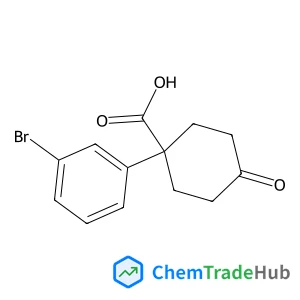
1-(3-Bromophenyl)-4-oxocyclohexanecarboxylic acid
CAS Number:
1385694-53-0
Molecular Formula:
C13H13BrO3
Recommended Suppliers





Disclaimer
This page provides academic journal information for reference and research purposes only. We are not affiliated with any journal publishers and do not handle publication submissions. For publication-related inquiries, please contact the respective journal publishers directly.
If you notice any inaccuracies in the information displayed, please contact us at support@chemtradehub.com. We will promptly review and address your concerns.