



Metal–polydopamine framework-derived (Co)/N-doped carbon hollow nanocubes as efficient oxygen electrocatalysts
Literature Information
Publication Date
2020-05-11
DOI
10.1039/D0SE00548G
Impact Factor
6.367
Authors
Yuanyuan Jiang, Kai Dong, Xiaoying Yan, Chuanxia Chen, Pengjuan Ni, Cheng Yang, Yizhong Lu
View Original
Abstract
Oxygen electrocatalysis is of great significance for various energy conversion and storage-related applications. Herein, by using in situ polymerization of dopamine on specially designed metal–organic framework (MOF) nanocubes and subsequent annealing treatment, well-defined Co/N-doped carbon hollow nanocubes with high electrocatalytic activity and stability toward the oxygen evolution reaction are obtained. To attain a current density of 10 mA cm−2, the overpotential required for the Co/N-doped carbon hollow nanocubes is only 285 mV, which is comparable to that of commercial RuO2 (270 mV) and lower than those of most MOF-derived ones and other carbon supported Co-based electrocatalysts. Surprisingly, we find that when the Co nanoparticles are leached using simple acid wash, the as-synthesized N-doped carbon hollow nanocubes could act as an efficient electrocatalyst for the oxygen reduction reaction instead. The strategy presented here for controlled design and synthesis of MOF-derived hollow (metal)/N-doped carbon frameworks would offer new prospects for developing efficient oxygen electrocatalysts for electrochemical energy devices.
Recommended Journals

Russian Journal of Bioorganic Chemistry

Nature Medicine

Russian Chemical Bulletin

Journal of Saudi Chemical Society

Russian Journal of Applied Chemistry

Saudi Pharmaceutical Journal

Organic Process Research & Development

New Journal of Chemistry

Journal of Peptide Science

Russian Journal of Coordination Chemistry
Related Literature
Synthesis of 11C-amides using [11C]carbon monoxide and in situ activated amines by palladium-mediated carboxaminations
Farhad Karimi
2002-12-23
Paper
DOI: 10.1039/B209553J
QM/MM calculations of kinetic isotope effects in the chorismate mutase active site
Sergio Martí, Vicent Moliner, Iñaki Tuñón, Ian H. Williams
2003-01-17
Paper
DOI: 10.1039/B210508J
Differential substituent effects of β-halogens in water-soluble porphyrins
Justin C. Biffinger, Haoran Sun, Andrew P. Nelson, Stephen G. DiMagno
2003-01-24
Paper
DOI: 10.1039/B209345F
Catalyst-free 1 : 2 annulation of quinolines with trifluoroacetylacetylenes: an access to functionalized oxazinoquinolines
K. V. Belyaeva, L. P. Nikitina, A. V. Afonin, A. V. Vashchenko, V. M. Muzalevskiy, V. G. Nenajdenko, B. A. Trofimov
2018-10-12
Communication
DOI: 10.1039/C8OB02379D
The influence of chain elongation on Karplus-type relationships: a DFT study of scalar coupling constants in polyacetylene derivatives
Ibon Alkorta, José Elguero
2003-01-06
Paper
DOI: 10.1039/B208803G
Tetracyclic pyrazine-fused furazans as insensitive energetic materials: syntheses, structures, and properties
Qi Sun, Xin Li, Qiuhan Lin, Ming Lu
2018-10-11
Communication
DOI: 10.1039/C8OB02155D
The type I rat fatty acid synthase ACP shows structural homology and analogous biochemical properties to type II ACPs
Michelle A. C. Reed, Michael Schweizer, Anna E. Szafranska, Chris Arthur, Thomas P. Nicholson, Russell J. Cox, John Crosby, Matthew P. Crump, Thomas J. Simpson
2003-01-03
Paper
DOI: 10.1039/B208941F
The selective functionalisation and difunctionalisation of p-substituted calix[6]arene and calix[8]arenes using hydrophilic moieties
Gwénaëlle Hervé, Dirk Uwe Hahn, Anne-Cécile Hervé, Kerry J. Goodworth, Alison M. Hill, Helen C. Hailes
2002-12-19
Paper
DOI: 10.1039/B208649M
Direct determination of single-to-double stranded DNA ratio in solution using steady-state fluorescence measurements
Lori Beach, Claude Schweitzer, J. C. Scaiano
2002-12-23
Communication
DOI: 10.1039/B209284K
Base-catalyzed selective esterification of alcohols with unactivated esters
Chunyan Zhang, Guoying Zhang, Shizhong Luo, Chunfu Wang, Huiping Li
2018-10-17
Communication
DOI: 10.1039/C8OB02411A
You might also like
Compound Q&A
Is 4-Benzyl-2,2-dimethylmorpholine (CAS: 84761-04-6) safe?
4-Benzyl-2,2-dimethylmorpholine is generally considered safe when handled under ...
84761-04-64-Benzyl-2,2-dimethy...
Compound Q&A
What is (5,6-Dimethoxy-3-pyridinyl)boronic acid (CAS: 1346526-61-1)?
(5,6-Dimethoxy-3-pyridinyl)boronic acid is a chemical compound with the molecula...
1346526-61-1(5,6-Dimethoxy-3-pyr...
Compound Q&A
How is 1,1,3,3-Tetramethyl-1,3-bis(2-methyl-2-propanyl)disiloxane (CAS: 67875-55-2) typically synthesized?
1,1,3,3-Tetramethyl-1,3-bis(2-methyl-2-propanyl)disiloxane is synthesized throug...
67875-55-21,1,3,3-Tetramethyl-...
Compound Q&A
What are the main uses of (2R,4S)-1-Boc-4-methylpyrrolidine-2-carboxylic acid (CAS: 1018818-04-6)?
(2R,4S)-1-Boc-4-methylpyrrolidine-2-carboxylic acid is primarily used as a build...
1018818-04-6(2R,4S)-1-Boc-4-meth...
Compound Q&A
What precautions should be taken when handling 2,3-Dichloroacrylonitrile (CAS: 22410-58-8)?
When handling 2,3-Dichloroacrylonitrile, it is crucial to wear appropriate perso...
22410-58-82,3-Dichloroacryloni...
Compound Q&A
How should (S)-1-(o-Tolyl)ethanamine hydrochloride (CAS: 1332832-16-2) be stored?
(S)-1-(o-Tolyl)ethanamine hydrochloride should be stored in a cool, dry place to...
1332832-16-2(S)-1-(o-Tolyl)ethan...
Compound Q&A
What are the physical and chemical properties of Benzyl [1-(hydroxyamino)-1-imino-2-methyl-2-propanyl]carbamate (CAS: 518047-98-8)?
Benzyl [1-(hydroxyamino)-1-imino-2-methyl-2-propanyl]carbamate (CAS: 518047-98-8...
518047-98-8Benzyl [1-(hydroxyam...
Compound Q&A
What industries use 2-Methyloxazole-5-carbaldehyde (CAS: 885273-42-7)?
2-Methyloxazole-5-carbaldehyde is used in the pharmaceutical industry for the sy...
885273-42-72-Methyloxazole-5-ca...
Compound Q&A
What is the market or research trend for 2-Methyl-2-propanyl 4-[(1S)-1-hydroxyethyl]-1-piperidinecarboxylate (CAS: 389889-82-1)?
The market for 2-Methyl-2-propanyl 4-[(1S)-1-hydroxyethyl]-1-piperidinecarboxyla...
389889-82-12-Methyl-2-propanyl ...
Compound Q&A
Is 1-Butyl-3-methylpyridinium bromide (CAS: 26576-85-2) safe?
1-Butyl-3-methylpyridinium bromide is generally considered safe for laboratory u...
26576-85-21-Butyl-3-methylpyri...
Source Journal
Recommended Compounds
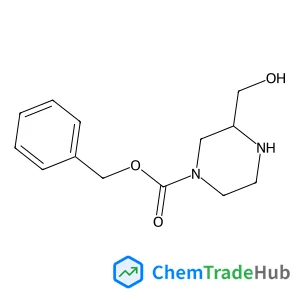
Benzyl 3-(hydroxymethyl)-1-piperazinecarboxylate
CAS Number:
191739-40-9
Molecular Formula:
C13H18N2O3
Recommended Suppliers





Disclaimer
This page provides academic journal information for reference and research purposes only. We are not affiliated with any journal publishers and do not handle publication submissions. For publication-related inquiries, please contact the respective journal publishers directly.
If you notice any inaccuracies in the information displayed, please contact us at support@chemtradehub.com. We will promptly review and address your concerns.