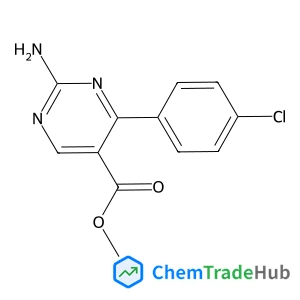
Methyl 2-amino-4-(4-chlorophenyl)-5-pyrimidinecarboxylate
CAS Number:
1133115-56-6
Molecular Formula:
C12H10ClN3O2
Ibon Alkorta, José Elguero
The coupling constants of a series of acetylenic derivatives have been calculated using the finite perturbation method. In the case of dimethylated derivatives a Karplus-type relationship has been obtained for coupling constants of hydrogen atoms separated up to 15 bonds. Additional relationships have been obtained between the interatomic distances and the coupling constants.
DOI: 10.1039/C4GC00602J
Luis Herrera-Estrella, Anne-Laure Chauvin
DOI: 10.1039/C4GC00631C
Lin He, Helfried Neumann, Matthias Beller
DOI: 10.1039/C4GC00801D
S. Gupta, T. Kobayashi
DOI: 10.1039/C4GC00998C
Patrick Wagner, Maud Bollenbach, Christelle Doebelin, Frédéric Bihel, Jean-Jacques Bourguignon, Martine Schmitt
DOI: 10.1039/C4GC00853G
Kristian Larsson, Koen Binnemans
DOI: 10.1039/C3GC41930D
Hilda Gómez Bernal, Luca Bernazzani
DOI: 10.1039/C4GC00450G
Taowei Yang, Hongmei Sun, Meijuan Xu, Xian Zhang, Zhenghong Xu, Shangtian Yang
DOI: 10.1039/C4GC00607K
B. S. Rajput, S. R. Gaikwad, S. K. Menon, S. H. Chikkali
DOI: 10.1039/C4GC00543K
2-Methylbenzene-1,4-diamine dihydrochloride (CAS: 615-45-2) should be stored in ...
(1S,4S)-2,5-Diazabicyclo[2.2.1]heptane dihydrobromide is generally considered sa...
(6-Chloropyridazin-3-YL)methanamine finds applications in the pharmaceutical ind...
2-Fluoro-3-methylphenol is primarily used in the synthesis of pharmaceuticals, p...
When handling 3-Methoxy-4-nitrobenzonitrile, it is important to wear appropriate...
When handling 1,3-Oxazolo[4,5-b]pyridine-2(3H)-thione (CAS: 211949-57-4), it is ...
4-Ethynylbenzamide (CAS: 90347-86-7) falls under various regulatory guidelines i...
3-(2-Ethylphenyl)-2-thioxo-4-imidazolidinone is primarily used as an intermediat...
(2-Fluoro-6-methoxyphenyl)acetic acid, also known as 4-fluoro-3-methoxybenzoic a...
Market trends for 2-[4-(Hydroxymethyl)phenoxy]ethanol (CAS: 102196-18-9) indicat...

Organic & Biomolecular Chemistry (OBC) publishes original and high impact research and reviews in organic chemistry. We welcome research that shows new or significantly improved protocols or methodologies in total synthesis, synthetic methodology or physical and theoretical organic chemistry as well as research that shows a significant advance in the organic chemistry or molecular design aspects of chemical biology, catalysis, supramolecular and macromolecular chemistry, theoretical chemistry, mechanism-oriented physical organic chemistry, medicinal chemistry or natural products. Articles published in the journal should report new work which makes a highly-significant impact in the field. Routine and incremental work is generally not suitable for publication in the journal. More details about key areas of our scope are below. In all cases authors should include in their article clear rationale for why their research has been carried out.
![[1-(5-Methyl-2-pyridinyl)-1H-pyrazol-4-yl]methanol structure](https://static.chemtradehub.com/structs/143/1439822-99-7-6cc9.webp "[1-(5-Methyl-2-pyridinyl)-1H-pyrazol-4-yl]methanol structure")