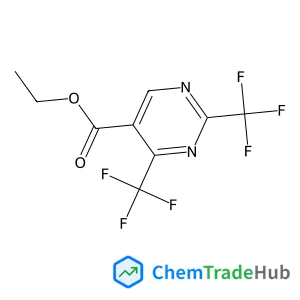
Ethyl 2,4-bis(trifluoromethyl)-5-pyrimidinecarboxylate
CAS Number:
188781-15-9
Molecular Formula:
C9H6F6N2O2
Xing Li, Lingling Ni, Chenxuan Sun, Wenqing Xu
End-functionalization of oligomers with multiple H-bonding units is a feasible method to prepare supramolecular polymers. Competitive crystallization of H-bonding units and oligomeric blocks can drive supramolecular polymers to form long-range ordered structures. Herein, we report the controlled synthesis, competitive crystallization kinetics, and crystallization-driven structural organization of thymine-monofunctionalized supramolecular poly(L-lactide) (PLLA-Thy). PLLA-Thy having a well-defined end-functionality and controlled molecular weight was synthesized by ring-opening polymerization using hydroxyl-functionalized thymine as the initiator. PLLA-Thy exhibits the double-crystalline nature, in which the PLLA block and the thymine terminal have a similar crystallization temperature (Tc) and melting point (Tm). The crystallizability of the thymine unit was depressed in PLLA-Thy with a long PLLA block. The thymine terminal and PLLA block revealed the competitive and coincident crystallization kinetics in PLLA-Thy with a medium thymine fraction, depending on Tc. Prompt crystallization of the thymine unit drove the lamellar organization of PLLA-Thy in a long range; the subsequent crystallization of the PLLA block segregated between thymine layers depressed the regularity of the lamellar ordering of PLLA-Thy. This work provides important insights into the multi-step crystallization and crystallization-induced structural organization of semicrystalline supramolecular polymers.
DOI: 10.1039/D1CP04991G
M. A. da Silva, D. Murnane, L. Porcar, C. A. Dreiss, M. T. Cook
DOI: 10.1039/D2PY00876A
Mengzhao Du, Xuan Liu, Shijie Xie
DOI: 10.1039/D2CP01092E
Chris Rehhagen, Shahnawaz Rafiq, Kyra N. Schwarz, Gregory D. Scholes, Stefan Lochbrunner
DOI: 10.1039/D1CP05375B
Kai Hong Luo, Struan H. Robertson
DOI: 10.1039/D2CP00065B
Peter Stange, Alexander G. Stepanov
DOI: 10.1039/D2CP00452F
Tim Kohlmann, Martin Goez
DOI: 10.1039/D1CP04690J
Hongming Yi, Tao Wu, Amélie Lauraguais, Cecile Coeur, Alexandre Tomas, Hongbo Fu, Xiaoming Gao, Weidong Chen
DOI: 10.1039/D2CP00206J
Paolo Restuccia, Ehsan A. Ahmad, Nicholas M. Harrison
DOI: 10.1039/D2CP01572B
Laura Vasilica Arsenie, Vincent Ladmiral, Patrick Lacroix-Desmazes, Sylvain Catrouillet
DOI: 10.1039/D2PY00920J
When handling lithium chloride hydrate (1:1:1) (CAS: 16712-20-2), it is importan...
4-(4H-1,2,4-Triazol-4-yl)piperidine is generally considered safe for use in phar...
Waste containing 1,3-Thiazole-2-carboxamide (CAS: 16733-85-0) should be collecte...
5-(Difluoromethyl)-2-fluorobenzonitrile (CAS: 934175-58-3) is subject to regulat...
Methyl 3-acetamido-2-thiophenecarboxylate can be synthesized by the reaction of ...
4-Isoquinolinecarbonitrile is a chemical compound with the CAS number 34846-65-6...
Store Methyl 1H-1,2,3-triazole-4-carboxylate (CAS: 877309-59-6) in a cool, dry p...
6-Bromo[1,3]thiazolo[5,4-b]pyridin-2-amine (CAS: 1160791-13-8) is subject to the...
(2S,3S)-2-Ammonio-3-(3,4-dihydroxyphenyl)-3-hydroxypropanoate (CAS: 23651-95-8) ...
7-Bromo-3-methyl-3,4-dihydroquinazolin-4-one is a solid with a crystalline form....

Polymer Chemistry welcomes submissions in all areas of polymer science that have a strong focus on macromolecular chemistry. Manuscripts may cover a broad range of fields, yet no direct application focus is required.