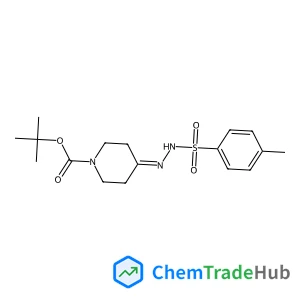
tert-Butyl 4-(2-(p-Tolylsulfonyl)hydrazono)piperidine-1-carboxylate
CAS Number:
1046478-89-0
Molecular Formula:
C17H25N3O4S
Guanxing Zhu, Yujun Song, Qianyu Zhang, Weiwei Ding, Xinxin Chen, Yuannan Wang, Gang Zhang
Embedding heteroatoms in buckybowls is an effective approach to alter their electronic structures and physicochemical properties. However, buckybowls with heteroatoms situated at both the peripheral rim and the central core to modulate the properties are quite rare. Herein, we report buckybowls containing sulfur atoms at the rim and nitrogen atoms in the center with tunable properties according to the state of the sulfur atoms. When the sulfur atoms are in the form of electron-donating sulfide, the buckybowl demonstrates weak fluorescence. It shows a low oxidative potential and elevated frontier molecular orbital energy levels due to the increased electron density. The electron-rich heterobuckybowl can be chemically oxidized to generate monocations and dications with gradually planarized structures according to the oxidation state. Moreover, it can assemble with electron-deficient fullerene C60 to form a 1 : 1 complex in toluene solution and a 2 : 1 complex in the crystalline state with strong intermolecular attractive interactions. After the oxidation of the sulfur atom to an electron-withdrawing sulfonyl group, the buckybowl shows the strongest photoluminescence in both solution and solid states in the regime of heterobuckybowls thus far. A decline in frontier molecular orbital energy levels and weak association behavior with fullerene C60 to generate a 1 : 1 complex in toluene solution are also observed due to the reduced electron density.
Junping Zhang, Cynthia S. Day, David L. Carroll
DOI: 10.1039/B913917F
Amrita Pal, Saurabh Shrivastava, Joykrishna Dey
DOI: 10.1039/B914665B
Hao-Wei Shih, Kuo-Ting Chen, Shao-Kang Chen, Chia-Ying Huang, Ting-Jen R Cheng, Che Ma, Chi-Huey Wong, Wei-Chieh Cheng
DOI: 10.1039/C000622J
Ayellet L. Zelikoff, Jacob Kopilov, Israel Goldberg, Geoffrey W. Coates, Moshe Kol
DOI: 10.1039/B915211C
Ioana Dumitrescu, Patrick R. Unwin, Julie V. Macpherson
DOI: 10.1039/B909734A
Renato Bonomi, Paolo Scrimin, Fabrizio Mancin
DOI: 10.1039/B926916A
Kazuhito Tanabe, Eiji Matsumoto, Takeo Ito, Sei-ichi Nishimoto
DOI: 10.1039/C0OB00275E
Daniel J. Knowles, Tianfang Wang, John H. Bowie
DOI: 10.1039/C0OB00232A
Li-Yan Zeng, Chun Cai
DOI: 10.1039/C0OB00364F
Binbin Zhou, Mark S. Denning, Thomas A. D. Chapman, John E. McGrady, Jose M. Goicoechea
DOI: 10.1039/B917185A
(1R,3S)-1,3-Cyclopentanediol finds applications in various industries. In the ph...
When handling N'-[4-(Dimethylamino)phenyl]-N,N-dimethyl-1,4-benzenediamine, it i...
There are several alternatives to 5-(2,4-Difluorophenyl)-2-methoxypyrimidine in ...
1-(3-Methoxyphenoxy)propan-2-ol (CAS: 382141-68-6) must comply with the Globally...
Tetrodotoxin Citrate is extremely dangerous and should be handled with extreme c...
2-Methyl-2-propanyl [(1R,3S)-3-hydroxycyclopentyl]carbamate (CAS: 225641-84-9) i...
Waste containing 4-(2-Hydroxyhexafluoroisopropyl)Benzoic Acid (CAS: 16261-80-6) ...
2-Methyl-2-proanyl {(2S)-1-[(benzyloxy)amino]-3-hydroxy-3-methyl-1-oxo-2-butanyl...
Benzeneethanamine, α-ethyl-, hydrochloride (1:1) is an organic compound with the...
In the synthesis of compounds similar to 3-{(E)-[4-(Dimethylamino)phenyl]diazeny...

Organic Chemistry Frontiers publishes high-quality research from across organic chemistry. Emphases are placed on studies that make significant contributions to the field of organic chemistry by reporting either new or significantly improved protocols or methodologies. Topics include, but are not limited to the following: Organic synthesis Development of synthetic methodologies Catalysis Natural products Functional organic materials Supramolecular and macromolecular chemistry Physical and computational organic chemistry