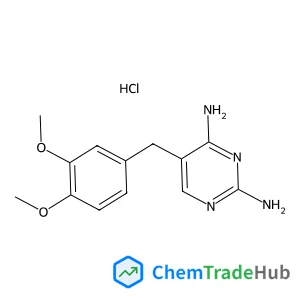
5-(3,4-Dimethoxybenzyl)-2,4-pyrimidinediamine hydrochloride (1:1)
CAS Number:
2507-23-5
Molecular Formula:
C13H17ClN4O2
Ioana Dumitrescu, Patrick R. Unwin, Julie V. Macpherson
Electrochemistry at carbon nanotubes (CNTs) is a large and growing field, but one in which there is still uncertainty about the fundamental activity of CNTs as electrode materials. On the one hand, there are many reports which focus on the favourable electrochemical properties of CNT electrodes, such as enhanced detection sensitivity, electrocatalytic effects and reduced fouling. On the other hand, other studies suggest that CNTs may be no more electroactive than graphitic powder. Furthermore, it has been proposed that the catalytic nanoparticles from which CNTs are formed may dominate the electrochemical characteristics in some instances. A considerable body of the literature presumes that the CNT sidewall is inert and that edge-plane-graphite-like open ends and defect sites are responsible for the electron transfer activity observed. In contrast, studies of well characterised single-walled nanotube (SWNT) electrodes, either as individual tubes or as two-dimensional networks, suggest sidewall activity. This review highlights how the various discrepancies in CNT electrochemistry may have arisen, by taking a historical view of the field and identifying crucial issues that still need to be solved. When assessing the behaviour of CNT electrodes, it is vitally important that careful consideration is given to the type of CNT used (SWNT or multi-walled), the quality of the material (presence of impurities), the effect of chemical processing steps in the fabrication of electrodes and the experimental arrangements adopted. Understanding these key features is an essential requirement to develop a fundamental understanding of CNT electrochemistry, to allow a wide range of electroanalytical applications, and to move the field forward rationally. As part of this process, high resolution electrochemical and electrical imaging techniques are expected to play a significant role in the future, as well as theoretical developments which examine the fundamentals of electron transfer at different types of CNTs and their characteristic surface sites.
Hao Liu, Huaizhi Gao, Jun Lin, Tasawar Hayat, Ahmed Alsaedi, Zhan'ao Tan
DOI: 10.1039/D0SE00206B
N. Angulakshmi, R. Baby Dhanalakshmi, Paulina Półrolniczak, Mariusz Walkowiak, Pengfei Xie, Xiaohui Tian, Yingke Zhou, A. Manuel Stephan
DOI: 10.1039/D0SE00594K
Hassan A. Alabdrabalameer, Juho Kauppinen, Toni Pikkarainen
DOI: 10.1039/D0SE00155D
Meghali Devi, Monjur H. Barbhuiya, Bishal Das, Bishal Bhuyan, Siddhartha S. Dhar
DOI: 10.1039/D0SE00406E
Xiao Shang, Jian-Hong Tang, Yujie Sun
DOI: 10.1039/D0SE00466A
Jieqiong Wang, Shuai Zhao, Man Lin Lai, Tianan Jiang, Fei Yan
DOI: 10.1039/D1BM00251A
(1R,3S)-1,3-Cyclopentanediol finds applications in various industries. In the ph...
When handling N'-[4-(Dimethylamino)phenyl]-N,N-dimethyl-1,4-benzenediamine, it i...
There are several alternatives to 5-(2,4-Difluorophenyl)-2-methoxypyrimidine in ...
1-(3-Methoxyphenoxy)propan-2-ol (CAS: 382141-68-6) must comply with the Globally...
Tetrodotoxin Citrate is extremely dangerous and should be handled with extreme c...
2-Methyl-2-propanyl [(1R,3S)-3-hydroxycyclopentyl]carbamate (CAS: 225641-84-9) i...
Waste containing 4-(2-Hydroxyhexafluoroisopropyl)Benzoic Acid (CAS: 16261-80-6) ...
2-Methyl-2-proanyl {(2S)-1-[(benzyloxy)amino]-3-hydroxy-3-methyl-1-oxo-2-butanyl...
Benzeneethanamine, α-ethyl-, hydrochloride (1:1) is an organic compound with the...
In the synthesis of compounds similar to 3-{(E)-[4-(Dimethylamino)phenyl]diazeny...

ChemComm publishes urgent research which is of outstanding significance and interest to experts in the field, while also appealing to the journal’s broad chemistry readership. Our communication format is ideally suited to short, urgent studies that are of such importance that they require accelerated publication. Our scope covers all topics in chemistry, and research at the interface of chemistry and other disciplines (such as materials science, nanoscience, physics, engineering and biology) where there is a significant novelty in the chemistry aspects. Major topic areas covered include: Analytical Chemistry Catalysis Chemical Biology and medicinal chemistry Computational Chemistry and Machine Learning Energy and sustainable chemistry Environmental Chemistry Green Chemistry Inorganic Chemistry Materials Chemistry Nanoscience Organic Chemistry Physical Chemistry Polymer Chemistry Supramolecular Chemistry