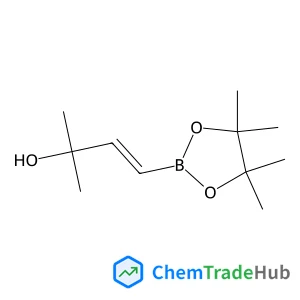
(E)-2-methyl-4-(4,4,5,5-tetramethyl-1,3,2-dioxaborolan-2-yl)but-3-en-2-ol
CAS Number:
581802-26-8
Molecular Formula:
C11H21BO3
Yuhui Zhou, Laiqiang Li, Yongmin Ma, Pinhua Li
This paper reports a metal-free and external oxidant-free electrochemical method for the C-3 amination of 2H-indazoles. The protocol employs commercially available azoles and aliphatic amines as amination reagents and has a broad substrate scope, providing the corresponding C3-amination products in high yields at room temperature. Mechanistic studies indicate that an oxidative addition/elimination sequence is involved under electrochemical conditions.
Panpan Zhang, Haixia Wang, Wei Xu, Yang Li, Qing Li, Gang Wei, Zhiqiang Su
DOI: 10.1039/C5BM00058K
Minjin Kim, Tae Kyung Lee, In Woo Choi, Hye Won Choi, Yimhyun Jo, Jiyun Lee, Gi-Hwan Kim, Sang Kyu Kwak, Dong Suk Kim
DOI: 10.1039/D0SE00382D
Małgorzata A. Witek, John K. Osiri, Hong Wang, Rondedrick Sinville, Hanna Pincas, Francis Barany
DOI: 10.1039/C1AY05366C
Nishita Lucas
DOI: 10.1039/D0SE00361A
Hasan Baig, Hiroyuki Kanda, Abdullah M. Asiri, Mohammad Khaja Nazeeruddin, Tapas Mallick
DOI: 10.1039/D0SE90048F
Ramon Díaz, María Ibáñez, Juan V. Sancho, Félix Hernández
DOI: 10.1039/C1AY05385J
(1R,3S)-1,3-Cyclopentanediol finds applications in various industries. In the ph...
When handling N'-[4-(Dimethylamino)phenyl]-N,N-dimethyl-1,4-benzenediamine, it i...
There are several alternatives to 5-(2,4-Difluorophenyl)-2-methoxypyrimidine in ...
1-(3-Methoxyphenoxy)propan-2-ol (CAS: 382141-68-6) must comply with the Globally...
Tetrodotoxin Citrate is extremely dangerous and should be handled with extreme c...
2-Methyl-2-propanyl [(1R,3S)-3-hydroxycyclopentyl]carbamate (CAS: 225641-84-9) i...
Waste containing 4-(2-Hydroxyhexafluoroisopropyl)Benzoic Acid (CAS: 16261-80-6) ...
2-Methyl-2-proanyl {(2S)-1-[(benzyloxy)amino]-3-hydroxy-3-methyl-1-oxo-2-butanyl...
Benzeneethanamine, α-ethyl-, hydrochloride (1:1) is an organic compound with the...
In the synthesis of compounds similar to 3-{(E)-[4-(Dimethylamino)phenyl]diazeny...

Organic Chemistry Frontiers publishes high-quality research from across organic chemistry. Emphases are placed on studies that make significant contributions to the field of organic chemistry by reporting either new or significantly improved protocols or methodologies. Topics include, but are not limited to the following: Organic synthesis Development of synthetic methodologies Catalysis Natural products Functional organic materials Supramolecular and macromolecular chemistry Physical and computational organic chemistry