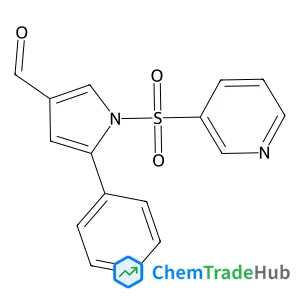
5-Phenyl-1-(pyridin-3-ylsulfonyl)-1H-pyrrole-3-carbaldehyde
CAS Number:
881676-90-0
Molecular Formula:
C16H12N2O3S
Ramon Díaz, María Ibáñez, Juan V. Sancho, Félix Hernández
In this paper, we illustrate the potential of ultra-high performance liquid chromatography (UHPLC) coupled with hybrid quadrupole time-of-flight mass spectrometry (QTOF MS) for large scale screening of organic contaminants in different types of samples. Thanks to the full-spectrum acquisition at satisfactory sensitivity, it is feasible to apply both (post)-target and non-target approaches for the rapid qualitative screening of organic pollutants in food, biological and environmental samples. Different strategies have been applied and compared in this work. The first approach consists of target screening based on automatically extracting the exact analyte masses with a narrow mass window (±10 mDa). The selection of analytes can be made after MS acquisition as non-specific analyte information is required when injecting the samples. The second, non-targeted approach, consists of a first component detection step followed by the search of the detected components in home-made spectral libraries. In this work, two types of libraries have been evaluated: a theoretical database, including the molecular formula of a large number of pollutants (∼1000), and an empirical mass spectra library which includes a lower number of compounds for which reference standards were available. In all cases the confidence of the identification process was excellent, thanks to the value of information given in QTOF MSE acquisition mode (i.e. simultaneous acquisition of low and high energy TOF MS spectra in a unique run). Both, target and non-target approaches, are complementary and both have advantages and drawbacks. Their application to different types of samples has allowed the detection of diverse organic compounds, for example the mycotoxin fumonisin B1 in food samples, cocaine and several metabolites in human urine, as well as several pesticides, antibiotics and drugs of abuse in urban wastewater.
Lei Xu, Hairong Wang, Hongrui Tian, Mingzu Zhang, Jinlin He, Peihong Ni
DOI: 10.1039/D1PY00135C
Brian J. Ree, Yusuke Satoh, Takuya Isono, Toshifumi Satoh
DOI: 10.1039/D1PY00421B
Josina L. Bohlen, Bragavie Kulendran, Hannah Rothfuss, Peter W. Roesky
DOI: 10.1039/D1PY00552A
Bingfeng Shi, Jianhua Lü, Ying Liu, Yang Xiao, Changli Lü
DOI: 10.1039/D1PY00308A
Matilde Concilio, Nga Nguyen, C. Remzi Becer
DOI: 10.1039/D1PY00534K
Pauline Sautrot-Ba, Vlasta Brezová, Jean-Pierre Malval, Annalisa Chiappone, Louise Breloy, Samir Abbad-Andaloussi, Davy-Louis Versace
DOI: 10.1039/D1PY00126D
Georges M. Pavlov, Anna A. Gosteva, Olga V. Okatova, Olga A. Dommes, Irina I. Gavrilova
DOI: 10.1039/D0PY01725F
Chai Won Kim, Ji Hye Lee, Seunguk Cho, Hyung Jong Kim, Jinhyo Hwang, Yong Woo Kim, Dae Hyuk Choi, Min Ju Cho, Kwangyeol Lee, Dong Hoon Choi
DOI: 10.1039/D1PY00497B
(1R,3S)-1,3-Cyclopentanediol finds applications in various industries. In the ph...
When handling N'-[4-(Dimethylamino)phenyl]-N,N-dimethyl-1,4-benzenediamine, it i...
There are several alternatives to 5-(2,4-Difluorophenyl)-2-methoxypyrimidine in ...
1-(3-Methoxyphenoxy)propan-2-ol (CAS: 382141-68-6) must comply with the Globally...
Tetrodotoxin Citrate is extremely dangerous and should be handled with extreme c...
2-Methyl-2-propanyl [(1R,3S)-3-hydroxycyclopentyl]carbamate (CAS: 225641-84-9) i...
Waste containing 4-(2-Hydroxyhexafluoroisopropyl)Benzoic Acid (CAS: 16261-80-6) ...
2-Methyl-2-proanyl {(2S)-1-[(benzyloxy)amino]-3-hydroxy-3-methyl-1-oxo-2-butanyl...
Benzeneethanamine, α-ethyl-, hydrochloride (1:1) is an organic compound with the...
In the synthesis of compounds similar to 3-{(E)-[4-(Dimethylamino)phenyl]diazeny...

Analytical Methods welcomes early applications of new analytical and bioanalytical methods and technology demonstrating the potential for societal impact. We require that methods and technology reported in the journal are sufficiently innovative, robust, accurate, and compared to other available methods for the intended application. Developments with interdisciplinary approaches are particularly welcome. Systems should be proven with suitably complex and analytically challenging samples. We encourage developments within, but not limited to, the following technologies and applications: global health, point-of-care and molecular diagnostics biosensors and bioengineering drug development and pharmaceutical analysis applied microfluidics and nanotechnology omics studies, such as proteomics, metabolomics or glycomics environmental, agricultural and food science neuroscience biochemical and clinical analysis forensic analysis industrial process and method development
![6-Bromo-2,3-dihydro-1H-pyrido[2,3-b][1,4]oxazine structure](https://static.chemtradehub.com/structs/120/1203499-17-5-b4d1.webp "6-Bromo-2,3-dihydro-1H-pyrido[2,3-b][1,4]oxazine structure")