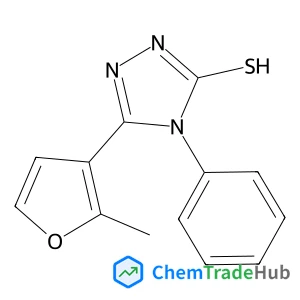
5-(2-Methyl-3-furyl)-4-phenyl-2,4-dihydro-3H-1,2,4-triazole-3-thione
CAS Number:
346464-59-3
Molecular Formula:
C13H11N3OS
Julijana Cvjetinovic, Anastasiia A. Merdalimova, Maria A. Kirsanova, Pavel A. Somov, Daniil V. Nozdriukhin, Alexey I. Salimon, Alexander M. Korsunsky, Dmitry A. Gorin
Siliceous diatom frustules represent an up-and-coming platform for a range of bio-assisted nanofabrication processes able to overcome the complexity and high cost of current engineering technology solutions in terms of negligibly small power consumption and environmentally friendly processing combined with unique highly porous structures and properties. Herein, the modification of diatomite – a soft, loose, and fine-grained siliceous sedimentary rock composed of the remains of fossilized diatoms – with gold nanoparticles using layer-by-layer technology in combination with a freezing-induced loading approach is demonstrated. The obtained composite structures are characterized by dynamic light scattering, extinction spectroscopy, scanning (SEM) and transmission electron microscopy (TEM), and photoacoustic imaging techniques, and tested as a platform for surface-enhanced Raman scattering (SERS) using Rhodamine 6G. SEM, TEM, and energy dispersive X-ray spectroscopy (EDX) confirmed a dense coating of gold nanoparticles with an average size of 19 nm on the surface of the diatomite and within the pores. The photoacoustic signal excited at a wavelength of 532 nm increases with increasing loading cycles of up to three polyelectrolyte-gold nanoparticle bilayers. The hybrid materials based on diatomite modified with gold nanoparticles can be used as SERS substrates, but also as biosensors, catalysts, and platforms for advanced bioimaging.
Géraldine Féraud, Claude Dedonder-Lardeux, Gilles Grégoire, Satchin Soorkia, Christophe Jouvet
DOI: 10.1039/C3CP54736A
DOI: 10.1039/C4CP03099K
Diana M. Gómez, Vladimir V. Galvita, José M. Gatica, Hilario Vidal, Guy B. Marin
DOI: 10.1039/C4CP00886C
D. Herráez-Aguilar, P. G. Jambrina, M. Menéndez, J. Aldegunde, R. Warmbier, F. J. Aoiz
DOI: 10.1039/C4CP03289F
Maciej J. Marczewski, Bernhard Stanje, Martin Wilkening
DOI: 10.1039/C4CP01133C
Emmanuel Cottancin, Cyril Langlois, Jean Lermé, Michel Broyer, Marie-Ange Lebeault, Michel Pellarin
DOI: 10.1039/C3CP55135K
M. T. Heinze, J. C. Zill, J. Matysik, W. D. Einicke, R. Gläser
DOI: 10.1039/C4CP02749C
Shintaro Takata, Yoshihiro Miura
DOI: 10.1039/C4CP03280B
Terence Musho, Jiangtan Li, Nianqiang Wu
DOI: 10.1039/C4CP03110E
When handling lithium chloride hydrate (1:1:1) (CAS: 16712-20-2), it is importan...
4-(4H-1,2,4-Triazol-4-yl)piperidine is generally considered safe for use in phar...
Waste containing 1,3-Thiazole-2-carboxamide (CAS: 16733-85-0) should be collecte...
5-(Difluoromethyl)-2-fluorobenzonitrile (CAS: 934175-58-3) is subject to regulat...
Methyl 3-acetamido-2-thiophenecarboxylate can be synthesized by the reaction of ...
4-Isoquinolinecarbonitrile is a chemical compound with the CAS number 34846-65-6...
Store Methyl 1H-1,2,3-triazole-4-carboxylate (CAS: 877309-59-6) in a cool, dry p...
6-Bromo[1,3]thiazolo[5,4-b]pyridin-2-amine (CAS: 1160791-13-8) is subject to the...
(2S,3S)-2-Ammonio-3-(3,4-dihydroxyphenyl)-3-hydroxypropanoate (CAS: 23651-95-8) ...
7-Bromo-3-methyl-3,4-dihydroquinazolin-4-one is a solid with a crystalline form....

Physical Chemistry Chemical Physics (PCCP) is an international journal co-owned by 19 physical chemistry and physics societies from around the world. This journal publishes original, cutting-edge research in physical chemistry, chemical physics and biophysical chemistry. To be suitable for publication in PCCP, articles must include significant innovation and/or insight into physical chemistry; this is the most important criterion that reviewers and Editors will judge against when evaluating submissions. The journal has a broad scope and welcomes contributions spanning experiment, theory, computation and data science. Topical coverage includes spectroscopy, dynamics, kinetics, statistical mechanics, thermodynamics, electrochemistry, catalysis, surface science, quantum mechanics, quantum computing and machine learning. Interdisciplinary research areas such as polymers and soft matter, materials, nanoscience, energy, surfaces/interfaces, and biophysical chemistry are welcomed if they demonstrate significant innovation and/or insight into physical chemistry. Joined experimental/theoretical studies are particularly appreciated when complementary and based on up-to-date approaches.

![[(2R)-6,6-Dimethyl-2-morpholinyl]methanol hydrochloride (1:1) structure](https://static.chemtradehub.com/structs/141/1416444-88-6-e06a.webp "[(2R)-6,6-Dimethyl-2-morpholinyl]methanol hydrochloride (1:1) structure")