













Analysis of cyclic polymer purity by size exclusion chromatography: a model system
Literature Information
Publication Date
2020-10-27
DOI
10.1039/D0PY01277G
Impact Factor
5.582
Authors
Yanlin Shi, Sung-Po R. Chen, Zhongfan Jia, Michael J. Monteiro
View Original
Abstract
Because cyclic polymers have intriguing physical properties, considerable synthetic strategies have been developed to create a wide variety of cyclic architectures. One of the most utilized cyclization procedures is via ring-closure of a difunctional linear polymer using the copper catalyzed azide–alkyne cycloaddition (CuAAC) ‘click’ reaction. However, quantifying the percentage of mono-cyclic species (i.e. formed directly from the starting α,ω-linear polymer) still remains a challenge even with access to a variety of characterization techniques, including NMR, MALDI-ToF, size exclusion chromatography (SEC) and liquid chromatography at the critical condition (LCCC). Here, we demonstrated that SEC in combination with the log-normal distribution (LND) method and minimization of the sum of squares of the weighted residuals to fit the distribution provided an analytical method for the accurate analysis of cyclic purity. The key to the SEC analysis method relies on quantification of the hydrodynamic shift from linear to mono-cyclic. The technique developed in this work has wide applicability for the characterization of complex polymer architectures and compositions (and can be easily applied to sequence controlled polymers).
Related Literature
Second harmonic generation from aluminum plasmonic nanocavities: from scanning to imaging
Tchiya Zar, Alon Krause, Hannah Aharon, Racheli Ron, Martin Oheim
2023-06-29
Paper
DOI: 10.1039/D3CP01678A
Isolation of naturally occurring aluminium ligands using immobilized metal affinity chromatography for analysis by ESI-MS
Carson Baldwin, Jonathan Cumming, Aaron T. Timperman
2005-01-17
Paper
DOI: 10.1039/B417016D
Disequilibrium effects in metal speciation by capillary electrophoresisinductively coupled plasma mass spectrometry (CE-ICP-MS); theory, simulations and experiments
Jeroen E. Sonke, Vincent J. M. Salters
2004-07-06
Paper
DOI: 10.1039/B407162J
Analytical chemistry of synthetic routes to psychoactive tryptamines Part I. Characterisation of the Speeter and Anthony synthetic route to 5-methoxy-N,N-diisopropyltryptamine using ESI-MS-MS and ESI-TOF-MS
Simon D. Brandt, Sally Freeman, Ian A. Fleet, Peter McGagh, John F. Alder
2004-10-01
Paper
DOI: 10.1039/B407239C
Design and characterization of a directly polarized radioluminescent light source
James H. Barnes, IV, Gary M. Hieftje
2004-07-14
Paper
DOI: 10.1039/B314563H
In-depth study of binary ethanol–triacetin mixtures in relation to their excellent solubilization power
Evamaria Hofmann, Anna Saridis, Didier Touraud, Richard Buchner, Werner Kunz
2023-07-25
Paper
DOI: 10.1039/D3CP02716C
Electrochemical detection of amino acids at carbon nanotube and nickel–carbon nanotube modified electrodes
Randhir P. Deo, Nathan S. Lawrence, Joseph Wang
2004-08-13
Paper
DOI: 10.1039/B407418A
Mechanistic insights for regulating the site occupancy, valence states and optical transitions of Mn ions in yttrium–aluminum garnets via codoping
Chong-Geng Ma
2023-06-21
Paper
DOI: 10.1039/D3CP01548C
Optical calcium sensors: development of a generic method for their introduction to the cell using conjugated cell penetrating peptides
Abigail Webster, Steven J. Compton, Jonathan W. Aylott
2004-12-15
Paper
DOI: 10.1039/B413725F
You might also like
Compound Q&A
What are the main uses of 1H-Indazole-6-carbonitrile (CAS: 141290-59-7)?
1H-Indazole-6-carbonitrile finds applications in pharmaceuticals, where it serve...
141290-59-71H-Indazole-6-carbon...
Compound Q&A
How should waste containing Dioctyl (2E)-2-butenedioate (CAS: 2997-85-5) be handled?
Waste containing Dioctyl (2E)-2-butenedioate (CAS: 2997-85-5) should be collecte...
2997-85-5Dioctyl (2E)-2-buten...
Compound Q&A
What industries use Sodium [(1,2-benzoxazol-3-ylmethyl)sulfonyl]azanide (CAS: 68291-98-5)?
Sodium [(1,2-benzoxazol-3-ylmethyl)sulfonyl]azanide is primarily used in pharmac...
68291-98-5Sodium [(1,2-benzoxa...
Compound Q&A
Are there alternatives to Dimethyl 4-(4,4,5,5-tetramethyl-1,3,2-dioxaborolan-2-yl)-2,6-pyridinedicarboxylate (CAS: 741709-66-0) in synthesis?
Dimethyl 4-(4,4,5,5-tetramethyl-1,3,2-dioxaborolan-2-yl)-2,6-pyridinedicarboxyla...
741709-66-0Dimethyl 4-(4,4,5,5-...
Compound Q&A
How should waste containing 2-Fluoro-6-hydrazinopyridine (CAS: 80714-39-2) be handled?
Waste containing 2-Fluoro-6-hydrazinopyridine (CAS: 80714-39-2) should be manage...
80714-39-22-Fluoro-6-hydrazino...
Compound Q&A
What is 6-Formyl-2-pyridinecarboxylic acid (CAS: 499214-11-8)?
6-Formyl-2-pyridinecarboxylic acid is an organic compound with the molecular for...
499214-11-86-Formyl-2-pyridinec...
Compound Q&A
What is the market or research trend for 3-(3,4-dimethoxyphenyl)-2,5-dimethyl-N-(2-morpholin-4-ylethyl)pyrazolo[1,5-a]pyrimidin-7-amine (CAS: 900874-91-1)?
Research trends for this compound indicate a focus on its potential applications...
900874-91-13-(3,4-dimethoxyphen...
Compound Q&A
How is 9H-Tribenzo[b,d,f]azepine (CAS: 29875-73-8) typically synthesized?
9H-Tribenzo[b,d,f]azepine is typically synthesized via a multi-step process invo...
29875-73-89H-Tribenzo[b,d,f]az...
Compound Q&A
How is 1-Cyclopropyl-7-ethoxy-6-fluoro-8-methoxy-4-oxo-1,4-dihydro-3-quinolinecarboxylic acid (CAS: 1797982-51-4) typically synthesized?
1-Cyclopropyl-7-ethoxy-6-fluoro-8-methoxy-4-oxo-1,4-dihydro-3-quinolinecarboxyli...
1797982-51-41-Cyclopropyl-7-etho...
Compound Q&A
How should waste containing Methyl 3-oxo-1,2,3,4-tetrahydro-6-quinoxalinecarboxylate (CAS: 671820-52-3) be handled?
Waste containing Methyl 3-oxo-1,2,3,4-tetrahydro-6-quinoxalinecarboxylate (CAS: ...
671820-52-3Methyl 3-oxo-1,2,3,4...
Source Journal
Polymer Chemistry

CiteScore:
8.6
Self-citation Rate:
7.3%
Articles per Year:
457
Polymer Chemistry welcomes submissions in all areas of polymer science that have a strong focus on macromolecular chemistry. Manuscripts may cover a broad range of fields, yet no direct application focus is required.
Recommended Compounds

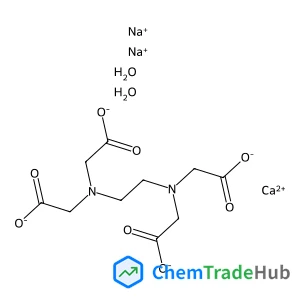
EthylenediaminetetraaceticacidcalciumDisodiumsalthydrate
CAS Number:
23411-34-9
Molecular Formula:
C10H16CaN2Na2O10
Recommended Suppliers






Disclaimer
This page provides academic journal information for reference and research purposes only. We are not affiliated with any journal publishers and do not handle publication submissions. For publication-related inquiries, please contact the respective journal publishers directly.
If you notice any inaccuracies in the information displayed, please contact us at support@chemtradehub.com. We will promptly review and address your concerns.