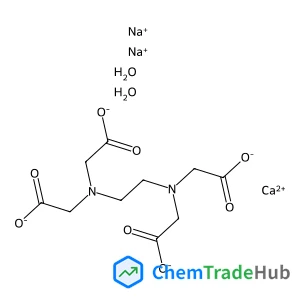
EthylenediaminetetraaceticacidcalciumDisodiumsalthydrate
CAS Number:
23411-34-9
Molecular Formula:
C10H16CaN2Na2O10
Jeroen E. Sonke, Vincent J. M. Salters
A theoretical–experimental approach to evaluate disequilibrium effects in capillary electrophoresis inductively coupled plasma mass spectrometry (CE-ICP-MS) is presented. Electrophoresis requires metal ligand (ML) complexes to be stable on the time scale of separation and detection. By expressing ML complex stability in terms of half-life during a CE separation, an evaluation of separation artifacts can be made. Kinetically slow metals like Cr, Al or Fe form complexes that are stable on the time scale of electrophoretic separations. Kinetically fast metals, like Pb, Hg, Cu, Cd and REE, however tend to form labile complexes which unless complexed by strong chelators will dissociate during CE separations. A reactive transport simulation model of CE separations involving ML complexes allows a more detailed prediction of disequilibrium bias and identifies kinetically limited from mobility-limited types of dissociation. Complementary experimental results are given for kinetic and equilibrium binding experiments of Sm with humic acid. The equilibrium logK for Sm–Leonardite humic acid (HA) binding at pH 7 and 0.01 mol L−1 ionic strength was determined to be 13.04. Kinetic rates of formation and dissociation for SmHA were 5.9 108 and 5.3 10−5 mol s−1.

Journal of Physics and Chemistry of Solids

Russian Chemical Reviews

Molecular Pharmacology

Kinetics and Catalysis

Helvetica Chimica Acta

Journal of Medicinal Chemistry

Organic Preparations and Procedures International

Science

Proceedings of the National Academy of Sciences of the United States of America

Nature
Qiong He, Meng Wang, Minghui Sun, Jie Yao, Tianhong Ao
DOI: 10.1039/C5CP03600C
Cigdem Toparli, Adnan Sarfraz, Andreas Erbe
DOI: 10.1039/C5CP05172J
Yanyan Yuan, Wenhua Zhang, Junfa Zhu, Jie Su, Jiawei Li
DOI: 10.1039/C5CP04802H
Xiaoqing Tian, Lin Liu, Yu Du, Juan Gu, Jian-bin Xu, Boris I. Yakobson
DOI: 10.1039/C5CP05443E
DOI: 10.1039/C5CP01222H
Nan Chen, Xianke Huang, Liangti Qu
DOI: 10.1039/C5CP04391C
P. M. G. L. Ferreira, M. S. Ishikawa, S. Kogikoski, Jr., W. A. Alves, H. Martinho
DOI: 10.1039/C5CP01055A
Helgi Rafn Hróðmarsson, Ágúst Kvaran
DOI: 10.1039/C5CP06185G
Dorian S. N. Parker, Ralf I. Kaiser, Oleg Kostko, Tyler P. Troy, Musahid Ahmed, Bing-Jian Sun, Shih-Hua Chen, A. H. H. Chang
DOI: 10.1039/C5CP02960K
1H-Indazole-6-carbonitrile finds applications in pharmaceuticals, where it serve...
Waste containing Dioctyl (2E)-2-butenedioate (CAS: 2997-85-5) should be collecte...
Sodium [(1,2-benzoxazol-3-ylmethyl)sulfonyl]azanide is primarily used in pharmac...
Dimethyl 4-(4,4,5,5-tetramethyl-1,3,2-dioxaborolan-2-yl)-2,6-pyridinedicarboxyla...
Waste containing 2-Fluoro-6-hydrazinopyridine (CAS: 80714-39-2) should be manage...
6-Formyl-2-pyridinecarboxylic acid is an organic compound with the molecular for...
Research trends for this compound indicate a focus on its potential applications...
9H-Tribenzo[b,d,f]azepine is typically synthesized via a multi-step process invo...
1-Cyclopropyl-7-ethoxy-6-fluoro-8-methoxy-4-oxo-1,4-dihydro-3-quinolinecarboxyli...
Waste containing Methyl 3-oxo-1,2,3,4-tetrahydro-6-quinoxalinecarboxylate (CAS: ...

Analyst publishes analytical and bioanalytical research that reports premier fundamental discoveries and inventions, and the applications of those discoveries, unconfined by traditional discipline barriers.