


SELEX: Just another separation?
Literature Information
Publication Date
2005-01-06
DOI
10.1039/B412492H
Impact Factor
4.616
Authors
View Original
Abstract
The potential for quickly isolating high affinity, highly selective ligands generated much excitement when SELEX was first described. Fifteen years later, SELEX has still not achieved widespread acceptance due to limitations in aptamer affinity, stability and throughput. Recent research is beginning to address these limitations though and SELEX is quickly regaining its standing as a hot topic in areas as diverse as drug discovery, chemical analysis, and even genomics and proteomics.
Recommended Journals

Molecular Diversity

Foundations of Chemistry

Advanced Engineering Materials

Physical Chemistry Chemical Physics

Environmental Toxicology and Pharmacology

Mini-Reviews in Medicinal Chemistry

Journal of Medical Biochemistry

Journal of Enzyme inhibition and Medicinal Chemistry

Current Pharmaceutical Biotechnology

Nature Reviews Drug Discovery
Related Literature
Alzheimer's disease: which type of amyloid-preventing drug agents to employ?
Hyunbum Jang, Laura Connelly, Fernando Teran Arce, Srinivasan Ramachandran, Ratnesh Lal, Bruce L. Kagan
2013-02-21
Perspective
DOI: 10.1039/C3CP00017F
An extrapolation method for the efficient calculation of molecular response properties within Born–Oppenheimer molecular dynamics
2013-05-10
Paper
DOI: 10.1039/C3CP50204J
Fluorescence behavior of (selected) flavonols: a combined experimental and computational study
Sebastian Höfener, Pieter C. Kooijman, Janneke Groen, Freek Ariese, Lucas Visscher
2013-05-24
Paper
DOI: 10.1039/C3CP44267E
Robust switching characteristics of CdSe/ZnS quantum dot non-volatile memory devices
V. Kannan, J. K. Rhee
2013-05-10
Paper
DOI: 10.1039/C3CP50216C
Hematite–NiO/α-Ni(OH)2 heterostructure photoanodes with high electrocatalytic current density and charge storage capacity
Artur Braun, Rolf Erni, Ulrich Müller, Max Döbeli, Edwin C. Constable
2013-05-30
Paper
DOI: 10.1039/C3CP52179F
The conformational landscape of tartrate-based inhibitors of the TACE enzyme as revealed by Hamiltonian Replica Exchange simulation
Carlo Guardiani, Piero Procacci
2013-04-15
Paper
DOI: 10.1039/C3CP00108C
Octahedral tin dioxidenanocrystals as high capacity anode materials for Na-ion batteries
Dawei Su, Chengyin Wang, Hyojun Ahn, Guoxiu Wang
2013-05-30
Paper
DOI: 10.1039/C3CP52037D
You might also like
Compound Q&A
What are the main uses of 1H-Indazole-6-carbonitrile (CAS: 141290-59-7)?
1H-Indazole-6-carbonitrile finds applications in pharmaceuticals, where it serve...
141290-59-71H-Indazole-6-carbon...
Compound Q&A
How should waste containing Dioctyl (2E)-2-butenedioate (CAS: 2997-85-5) be handled?
Waste containing Dioctyl (2E)-2-butenedioate (CAS: 2997-85-5) should be collecte...
2997-85-5Dioctyl (2E)-2-buten...
Compound Q&A
What industries use Sodium [(1,2-benzoxazol-3-ylmethyl)sulfonyl]azanide (CAS: 68291-98-5)?
Sodium [(1,2-benzoxazol-3-ylmethyl)sulfonyl]azanide is primarily used in pharmac...
68291-98-5Sodium [(1,2-benzoxa...
Compound Q&A
Are there alternatives to Dimethyl 4-(4,4,5,5-tetramethyl-1,3,2-dioxaborolan-2-yl)-2,6-pyridinedicarboxylate (CAS: 741709-66-0) in synthesis?
Dimethyl 4-(4,4,5,5-tetramethyl-1,3,2-dioxaborolan-2-yl)-2,6-pyridinedicarboxyla...
741709-66-0Dimethyl 4-(4,4,5,5-...
Compound Q&A
How should waste containing 2-Fluoro-6-hydrazinopyridine (CAS: 80714-39-2) be handled?
Waste containing 2-Fluoro-6-hydrazinopyridine (CAS: 80714-39-2) should be manage...
80714-39-22-Fluoro-6-hydrazino...
Compound Q&A
What is 6-Formyl-2-pyridinecarboxylic acid (CAS: 499214-11-8)?
6-Formyl-2-pyridinecarboxylic acid is an organic compound with the molecular for...
499214-11-86-Formyl-2-pyridinec...
Compound Q&A
What is the market or research trend for 3-(3,4-dimethoxyphenyl)-2,5-dimethyl-N-(2-morpholin-4-ylethyl)pyrazolo[1,5-a]pyrimidin-7-amine (CAS: 900874-91-1)?
Research trends for this compound indicate a focus on its potential applications...
900874-91-13-(3,4-dimethoxyphen...
Compound Q&A
How is 9H-Tribenzo[b,d,f]azepine (CAS: 29875-73-8) typically synthesized?
9H-Tribenzo[b,d,f]azepine is typically synthesized via a multi-step process invo...
29875-73-89H-Tribenzo[b,d,f]az...
Compound Q&A
How is 1-Cyclopropyl-7-ethoxy-6-fluoro-8-methoxy-4-oxo-1,4-dihydro-3-quinolinecarboxylic acid (CAS: 1797982-51-4) typically synthesized?
1-Cyclopropyl-7-ethoxy-6-fluoro-8-methoxy-4-oxo-1,4-dihydro-3-quinolinecarboxyli...
1797982-51-41-Cyclopropyl-7-etho...
Compound Q&A
How should waste containing Methyl 3-oxo-1,2,3,4-tetrahydro-6-quinoxalinecarboxylate (CAS: 671820-52-3) be handled?
Waste containing Methyl 3-oxo-1,2,3,4-tetrahydro-6-quinoxalinecarboxylate (CAS: ...
671820-52-3Methyl 3-oxo-1,2,3,4...
Source Journal
Analyst

CiteScore:
7.8
Self-citation Rate:
5.6%
Articles per Year:
653
Analyst publishes analytical and bioanalytical research that reports premier fundamental discoveries and inventions, and the applications of those discoveries, unconfined by traditional discipline barriers.
Recommended Compounds
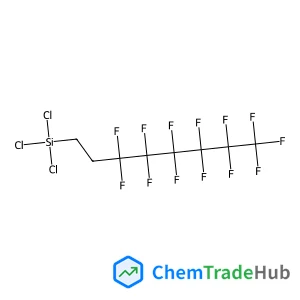
Trichloro(3,3,4,4,5,5,6,6,7,7,8,8,8-tridecafluorooctyl)silane
CAS Number:
78560-45-9
Molecular Formula:
C8H4Cl3F13Si
Recommended Suppliers





Disclaimer
This page provides academic journal information for reference and research purposes only. We are not affiliated with any journal publishers and do not handle publication submissions. For publication-related inquiries, please contact the respective journal publishers directly.
If you notice any inaccuracies in the information displayed, please contact us at support@chemtradehub.com. We will promptly review and address your concerns.