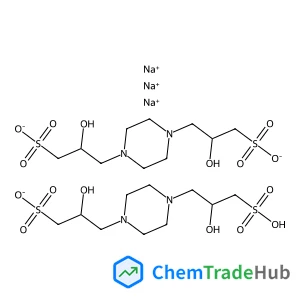
3,3'-(Piperazine-1,4-diyl)bis(2-hydroxypropane-1-sulfonic acid) Sodium Salt
CAS Number:
108321-08-0
Molecular Formula:
C20H41N4Na3O16S4
Theona Șucu
Thermosets are an important class of materials that provide excellent temperature and solvent resistance; however, their high dimensional stability precludes degradation or reprocessing. While traditional thermoplastics can be mechanically and chemically recycled, these pathways are often elusive for resins due to their intrinsic structure. The renewed demand for sustainable polymers from public, industry and government stakeholders has increased research into (bio)degradable thermoplastics, but thermosets have often been overlooked. Aliphatic polyesters and polycarbonates are the cornerstone of biodegradable polymers, yet offer an arguably greater potential in thermosets as end-of-life options are more limited for these materials. This review summarises the most recent advances in the synthesis and characterisation of degradable thermosetting polyester and polycarbonate materials, including partially degradable systems derived from renewable resources such as itaconic acid or isosorbide. The review is organised by synthetic methodology including one-pot reactions and multi-step approaches making use of pre-polymers. Photo-cross-linking and high-energy irradiation are also discussed as emerging synthetic strategies.
Adam Czajka, Christopher Hill, Jocelyn Peach, Jonathan C. Pegg, Isabelle Grillo, Frédéric Guittard, Sarah E. Rogers, Masanobu Sagisaka, Julian Eastoe
DOI: 10.1039/C7CP02570J
Li Chen, Hongmei Liu, Zhishan Mi, Changmin Shi, Lijie Qiao
DOI: 10.1039/C7CP02472J
I. Yavuz
DOI: 10.1039/C7CP05297A
Víctor de Souza Bonfim, Roberto Barbosa de Castilho, Leonardo Baptista
DOI: 10.1039/C7CP03679E
DOI: 10.1039/C7CP04068G
Jinbo Fei, Ganglong Cui, Xiangyang Liu, Weihai Fang
DOI: 10.1039/C7CP02543B
Hasyiya Karimah Adli, Takashi Harada, Shuji Nakanishi, Shigeru Ikeda
DOI: 10.1039/C7CP04132B
Ge Yao, Zelong Zhang, Jianwei Wang
DOI: 10.1039/C7CP02846F
3-Fluoro-2-methylbenzylamine is an organic compound with the CAS number 771573-3...
Tert-butyl 2-(oxetan-3-ylidene)acetate is considered safe for its intended uses ...
Proper personal protective equipment (PPE) such as gloves, goggles, and a lab co...
2-Ethyl-4-methyl-1,3-thiazole is commonly synthesized via the reaction of thiour...
This compound should be stored in a cool, dry place away from direct sunlight an...
L-Lysine Acetate Salt (CAS: 52315-92-1) is subject to various regulatory guideli...
6-Fluoro-3-hydroxy-2-pyrazinecarboxamide (CAS: 259793-96-9) is generally conside...
1,1'-Sulfonylbis(1H-imidazole) is a crystalline solid with a molecular weight of...
4-Methyl-7-nitro-1H-indole-3-carbonitrile (CAS: 289483-82-5) is primarily used i...
Waste containing 5-Bromo-3-indolyl-beta-galactoside (CAS: 97753-82-7) should be ...

Polymer Chemistry welcomes submissions in all areas of polymer science that have a strong focus on macromolecular chemistry. Manuscripts may cover a broad range of fields, yet no direct application focus is required.
![2,4,5-Trichloro-7H-pyrrolo[2,3-d]pyrimidine structure](https://static.chemtradehub.com/structs/105/1053228-28-6-fba3.webp "2,4,5-Trichloro-7H-pyrrolo[2,3-d]pyrimidine structure")