



Insight into the synthesis of N-methylated polypeptides
Literature Information
Publication Date
2020-10-06
DOI
10.1039/D0PY01055C
Impact Factor
5.582
Authors
Christian Muhl, Lydia Zengerling, Jonathan Groß, Paul Eckhardt, Till Opatz, Pol Besenius
View Original
Abstract
The ring-opening polymerization (ROP) of N-carboxy anhydrides (NCAs) is mostly divided into two classes: NCAs of α-substituted amino acids and N-methylated NCAs of α-unsubstituted glycine derivatives (NNCAs). The use of both monomer types offers different mechanistic features and results in a multitude of functional materials. To combine these properties, the synthesis and ROP of α-substituted and N-methylated NCAs (αNNCAs) of several amino acids were investigated. The current study provides insight into the influence of polymerization conditions and the limitations caused by the enhanced steric demand of the amino acid NCA monomers and their N-methylated derivatives. Namely, the effects of solvent polarity (DMF and DCM) and steric demand of the initiator by using neopentyl amine (NPA) and n-butyl amine (nBu) were studied. Analysis by HFIP-GPC and MALDI-ToF MS reveals that the polymerization and the resulting polymers are tremendously affected by the steric demand of both the initiators and the monomers, while electronic effects seem to have only minor influences. The experimental results are further compared with computational studies, based on coupled cluster (CC) calculations, which underline that electronic effects are of lower importance than steric constraints for the ROP of αNNCAs. Moreover, poly(N-methyl-L-methionine) forms helical secondary structures in solution. Therefore, this work combines mechanistic studies of the ROP of αNNCAs with initial studies on the solution properties of these polypeptides.
Recommended Journals

Electroanalysis

Journal of Asian Natural Products Research

Critical Reviews in Solid State and Materials Sciences

Acta Metallurgica Sinica-English Letters

Bioorganic & Medicinal Chemistry

Polycyclic Aromatic Compounds

NDT & E International

Journal of the Indian Institute of Science

Bioorganic & Medicinal Chemistry Letters

Cellulose
Related Literature
Disequilibrium effects in metal speciation by capillary electrophoresisinductively coupled plasma mass spectrometry (CE-ICP-MS); theory, simulations and experiments
Jeroen E. Sonke, Vincent J. M. Salters
2004-07-06
Paper
DOI: 10.1039/B407162J
A first-principles study of the structural, electronic and elastic properties of the FeO2–FeO2He system under high pressure
Haibo Liu, Lei Liu, Cunlin Xin, Longxing Yang, Xiaoyu Gu
2023-07-11
Paper
DOI: 10.1039/D3CP02315J
Activating lattice oxygen of single-layer ZnO for the catalytic oxidation reaction
Le Lin, Hao Wu, Rentao Mu, Qiang Fu
2023-07-11
Paper
DOI: 10.1039/D3CP02580B
Rapid, quantitative analysis of ppm/ppb nicotine using surface-enhanced Raman scattering from polymer-encapsulated Ag nanoparticles (gel-colls)
Steven E. J. Bell, Narayana M. S. Sirimuthu
2004-09-16
Paper
DOI: 10.1039/B408775E
Novel ion chromatographic stationary phases for the analysis of complex matrices
Brett Paull, Pavel N. Nesterenko
2004-10-21
Tutorial Review
DOI: 10.1039/B406355B
Enhancing the ionic conductivity and mechanical properties of PEO-based solid electrolytes through thermal pre-stretching treatment
Hong Liu
2023-06-19
Paper
DOI: 10.1039/D3CP01068F
Identification of selenomethionine in selenized yeast using two-dimensional liquid chromatography-mass spectrometry based proteomic analysis
S. McSheehy, J. Kelly, L. Tessier, Z. Mester
2004-11-22
Communication
DOI: 10.1039/B414246B
A neural network potential energy surface for the Li + LiNa → Li2 + Na reaction and quantum dynamics study from ultracold to thermal energies
2023-07-07
Paper
DOI: 10.1039/D3CP01753B
You might also like
Compound Q&A
What are the main uses of 1H-Indazole-6-carbonitrile (CAS: 141290-59-7)?
1H-Indazole-6-carbonitrile finds applications in pharmaceuticals, where it serve...
141290-59-71H-Indazole-6-carbon...
Compound Q&A
How should waste containing Dioctyl (2E)-2-butenedioate (CAS: 2997-85-5) be handled?
Waste containing Dioctyl (2E)-2-butenedioate (CAS: 2997-85-5) should be collecte...
2997-85-5Dioctyl (2E)-2-buten...
Compound Q&A
What industries use Sodium [(1,2-benzoxazol-3-ylmethyl)sulfonyl]azanide (CAS: 68291-98-5)?
Sodium [(1,2-benzoxazol-3-ylmethyl)sulfonyl]azanide is primarily used in pharmac...
68291-98-5Sodium [(1,2-benzoxa...
Compound Q&A
Are there alternatives to Dimethyl 4-(4,4,5,5-tetramethyl-1,3,2-dioxaborolan-2-yl)-2,6-pyridinedicarboxylate (CAS: 741709-66-0) in synthesis?
Dimethyl 4-(4,4,5,5-tetramethyl-1,3,2-dioxaborolan-2-yl)-2,6-pyridinedicarboxyla...
741709-66-0Dimethyl 4-(4,4,5,5-...
Compound Q&A
How should waste containing 2-Fluoro-6-hydrazinopyridine (CAS: 80714-39-2) be handled?
Waste containing 2-Fluoro-6-hydrazinopyridine (CAS: 80714-39-2) should be manage...
80714-39-22-Fluoro-6-hydrazino...
Compound Q&A
What is 6-Formyl-2-pyridinecarboxylic acid (CAS: 499214-11-8)?
6-Formyl-2-pyridinecarboxylic acid is an organic compound with the molecular for...
499214-11-86-Formyl-2-pyridinec...
Compound Q&A
What is the market or research trend for 3-(3,4-dimethoxyphenyl)-2,5-dimethyl-N-(2-morpholin-4-ylethyl)pyrazolo[1,5-a]pyrimidin-7-amine (CAS: 900874-91-1)?
Research trends for this compound indicate a focus on its potential applications...
900874-91-13-(3,4-dimethoxyphen...
Compound Q&A
How is 9H-Tribenzo[b,d,f]azepine (CAS: 29875-73-8) typically synthesized?
9H-Tribenzo[b,d,f]azepine is typically synthesized via a multi-step process invo...
29875-73-89H-Tribenzo[b,d,f]az...
Compound Q&A
How is 1-Cyclopropyl-7-ethoxy-6-fluoro-8-methoxy-4-oxo-1,4-dihydro-3-quinolinecarboxylic acid (CAS: 1797982-51-4) typically synthesized?
1-Cyclopropyl-7-ethoxy-6-fluoro-8-methoxy-4-oxo-1,4-dihydro-3-quinolinecarboxyli...
1797982-51-41-Cyclopropyl-7-etho...
Compound Q&A
How should waste containing Methyl 3-oxo-1,2,3,4-tetrahydro-6-quinoxalinecarboxylate (CAS: 671820-52-3) be handled?
Waste containing Methyl 3-oxo-1,2,3,4-tetrahydro-6-quinoxalinecarboxylate (CAS: ...
671820-52-3Methyl 3-oxo-1,2,3,4...
Source Journal
Polymer Chemistry

CiteScore:
8.6
Self-citation Rate:
7.3%
Articles per Year:
457
Polymer Chemistry welcomes submissions in all areas of polymer science that have a strong focus on macromolecular chemistry. Manuscripts may cover a broad range of fields, yet no direct application focus is required.
Recommended Compounds
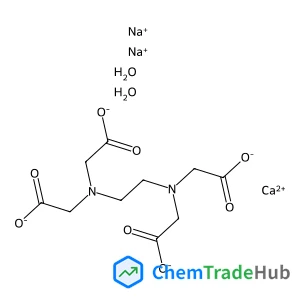
EthylenediaminetetraaceticacidcalciumDisodiumsalthydrate
CAS Number:
23411-34-9
Molecular Formula:
C10H16CaN2Na2O10


Recommended Suppliers






Disclaimer
This page provides academic journal information for reference and research purposes only. We are not affiliated with any journal publishers and do not handle publication submissions. For publication-related inquiries, please contact the respective journal publishers directly.
If you notice any inaccuracies in the information displayed, please contact us at support@chemtradehub.com. We will promptly review and address your concerns.