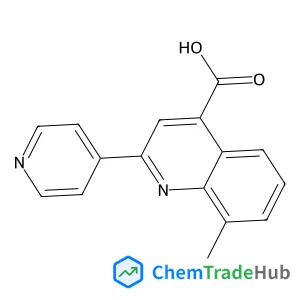
8-Methyl-2-pyridin-4-ylquinoline-4-carboxylic acid
CAS Number:
107027-42-9
Molecular Formula:
C16H12N2O2
Shaohui Liu, Damien Brunel, Ke Sun, Yangyang Xu, Fabrice Morlet-Savary, Bernadette Graff, Pu Xiao, Frédéric Dumur, Jacques Lalevée
A bifunctional benzophenone–carbazole-based photoinitiator (BPC) was designed from its molecular structure viewpoint. To achieve this, two benzoyl substituents were introduced as peripheral groups of carbazole, so that a molecule in which two benzophenones were fused to one carbazole unit could be obtained in a one-step procedure. As a result of this combination, synergetic effects are thus achieved. Interestingly, BPC could efficiently initiate the free radical photopolymerization (FRP) of acrylates without addition of any extra hydrogen donors, demonstrating that not only a monocomponent Type II behavior but also fast photoinitiation rates were obtained in the presence of an amine and/or an iodonium salt under LED@365 nm irradiation. Meanwhile, BPC can also interact with the iodonium salt to generate cationic species for the cationic photopolymerization (CP) of epoxides. BPC was found as a versatile photoinitiator that can be used for both radical and cationic polymerizations. The best photoinitiating system (PIS) determined during the FRP tests was selected for 3D printing experiments. Steady state photolysis and fluorescence quenching experiments were carried out to verify the interaction between BPC and the different additives in the excited state. Electron spin resonance-spin trapping experiments successfully distinguished the free radicals generated by the different PISs and the proposed electron transfer mechanisms are also discussed.
Lauren L. Grant, Clarissa S. Sit
DOI: 10.1039/D1MD00074H
Ingrid Allart-Simon, Aurélie Moniot, Nicolo Bisi, Miguel Ponce-Vargas, Sandra Audonnet, Marie Laronze-Cochard, Janos Sapi, Eric Hénon, Frédéric Velard, Stéphane Gérard
DOI: 10.1039/D0MD00423E
Giselle de Andrade Ramos, Andressa Souza de Oliveira, Manuela Bartolini, Marina Naldi, Irene Liparulo, Christian Bergamini, Elisa Uliassi, Ling Wu, Paul E. Fraser, Monica Abreu, Alessandra Sofia Kiametis, Ricardo Gargano, Edilberto Rocha Silveira, Guilherme D. Brand, Lukas Prchal, Maria Laura Bolognesi, Luiz Antonio Soares Romeiro
DOI: 10.1039/D1MD00046B
Shahinda S. R. Alsayed, Amreena Suri, Anders W. Bailey, Samuel Lane, Chiang-Ching Huang, Li-Fang Yu, Michael Kassiou, Hendra Gunosewoyo
DOI: 10.1039/D1MD00065A
Koushik Roy, Syamal Roy, Siddhartha Roy
DOI: 10.1039/D1MD00099C
Kaitlind C. Howard, Octavio A. Gonzalez, Sylvie Garneau-Tsodikova
DOI: 10.1039/D0MD00424C
Tomris Coban, Cameron Robertson, Sianne Schwikkard, Richard Singer, Adam LeGresley
DOI: 10.1039/D0MD00428F
Ivana Cacciatore, Hasan Turkez, Annalisa Di Rienzo, Michele Ciulla, Antonio Di Stefano
DOI: 10.1039/D1MD00177A
Waste containing 6-Chloro-5-(2'-hydroxy-3'-methoxy-4-biphenylyl)-3-(3-methoxyphe...
(3alpha,5alpha)-3-Hydroxypregnane-11,20-dione is primarily used in the pharmaceu...
The market for 4-Amino-6-chloro-2-pyridinecarboxylic acid (CAS: 546141-56-4) is ...
Alternatives to (2-Benzoylethyl)trimethylammonium chloride (CAS: 24472-88-6) in ...
N-[4-Nitro-3-(trifluoromethyl)phenyl]acetamide (CAS: 393-12-4) is generally safe...
Alternative reagents such as other phosphates or similar functional groups can b...
There are alternatives to N,N'-Bis(3-aminopropyl)-1,3-propanediamine (CAS: 4605-...
When handling Aluminium trihexadecanoate, it is important to use appropriate per...
(1,1-Dioxido-3-oxo-1,2-benzothiazol-2(3H)-yl)acetic acid is a chemical compound ...
Several alternatives to 5,5-dimethyloxolan-2-one (CAS: 3123-97-5) can be used in...

Polymer Chemistry welcomes submissions in all areas of polymer science that have a strong focus on macromolecular chemistry. Manuscripts may cover a broad range of fields, yet no direct application focus is required.