













Photo-switching of surface wettability on micropatterned photopolymers for fast transport of water droplets over a long-distance
Literature Information
Publication Date
2020-03-24
DOI
10.1039/D0PY00263A
Impact Factor
5.582
Authors
E. Rossegger, D. Nees, S. Turisser, S. Radl, T. Griesser, S. Schlögl
View Original
Abstract
The present work addresses the directional movement of water droplets (2 μL droplet) across a photopolymer surface over a distance of more than 20 mm. The long-distance movement of the droplet is achieved by inscribing multi-gradients onto the surface, which is realized by a photo-induced increase in wettability amplified by a change in surface texture. To create highly hydrophobic surface characteristics, photo-reactive resin formulations containing an o-nitrobenzyl alcohol derivative with terminal acrylate groups, a multi-functional thiol and a fluorinated methacrylate monomer are patterned by visible light-assisted nanoimprint lithography. The needle-like surface microstructures in combination with the fluorine groups of the methacrylate monomer enable the formation of photopolymers with static water contact angles in the range of 140°. Subsequent irradiation of the photopolymer with light in the UV-A spectral region leads to the localized formation of polar groups such as carboxylic acids (photolysis of the o-nitrobenzyl ester moieties) and sulfonic acids (photooxidation of free thiol groups). Along with the change in the chemical surface composition, prolonged UV exposure under air erodes the surface microstructures leading to fully wettable surfaces. The controlled photo-switching between highly hydrophobic (140°) and fully wettable (7°) photopolymer surfaces enables the introduction of wettability gradients by asymmetrical UV irradiation. Linear-shaped gradients rapidly drive a water droplet over a distance of 14 mm. By inscribing the wettability gradient in wedge-shaped patterns, a Laplace pressure gradient is additionally formed, which allows a directed movement of water droplets over a distance of 22 mm.
Recommended Journals
Related Literature
Design, synthesis and biological evaluation of combretastatin A-4 sulfamate derivatives as potential anti-cancer agents
Leilei Huang, Hui Nie, Yingzi Li, Lixing Song
2021-06-23
Research Article
DOI: 10.1039/D0MD00372G
Using NMR to identify binding regions for N and C-terminal Hsp90 inhibitors using Hsp90 domains
Jeanette R. McConnell, H. Jane Dyson, Shelli R. McAlpine
2021-02-15
Research Article
DOI: 10.1039/D0MD00387E
Synthesis and structure–activity relationships of 3,4,5-trisubstituted-1,2,4-triazoles: high affinity and selective somatostatin receptor-4 agonists for Alzheimer's disease treatment
William L. Neumann, Karin E. Sandoval, Shirin Mobayen, Mahsa Minaeian, Stephen G. Kukielski, Khush N. Srabony, Rafael Frare, Olivia Slater, Susan A. Farr, Michael L. Niehoff, Audrey Hospital, Maria Kontoyianni, A. Michael Crider, Ken A. Witt
2021-05-26
Research Article
DOI: 10.1039/D1MD00044F
Sulfonium-based liposome-encapsulated antibiotics deliver a synergistic antibacterial activity
Anjali Patel, Subhasis Dey, Kamal Shokeen, Tomasz M. Karpiński, Senthilkumar Sivaprakasam, Sachin Kumar
2021-05-24
Research Article
DOI: 10.1039/D1MD00091H
Discovery, synthesis and biological characterization of a series of N-(1-(1,1-dioxidotetrahydrothiophen-3-yl)-3-methyl-1H-pyrazol-5-yl)acetamide ethers as novel GIRK1/2 potassium channel activators
Swagat Sharma, Lauren Lesiak, Christopher D. Aretz, Yu Du, Sushil Kumar, Nagsen Gautam, Yazen Alnouti, Nikilesh V. Dhuria, Yashpal S. Chhonker, C. David Weaver, Corey R. Hopkins
2021-06-21
Research Article
DOI: 10.1039/D1MD00129A
Optimization of brain-penetrant picolinamide derived leucine-rich repeat kinase 2 (LRRK2) inhibitors
Anmol Gulati, Charles S. Yeung, Blair Lapointe, Solomon D. Kattar, Hakan Gunaydin, Jack D. Scott, Kaleen K. Childers, Joey L. Methot, Vladimir Simov, Ravi Kurukulasuriya, Barbara Pio, Greg J. Morriello, Ping Liu, Haiqun Tang, Santhosh Neelamkavil, Harold B. Wood, Vanessa L. Rada, Michael J. Ardolino, Xin Cindy Yan, Rachel Palte, Karin Otte, Robert Faltus, Janice Woodhouse, Laxminarayan G. Hegde, Paul Ciaccio, Ellen C. Minnihan, Erin F. DiMauro, Matthew J. Fell, Peter H. Fuller, J. Michael Ellis
2021-06-04
Research Article
DOI: 10.1039/D1MD00097G
Recent developments on MOF-based platforms for antibacterial therapy
Yiwei Liu, Luyi Zhou, Ying Dong, Rui Wang, Ying Pan, Shuze Zhuang, Dong Liu, Jianqiang Liu
2021-04-09
Review Article
DOI: 10.1039/D0MD00416B
Design, synthesis, and biological evaluation of pyrazole-linked aloe emodin derivatives as potential anticancer agents‡
Bandi Siva, Sravanthi Vadlamudi, Surendar Reddy Bathula, Hashnu Dutta, K. Suresh Babu
2021-04-26
Research Article
DOI: 10.1039/D0MD00315H
You might also like
Compound Q&A
How should waste containing 6-Chloro-5-(2'-hydroxy-3'-methoxy-4-biphenylyl)-3-(3-methoxyphenyl)-1H-pyrrolo[3,2-d]pyrimidine-2,4(3H,5H)-dione (CAS: 1346607-05-3) be handled?
Waste containing 6-Chloro-5-(2'-hydroxy-3'-methoxy-4-biphenylyl)-3-(3-methoxyphe...
1346607-05-36-Chloro-5-(2'-hydro...
Compound Q&A
What are the main uses of (3alpha,5alpha)-3-Hydroxypregnane-11,20-dione (CAS: 23930-19-0)?
(3alpha,5alpha)-3-Hydroxypregnane-11,20-dione is primarily used in the pharmaceu...
23930-19-0(3alpha,5alpha)-3-Hy...
Compound Q&A
What is the market or research trend for 4-Amino-6-chloro-2-pyridinecarboxylic acid (CAS: 546141-56-4)?
The market for 4-Amino-6-chloro-2-pyridinecarboxylic acid (CAS: 546141-56-4) is ...
546141-56-44-Amino-6-chloro-2-p...
Compound Q&A
Are there alternatives to (2-Benzoylethyl)trimethylammonium chloride (CAS: 24472-88-6) in synthesis?
Alternatives to (2-Benzoylethyl)trimethylammonium chloride (CAS: 24472-88-6) in ...
24472-88-6(2-Benzoylethyl)trim...
Compound Q&A
Is N-[4-Nitro-3-(trifluoromethyl)phenyl]acetamide (CAS: 393-12-4) safe?
N-[4-Nitro-3-(trifluoromethyl)phenyl]acetamide (CAS: 393-12-4) is generally safe...
393-12-4N-[4-Nitro-3-(triflu...
Compound Q&A
Are there alternatives to [(4R,5R,6S)-5-hydroxy-10-imino-3,7-dioxa-1,9-diazatricyclo[6.4.0.02,6]dodeca-8,11-dien-4-yl]methyl dihydrogen phosphate (CAS: 39679-56-6) in synthesis?
Alternative reagents such as other phosphates or similar functional groups can b...
39679-56-6[(4R,5R,6S)-5-hydrox...
Compound Q&A
Are there alternatives to N,N'-Bis(3-aminopropyl)-1,3-propanediamine (CAS: 4605-14-5) in synthesis?
There are alternatives to N,N'-Bis(3-aminopropyl)-1,3-propanediamine (CAS: 4605-...
4605-14-5N,N'-Bis(3-aminoprop...
Compound Q&A
What precautions should be taken when handling Aluminium trihexadecanoate (CAS: 555-35-1)?
When handling Aluminium trihexadecanoate, it is important to use appropriate per...
555-35-1Aluminium trihexadec...
Compound Q&A
What is (1,1-Dioxido-3-oxo-1,2-benzothiazol-2(3H)-yl)acetic acid (CAS: 52188-11-1)?
(1,1-Dioxido-3-oxo-1,2-benzothiazol-2(3H)-yl)acetic acid is a chemical compound ...
52188-11-1(1,1-Dioxido-3-oxo-1...
Compound Q&A
Are there alternatives to 5,5-dimethyloxolan-2-one (CAS: 3123-97-5) in synthesis?
Several alternatives to 5,5-dimethyloxolan-2-one (CAS: 3123-97-5) can be used in...
3123-97-55,5-dimethyloxolan-2...
Source Journal
Polymer Chemistry

CiteScore:
8.6
Self-citation Rate:
7.3%
Articles per Year:
457
Polymer Chemistry welcomes submissions in all areas of polymer science that have a strong focus on macromolecular chemistry. Manuscripts may cover a broad range of fields, yet no direct application focus is required.
Recommended Compounds
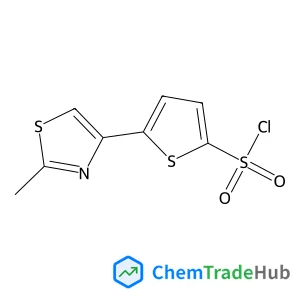
5-(2-Methyl-1,3-thiazol-4-yl)-2-thiophenesulfonyl chloride
CAS Number:
215434-25-6
Molecular Formula:
C8H6ClNO2S3
![4-{[4-(Trifluoromethoxy)benzyl]oxy}benzonitrile structure](https://static.chemtradehub.com/structs/103/1036629-63-6-2172.webp "4-{[4-(Trifluoromethoxy)benzyl]oxy}benzonitrile structure")
4-{[4-(Trifluoromethoxy)benzyl]oxy}benzonitrile
CAS Number:
1036629-63-6
Molecular Formula:
C15H10F3NO2
Recommended Suppliers




Disclaimer
This page provides academic journal information for reference and research purposes only. We are not affiliated with any journal publishers and do not handle publication submissions. For publication-related inquiries, please contact the respective journal publishers directly.
If you notice any inaccuracies in the information displayed, please contact us at support@chemtradehub.com. We will promptly review and address your concerns.