












Photo-induced copper mediated copolymerization of activated-ester methacrylate polymers and their use as reactive precursors to prepare multi-dentate ligands for the water transfer of inorganic nanoparticles
Literature Information
Publication Date
2020-03-19
DOI
10.1039/D0PY00212G
Impact Factor
5.582
Authors
Binh T. Mai, Markus J. Barthel, Aidin Lak, Tommaso Avellini, Ana Maria Panaite, Emille M. Rodrigues, Luca Goldoni, Teresa Pellegrino
View Original
Abstract
Multi-dentate ligands enabling a quick and high yield water transfer of inorganic nanocrystals (NCs) via a ligand exchange process is of great interest to promote the applications of NCs in the biomedical field. Here, we describe a facile two-step protocol for the synthesis of polymeric multi-dentate ligands that are suitable for the water transfer of hydrophobic colloidal inorganic nanocrystals (NCs). This protocol first exploits the photo-induced atom transfer radical (photo-ATRP) copolymerization of ester-activated N-succinimidyl methacrylate and oligoethylene glycol methyl ether methacrylate. A high monomer conversion rate along with a fair control over the polymerization is confirmed by size exclusion chromatography and nuclear magnetic resonance spectroscopy. In the second step, the activated carboxyl moieties of the copolymers are reacted with nucleophilic agents such as 2-aminoethylphosphonic acid or histamine dihydrochloride via a post-polymerization reaction to generate phosphonic- or amino-based multi-dentate ligands, respectively. As shown here, polymers comprising poly-phosphonic acid moieties are suitable as multi-dentate ligands for water transfer of multiple varieties of NCs with distinct compositions including iron oxide nanoparticles, CdSe@CdS quantum dots (QDs) and up-converting nanoparticles (UCNPs). Meanwhile the polymers containing histamine groups are also able to strongly coordinate to the surface of semiconductor QDs, thus enabling their water transfer. Notably, the NCs exhibit long-term stability in physiological media (saline) upon water transfer, while their size, shape, magnetic properties, and optical properties were also maintained. The UCNPs could be imaged when excited under an infrared laser while the QDs show a bright fluorescence signal under UV irradiation. QDs coated with a poly-phosphonic acid-based ligand resulted in a more homogeneous coating as demonstrated by the narrow band on gel electrophoresis, along with a higher quantum yield (QY ∼48%) in comparison with the polyimidazole-based ones (QY ∼31%). The aqueous IONPs instead were proven to provide a transversal relaxation making them useful as contrast agents in magnetic resonance imaging. The water transfer procedure is straightforward thanks to the full solubility of the amphiphilic polymer in the NC chloroform solution. This enables the right interaction between the anchoring moieties on the polymer chains and the surface of NCs, thus replacing the surfactant molecules. The gram scale production of the polymer together with the very simple steps of the water transfer protocol enables a quick translation of the protocol for large scale production of aqueous stabilized nanoparticles.
Related Literature
Retraction: MicroRNA-451 blockade promotes osteoblastic differentiation and skeletal anabolic effects by promoting YWHAZ-mediated RUNX2 protein stabilization
2021-01-26
Retraction
DOI: 10.1039/D1MD90001C
Selective degradation-inducing probes for studying cereblon (CRBN) biology
2021-07-06
Research Article
DOI: 10.1039/D0MD00382D
Recent developments on MOF-based platforms for antibacterial therapy
Yiwei Liu, Luyi Zhou, Ying Dong, Rui Wang, Ying Pan, Shuze Zhuang, Dong Liu, Jianqiang Liu
2021-04-09
Review Article
DOI: 10.1039/D0MD00416B
Structure-based design of haloperidol analogues as inhibitors of acetyltransferase Eis from Mycobacterium tuberculosis to overcome kanamycin resistance
Ankita Punetha, Keith D. Green, Atefeh Garzan, Nishad Thamban Chandrika, Melisa J. Willby, Allan H. Pang, Caixia Hou, Selina Y. L. Holbrook, Kyle Krieger, James E. Posey, Tanya Parish, Oleg V. Tsodikov, Sylvie Garneau-Tsodikova
2021-10-05
Research Article
DOI: 10.1039/D1MD00239B
Ruthenium(ii)–arene complexes as anti-metastatic agents, and related techniques
Chanchal Sonkar, Sayantan Sarkar
2021-09-15
Review Article
DOI: 10.1039/D1MD00220A
Cucurbit[8]uril-based supramolecular hydrogels for biomedical applications
Zeyu Wang, Mingju Shui, Ian W. Wyman, Qing-Wen Zhang, Ruibing Wang
2021-03-10
Review Article
DOI: 10.1039/D1MD00019E
Comprehensive overview of biased pharmacology at the opioid receptors: biased ligands and bias factors‡
Jolien De Neve, Thomas M. A. Barlow, Dirk Tourwé, Frédéric Bihel, Frédéric Simonin, Steven Ballet
2021-04-21
Review Article
DOI: 10.1039/D1MD00041A
Design, synthesis, crystal structure and anti-plasmodial evaluation of tetrahydrobenzo[4,5]thieno[2,3-d]pyrimidine derivatives
Kavita Pal, Md Kausar Raza, Jenny Legac, Md. Ataur Rahman, Shoaib Manzoor, Philip J. Rosenthal, Nasimul Hoda
2021-05-18
Research Article
DOI: 10.1039/D1MD00038A
You might also like
Compound Q&A
How should waste containing 6-Chloro-5-(2'-hydroxy-3'-methoxy-4-biphenylyl)-3-(3-methoxyphenyl)-1H-pyrrolo[3,2-d]pyrimidine-2,4(3H,5H)-dione (CAS: 1346607-05-3) be handled?
Waste containing 6-Chloro-5-(2'-hydroxy-3'-methoxy-4-biphenylyl)-3-(3-methoxyphe...
1346607-05-36-Chloro-5-(2'-hydro...
Compound Q&A
What are the main uses of (3alpha,5alpha)-3-Hydroxypregnane-11,20-dione (CAS: 23930-19-0)?
(3alpha,5alpha)-3-Hydroxypregnane-11,20-dione is primarily used in the pharmaceu...
23930-19-0(3alpha,5alpha)-3-Hy...
Compound Q&A
What is the market or research trend for 4-Amino-6-chloro-2-pyridinecarboxylic acid (CAS: 546141-56-4)?
The market for 4-Amino-6-chloro-2-pyridinecarboxylic acid (CAS: 546141-56-4) is ...
546141-56-44-Amino-6-chloro-2-p...
Compound Q&A
Are there alternatives to (2-Benzoylethyl)trimethylammonium chloride (CAS: 24472-88-6) in synthesis?
Alternatives to (2-Benzoylethyl)trimethylammonium chloride (CAS: 24472-88-6) in ...
24472-88-6(2-Benzoylethyl)trim...
Compound Q&A
Is N-[4-Nitro-3-(trifluoromethyl)phenyl]acetamide (CAS: 393-12-4) safe?
N-[4-Nitro-3-(trifluoromethyl)phenyl]acetamide (CAS: 393-12-4) is generally safe...
393-12-4N-[4-Nitro-3-(triflu...
Compound Q&A
Are there alternatives to [(4R,5R,6S)-5-hydroxy-10-imino-3,7-dioxa-1,9-diazatricyclo[6.4.0.02,6]dodeca-8,11-dien-4-yl]methyl dihydrogen phosphate (CAS: 39679-56-6) in synthesis?
Alternative reagents such as other phosphates or similar functional groups can b...
39679-56-6[(4R,5R,6S)-5-hydrox...
Compound Q&A
Are there alternatives to N,N'-Bis(3-aminopropyl)-1,3-propanediamine (CAS: 4605-14-5) in synthesis?
There are alternatives to N,N'-Bis(3-aminopropyl)-1,3-propanediamine (CAS: 4605-...
4605-14-5N,N'-Bis(3-aminoprop...
Compound Q&A
What precautions should be taken when handling Aluminium trihexadecanoate (CAS: 555-35-1)?
When handling Aluminium trihexadecanoate, it is important to use appropriate per...
555-35-1Aluminium trihexadec...
Compound Q&A
What is (1,1-Dioxido-3-oxo-1,2-benzothiazol-2(3H)-yl)acetic acid (CAS: 52188-11-1)?
(1,1-Dioxido-3-oxo-1,2-benzothiazol-2(3H)-yl)acetic acid is a chemical compound ...
52188-11-1(1,1-Dioxido-3-oxo-1...
Compound Q&A
Are there alternatives to 5,5-dimethyloxolan-2-one (CAS: 3123-97-5) in synthesis?
Several alternatives to 5,5-dimethyloxolan-2-one (CAS: 3123-97-5) can be used in...
3123-97-55,5-dimethyloxolan-2...
Source Journal
Polymer Chemistry

CiteScore:
8.6
Self-citation Rate:
7.3%
Articles per Year:
457
Polymer Chemistry welcomes submissions in all areas of polymer science that have a strong focus on macromolecular chemistry. Manuscripts may cover a broad range of fields, yet no direct application focus is required.
Recommended Compounds
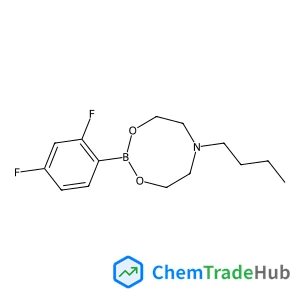
6-Butyl-2-(2,4-difluorophenyl)-1,3,6,2-dioxazaborocane
CAS Number:
1190988-98-7
Molecular Formula:
C14H20BF2NO2
![2-Methyl-2-propanyl [2-(2-oxa-6-azaspiro[3.3]hept-6-yl)ethyl]carbamate structure](https://static.chemtradehub.com/structs/141/1415562-38-7-c0a4.webp "2-Methyl-2-propanyl [2-(2-oxa-6-azaspiro[3.3]hept-6-yl)ethyl]carbamate structure")
2-Methyl-2-propanyl [2-(2-oxa-6-azaspiro[3.3]hept-6-yl)ethyl]carbamate
CAS Number:
1415562-38-7
Molecular Formula:
C12H22N2O3
Recommended Suppliers




Disclaimer
This page provides academic journal information for reference and research purposes only. We are not affiliated with any journal publishers and do not handle publication submissions. For publication-related inquiries, please contact the respective journal publishers directly.
If you notice any inaccuracies in the information displayed, please contact us at support@chemtradehub.com. We will promptly review and address your concerns.