












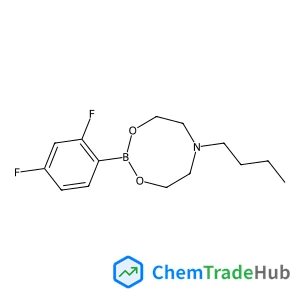
6-Butyl-2-(2,4-difluorophenyl)-1,3,6,2-dioxazaborocane
CAS Number:
1190988-98-7
Molecular Formula:
C14H20BF2NO2
Alex J. Anderson, Heidi R. Culver
An approach to efficient and scalable production of oligonucleotide-based gel networks is presented. Specifically, a new class of xenonucleic acid (XNA) synthesized through a scalable and efficient thiol–ene polymerization mechanism, “clickable” nucleic acids (CNAs), were conjugated to a multifunctional poly(ethylene glycol), PEG. In the presence of complementary single stranded DNA (ssDNA), the macromolecular conjugate assembled into a crosslinked 3D gel capable of achieving storage moduli on the order of 1 kPa. Binding studies between the PEG-CNA macromolecule and complementary ssDNA indicate that crosslinking is due to the CNA/DNA interaction. Gel formation was specific to the base sequence and length of the ssDNA crosslinker. The gels were fully thermoreversible, completely melting at temperatures above 60 °C and re-forming upon cooling over multiple cycles and with no apparent hysteresis. Shear stress relaxation experiments revealed that relaxation dynamics are dependent on crosslinker length, which is hypothesized to be an effect of the polydisperse CNA chains. Arrhenius analysis of characteristic relaxation times was only possible for shorter crosslinker lengths, and the activation energy for these gels was determined to be 110 ± 20 kJ mol−1. Overall, the present work demonstrates that CNA is capable of participating in stimuli-responsive interactions that would be expected from XNAs, and that these interactions support 3D gels that have potential uses in biological and materials science applications.
Atukuri Dorababu
DOI: 10.1039/D0MD00288G
Susanne Müller, Suzanne Ackloo, Arij Al Chawaf, Hartmut Beck, Shaunna Beedie, Ulrich A. K. Betz, Gustavo Arruda Bezerra, Paul E. Brennan, David Brown, Peter J. Brown, Alex N. Bullock, Adrian J. Carter, Apirat Chaikuad, Mathilde Chaineau, Alessio Ciulli, Ian Collins, Jan Dreher, Kristina Edfeldt, Aled M. Edwards, Ursula Egner, Stephen M. Fuchs, Matthew D. Hall, Ingo V. Hartung, Alexander Hillisch, Stephen H. Hitchcock, Evert Homan, Natarajan Kannan, James R. Kiefer, Stefan Knapp, Milka Kostic, Stefan Kubicek, Andrew R. Leach, Sven Lindemann, Hisanori Matsui, Jordan L. Meier, Maurice Michel, Maxwell R. Morgan, Anke Mueller-Fahrnow, Dafydd R. Owen, Benjamin G. Perry, Saul H. Rosenberg, Kumar Singh Saikatendu, Cora Scholten, Sujata Sharma, Anton Simeonov, Michael Sundström, Matthew H. Todd, Claudia Tredup, Timothy M. Willson, Georg E. Winter
DOI: 10.1039/D1MD00228G
Ingrid Allart-Simon, Aurélie Moniot, Nicolo Bisi, Miguel Ponce-Vargas, Sandra Audonnet, Marie Laronze-Cochard, Janos Sapi, Eric Hénon, Frédéric Velard, Stéphane Gérard
DOI: 10.1039/D0MD00423E
Deepender Kaushik, Arshpreet Kaur
DOI: 10.1039/D1MD00031D
Zhichang Zhao, Yeming Wang, Hong Yan, Juan Wang
DOI: 10.1039/D1MD00128K
DOI: 10.1039/D1MD00022E
Huihui Yang
DOI: 10.1039/D1MD00066G
Winnie Deuther-Conrad, Daniel Diez-Iriepa, Isabel Iriepa, Francisco López-Muñoz, María Angeles Martínez-Grau, Michael Gütschow, José Marco-Contelles
DOI: 10.1039/D1MD00105A
Ankita Punetha, Keith D. Green, Atefeh Garzan, Nishad Thamban Chandrika, Melisa J. Willby, Allan H. Pang, Caixia Hou, Selina Y. L. Holbrook, Kyle Krieger, James E. Posey, Tanya Parish, Oleg V. Tsodikov, Sylvie Garneau-Tsodikova
DOI: 10.1039/D1MD00239B
Waste containing 6-Chloro-5-(2'-hydroxy-3'-methoxy-4-biphenylyl)-3-(3-methoxyphe...
(3alpha,5alpha)-3-Hydroxypregnane-11,20-dione is primarily used in the pharmaceu...
The market for 4-Amino-6-chloro-2-pyridinecarboxylic acid (CAS: 546141-56-4) is ...
Alternatives to (2-Benzoylethyl)trimethylammonium chloride (CAS: 24472-88-6) in ...
N-[4-Nitro-3-(trifluoromethyl)phenyl]acetamide (CAS: 393-12-4) is generally safe...
Alternative reagents such as other phosphates or similar functional groups can b...
There are alternatives to N,N'-Bis(3-aminopropyl)-1,3-propanediamine (CAS: 4605-...
When handling Aluminium trihexadecanoate, it is important to use appropriate per...
(1,1-Dioxido-3-oxo-1,2-benzothiazol-2(3H)-yl)acetic acid is a chemical compound ...
Several alternatives to 5,5-dimethyloxolan-2-one (CAS: 3123-97-5) can be used in...

Polymer Chemistry welcomes submissions in all areas of polymer science that have a strong focus on macromolecular chemistry. Manuscripts may cover a broad range of fields, yet no direct application focus is required.
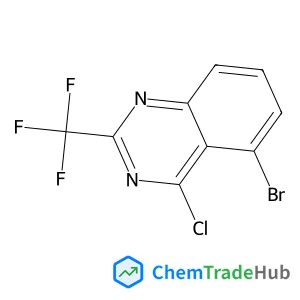
![2-Methyl-2-propanyl (2E)-5-chloro-2-[3-methoxy-4-(4-methyl-1H-imidazol-1-yl)benzylidene]pentanoate structure](https://static.chemtradehub.com/structs/122/1225232-42-7-ee03.webp "2-Methyl-2-propanyl (2E)-5-chloro-2-[3-methoxy-4-(4-methyl-1H-imidazol-1-yl)benzylidene]pentanoate structure")
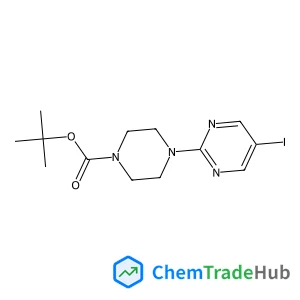
![1-(2-Chlorophenyl)-6-[(2S)-3,3,3-trifluoro-2-methylpropyl]-1,7-dihydro-4H-pyrazolo[3,4-d]pyrimidin-4-one structure](https://static.chemtradehub.com/structs/794/794568-91-5-0c34.webp "1-(2-Chlorophenyl)-6-[(2S)-3,3,3-trifluoro-2-methylpropyl]-1,7-dihydro-4H-pyrazolo[3,4-d]pyrimidin-4-one structure")




