












Structural evolution of toll-like receptor 7/8 agonists from imidazoquinolines to imidazoles
Literature Information
Publication Date
2021-05-14
DOI
10.1039/D1MD00031D
Impact Factor
0
Authors
Deepender Kaushik, Arshpreet Kaur
View Original
Abstract
Several synthetic heterocyclic small molecules like imiquimod, resiquimod, CL097, CL075, bromopirone, tilorone, loxoribine and isatoribine demonstrated TLR7/8 agonistic activity and relatively modest structural changes in such molecules result in major variation in the TLR7 and/or TLR8 activity. A strict dependency of the electronic configuration of the heterocyclic system was also observed to influence the agonistic activity. In the present review, an evolution of imidazole based TLR7/8 agonist from imidazoquinoline based scaffold is delineated along with the elaboration of detailed structure activity relationship (SAR) in each chemotype. The structural and activity details of not only the active compounds but also the related inactive compounds are included to better understand the SAR. TLR7/8 agonists are emerging as promising vaccine adjuvant candidates and the present SAR and structural information will provide a road map towards the identification of more potent and appropriate candidates for further drug discovery.
Related Literature
A ratiometric solvent polarity sensing Schiff base molecule for estimating the interfacial polarity of versatile amphiphilic self-assemblies
Rini Majumder, Yeasmin Sarkar, Suresh K. Jewrajka, Ambarish Ray, Partha Pratim Parui
2016-05-04
Communication
DOI: 10.1039/C6AN00582A
Effects of surface treatments on trapping with DC insulator-based dielectrophoresis
Claire V. Crowther, Viola Sanderlin, Mark A. Hayes, Gillian H. Gile
2019-11-05
Paper
DOI: 10.1039/C9AN01186B
Voltammetric detection of glutathione: an adsorptive stripping voltammetry approach
Madalena C. C. Areias, Kenichi Shimizu, Richard G. Compton
2016-04-01
Paper
DOI: 10.1039/C6AN00550K
A one-step colorimetric acid–base titration sensor using a complementary color changing coordination system
Hui Hun Cho, Si Hyun Kim, Jun Hyuk Heo, Young Eel Moon, Young Hun Choi, Dong Cheol Lim, Kwon-Hoon Han
2016-04-21
Paper
DOI: 10.1039/C6AN00744A
The origin of the band at around 730 cm−1 in the SERS spectra of bacteria: a stable isotope approach
Patrick Kubryk, Reinhard Niessner, Natalia P. Ivleva
2016-04-20
Communication
DOI: 10.1039/C6AN00306K
Feature engineering applied to intraoperative in vivo Raman spectroscopy sheds light on molecular processes in brain cancer: a retrospective study of 65 patients
Rajeev Yadav, Rajeev Agarwal, Samuel Kadoury, Dominique Trudel, Marie-Christine Guiot, Kevin Petrecca
2019-10-15
Communication
DOI: 10.1039/C9AN01144G
A carbon dot-based fluorescent nanoprobe for the associated detection of iron ions and the determination of the fluctuation of ascorbic acid induced by hypoxia in cells and in vivo
Qi Kang, Dazhong Shen, Yunqing Wang
2019-09-27
Paper
DOI: 10.1039/C9AN01694E
A rhodol-hemicyanine based ratiometric fluorescent probe for real-time monitoring of glutathione dynamics in living cells
Minghao Ren, Linfang Wang, Xin Lv, Yuanqiang Sun, Hu Chen, Keyuan Zhang, Qi Wu, Yurong Bai, Wei Guo
2019-11-01
Paper
DOI: 10.1039/C9AN01852B
Metabolomics for improved treatment monitoring of phenylketonuria: urinary biomarkers for non-invasive assessment of dietary adherence and nutritional deficiencies
Jennifer Wild, Meera Shanmuganathan, Mika Hayashi, Murray Potter
2019-10-03
Paper
DOI: 10.1039/C9AN01642B
Biosensor surface functionalization by a simple photochemical immobilization of antibodies: experimental characterization by mass spectrometry and surface enhanced Raman spectroscopy
Bartolomeo Della Ventura, Martina Banchelli, Riccardo Funari, Anna Illiano, Marella De Angelis, Paola Taroni, Angela Amoresano, Paolo Matteini, Raffaele Velotta
2019-10-10
Paper
DOI: 10.1039/C9AN00443B
You might also like
Compound Q&A
How should waste containing 6-Chloro-5-(2'-hydroxy-3'-methoxy-4-biphenylyl)-3-(3-methoxyphenyl)-1H-pyrrolo[3,2-d]pyrimidine-2,4(3H,5H)-dione (CAS: 1346607-05-3) be handled?
Waste containing 6-Chloro-5-(2'-hydroxy-3'-methoxy-4-biphenylyl)-3-(3-methoxyphe...
1346607-05-36-Chloro-5-(2'-hydro...
Compound Q&A
What are the main uses of (3alpha,5alpha)-3-Hydroxypregnane-11,20-dione (CAS: 23930-19-0)?
(3alpha,5alpha)-3-Hydroxypregnane-11,20-dione is primarily used in the pharmaceu...
23930-19-0(3alpha,5alpha)-3-Hy...
Compound Q&A
What is the market or research trend for 4-Amino-6-chloro-2-pyridinecarboxylic acid (CAS: 546141-56-4)?
The market for 4-Amino-6-chloro-2-pyridinecarboxylic acid (CAS: 546141-56-4) is ...
546141-56-44-Amino-6-chloro-2-p...
Compound Q&A
Are there alternatives to (2-Benzoylethyl)trimethylammonium chloride (CAS: 24472-88-6) in synthesis?
Alternatives to (2-Benzoylethyl)trimethylammonium chloride (CAS: 24472-88-6) in ...
24472-88-6(2-Benzoylethyl)trim...
Compound Q&A
Is N-[4-Nitro-3-(trifluoromethyl)phenyl]acetamide (CAS: 393-12-4) safe?
N-[4-Nitro-3-(trifluoromethyl)phenyl]acetamide (CAS: 393-12-4) is generally safe...
393-12-4N-[4-Nitro-3-(triflu...
Compound Q&A
Are there alternatives to [(4R,5R,6S)-5-hydroxy-10-imino-3,7-dioxa-1,9-diazatricyclo[6.4.0.02,6]dodeca-8,11-dien-4-yl]methyl dihydrogen phosphate (CAS: 39679-56-6) in synthesis?
Alternative reagents such as other phosphates or similar functional groups can b...
39679-56-6[(4R,5R,6S)-5-hydrox...
Compound Q&A
Are there alternatives to N,N'-Bis(3-aminopropyl)-1,3-propanediamine (CAS: 4605-14-5) in synthesis?
There are alternatives to N,N'-Bis(3-aminopropyl)-1,3-propanediamine (CAS: 4605-...
4605-14-5N,N'-Bis(3-aminoprop...
Compound Q&A
What precautions should be taken when handling Aluminium trihexadecanoate (CAS: 555-35-1)?
When handling Aluminium trihexadecanoate, it is important to use appropriate per...
555-35-1Aluminium trihexadec...
Compound Q&A
What is (1,1-Dioxido-3-oxo-1,2-benzothiazol-2(3H)-yl)acetic acid (CAS: 52188-11-1)?
(1,1-Dioxido-3-oxo-1,2-benzothiazol-2(3H)-yl)acetic acid is a chemical compound ...
52188-11-1(1,1-Dioxido-3-oxo-1...
Compound Q&A
Are there alternatives to 5,5-dimethyloxolan-2-one (CAS: 3123-97-5) in synthesis?
Several alternatives to 5,5-dimethyloxolan-2-one (CAS: 3123-97-5) can be used in...
3123-97-55,5-dimethyloxolan-2...
Source Journal
Recommended Compounds
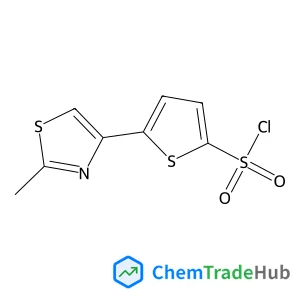
5-(2-Methyl-1,3-thiazol-4-yl)-2-thiophenesulfonyl chloride
CAS Number:
215434-25-6
Molecular Formula:
C8H6ClNO2S3
![2-Methyl-2-propanyl [2-(2-oxa-6-azaspiro[3.3]hept-6-yl)ethyl]carbamate structure](https://static.chemtradehub.com/structs/141/1415562-38-7-c0a4.webp "2-Methyl-2-propanyl [2-(2-oxa-6-azaspiro[3.3]hept-6-yl)ethyl]carbamate structure")
2-Methyl-2-propanyl [2-(2-oxa-6-azaspiro[3.3]hept-6-yl)ethyl]carbamate
CAS Number:
1415562-38-7
Molecular Formula:
C12H22N2O3
Recommended Suppliers




Disclaimer
This page provides academic journal information for reference and research purposes only. We are not affiliated with any journal publishers and do not handle publication submissions. For publication-related inquiries, please contact the respective journal publishers directly.
If you notice any inaccuracies in the information displayed, please contact us at support@chemtradehub.com. We will promptly review and address your concerns.