













A base-promoted tandem approach to bicyclic 8-membered ring ketones
Literature Information
Publication Date
2020-04-13
DOI
10.1039/D0OB00618A
Impact Factor
3.876
Authors
Emerson E. F. dos Santos, Gabriela F. P. de Souza, Deborah A. Simoni, Airton G. Salles, Jr
View Original
Abstract
A base-promoted tandem route toward unprecedented bicyclic 8-membered ring ketones is reported. Under our approach, the targeted products are delivered in high yields from phenylacetylenes and 1,3-diketones. The method has a good scope and gives access to a complex structure that offers a wealth of opportunities for further functionalization.
Related Literature
Uptake and reaction of HOI and IONO2 on frozen and dry NaCl/NaBr surfaces and H2SO4
Nicholas S. Holmes, Jonathan W. Adams, John N. Crowley
2001-03-29
Paper
DOI: 10.1039/B100247N
ATR-IR spectroscopy at the metal–liquid interface: influence of film properties on anomalous band-shape
2001-05-11
Paper
DOI: 10.1039/B101218P
A hybrid approach of the multi-configuration time-dependent Hartree and filter-diagonalisation methods for computing bound-state spectra. Application to HO2
F. Gatti, M. H. Beck, G. A. Worth, H.-D. Meyer
2001-03-27
Paper
DOI: 10.1039/B009949J
Spectroscopy of ozone at the dissociation threshold: Quantum calculations of bound and resonance states on a new global potential energy surface
Martina Bittererová
2001-04-20
Communication
DOI: 10.1039/B102830H
The effect of gravity on the rate of a simple liquid-state reaction in a small, unstirred cylindrical vessel
David F. Fletcher
2001-03-27
Paper
DOI: 10.1039/B100542L
Synthesis and anionic polymerization of isosorbide mono-epoxides for linear biobased polyethers
Livia Matt, Ilme Liblikas, Olivier Bonjour, Lauri Vares
2021-10-12
Communication
DOI: 10.1039/D1PY00687H
Phase equilibria of water in cylindrical nanopores
Ivan Brovchenko, Alfons Geiger, Alla Oleinikova
2001-04-05
Communication
DOI: 10.1039/B100922M
Progress, challenges and future directions of heterocycles as building blocks in iterative methodologies towards sequence-defined oligomers and polymers
Stephen A. Hill, Robert Steinfort, Laura Hartmann
2021-07-14
Review Article
DOI: 10.1039/D1PY00425E
Effects of rhodium dispersion on catalytic behavior of Rh/active-carbon catalysts for H/D exchange reaction between CH4 and D2
Hirotoshi Sakagami, Shingo Ogata, Nobuo Takahashi, Takeshi Matsuda
2001-04-05
Paper
DOI: 10.1039/B100687H
You might also like
Compound Q&A
What regulatory guidelines apply to 6-Bromo-2-methylimidazo[1,2-a]pyrimidine (CAS: 1111638-05-1)?
6-Bromo-2-methylimidazo[1,2-a]pyrimidine (CAS: 1111638-05-1) falls under various...
1111638-05-16-Bromo-2-methylimid...
Compound Q&A
Are there alternatives to 1-Pyrrolidineethanol, β-methyl-α-phenyl-, (αS,βR) (CAS: 123620-80-4) in synthesis?
While there are no direct alternatives, similar compounds like 1-Pyrrolidineetha...
123620-80-41-Pyrrolidineethanol...
Compound Q&A
Is 4-Methyl-2,6-bis(2-methyl-2-propanyl)phenyl methylcarbamate (CAS: 1918-11-2) safe?
4-Methyl-2,6-bis(2-methyl-2-propanyl)phenyl methylcarbamate (CAS: 1918-11-2) is ...
1918-11-24-Methyl-2,6-bis(2-m...
Compound Q&A
How should 2-(3-Bromo-4-fluorophenyl)-1,3-dioxolane (CAS: 77771-04-1) be stored?
2-(3-Bromo-4-fluorophenyl)-1,3-dioxolane (CAS: 77771-04-1) should be stored in a...
77771-04-12-(3-Bromo-4-fluorop...
Compound Q&A
What are the physical and chemical properties of 4,5,6,7-Tetrahydro-1H-indazole hydrochloride (CAS: 18161-11-0)?
4,5,6,7-Tetrahydro-1H-indazole hydrochloride is a white crystalline solid with a...
18161-11-04,5,6,7-Tetrahydro-1...
Compound Q&A
What is (2R)-1-Methoxy-3-phenyl-2-propanamine (CAS: 59919-07-2)?
(2R)-1-Methoxy-3-phenyl-2-propanamine is a chiral organic compound with the CAS ...
59919-07-2(2R)-1-Methoxy-3-phe...
Compound Q&A
What industries use Ethyl 1-(1-phenylethyl)-1H-imidazole-5-carboxylate (CAS: 56649-47-9)?
Ethyl 1-(1-phenylethyl)-1H-imidazole-5-carboxylate is used in various industries...
56649-47-9Ethyl 1-(1-phenyleth...
Compound Q&A
What regulatory guidelines apply to 4-[(1E,3S)-1-(4-Hydroxyphenyl)-1,4-pentadien-3-yl]phenol (CAS: 17676-24-3)?
4-[(1E,3S)-1-(4-Hydroxyphenyl)-1,4-pentadien-3-yl]phenol (CAS: 17676-24-3) falls...
17676-24-34-[(1E,3S)-1-(4-Hydr...
Compound Q&A
What industries use (S)-3-Amino-5-phenylpentanoic acid hydrochloride (CAS: 331846-97-0)?
(S)-3-Amino-5-phenylpentanoic acid hydrochloride is primarily used in the pharma...
331846-97-0(S)-3-Amino-5-phenyl...
Compound Q&A
How is 7-methoxy-1-benzothiophene-2-carboxylic acid (CAS: 88791-07-5) typically synthesized?
7-Methoxy-1-benzothiophene-2-carboxylic acid is typically synthesized by reactin...
88791-07-57-methoxy-1-benzothi...
Source Journal
Organic & Biomolecular Chemistry

CiteScore:
3.4
Self-citation Rate:
10.3%
Articles per Year:
1041
Organic & Biomolecular Chemistry (OBC) publishes original and high impact research and reviews in organic chemistry. We welcome research that shows new or significantly improved protocols or methodologies in total synthesis, synthetic methodology or physical and theoretical organic chemistry as well as research that shows a significant advance in the organic chemistry or molecular design aspects of chemical biology, catalysis, supramolecular and macromolecular chemistry, theoretical chemistry, mechanism-oriented physical organic chemistry, medicinal chemistry or natural products. Articles published in the journal should report new work which makes a highly-significant impact in the field. Routine and incremental work is generally not suitable for publication in the journal. More details about key areas of our scope are below. In all cases authors should include in their article clear rationale for why their research has been carried out.
Recommended Compounds

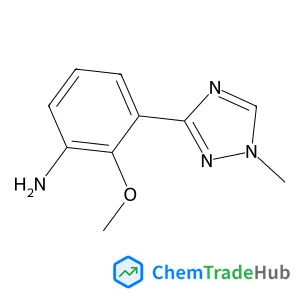
2-Methoxy-3-(1-methyl-1H-1,2,4-triazol-3-yl)aniline
CAS Number:
1609394-10-6
Molecular Formula:
C10H12N4O
Recommended Suppliers







Disclaimer
This page provides academic journal information for reference and research purposes only. We are not affiliated with any journal publishers and do not handle publication submissions. For publication-related inquiries, please contact the respective journal publishers directly.
If you notice any inaccuracies in the information displayed, please contact us at support@chemtradehub.com. We will promptly review and address your concerns.