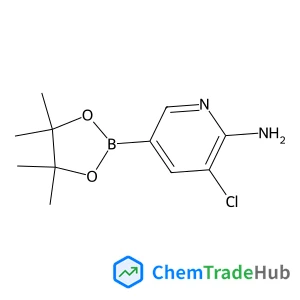
3-Chloro-5-(4,4,5,5-tetramethyl-1,3,2-dioxaborolan-2-yl)-2-pyridinamine
CAS Number:
1032758-99-8
Molecular Formula:
C11H16BClN2O2
Jun Wang
A key challenge in carrying out an efficient oxygen reduction reaction (ORR) is the design of a highly efficient electrocatalyst that must have fast kinetics, low cost and high stability for use in an energy-conversion device (e.g. metal–air batteries). Herein, we developed a platinum-free ORR electrocatalyst with a high surface area and pore volume via a molten salt method along with subsequent KOH activation. The activation treatment not only increases the surface area to 940.8 m2 g−1 by generating lots of pores, but also promotes the formation of uniform Fe3C nanoclusters within the atomic dispersed Fe–Nx carbon matrix in the final material (A-FeNC). A-FeNC displays excellent activity and long-term stability for the ORR in alkaline media, and shows a greater half-wave potential (0.85 V) and faster kinetics toward four-electron ORR as compared to those of 20 wt% Pt/C (0.83 V). As a cathode catalyst for the Zn–air battery, A-FeNC presents a peak power density of 102.2 mW cm−2, higher than that of the Pt/C constructed Zn–air battery (57.2 mW cm−2). The superior ORR catalytic performance of A-FeNC is ascribed to the increased exposure of active sites, active single-atom Fe–N–C centers, and enhancement by Fe3C nanoclusters.
Jinpeng Lv, Xingji Li
DOI: 10.1039/C8CP01855C
Tak-San Ho, Herschel Rabitz
DOI: 10.1039/C8CP00231B
Morten Lund Rasmussen, Hamid Hashemi, Hao Wu, Peter Glarborg, Matteo Pelucchi, Tiziano Faravelli, Paul Marshall
DOI: 10.1039/C7CP07552A
Michael Eikerling
DOI: 10.1039/C8CP01315B
Alexander Schmid, Ghislain M. Rupp, Jürgen Fleig
DOI: 10.1039/C7CP07845E
Mantas Šimėnas, Aneta Ciupa, Gediminas Usevičius, Kęstutis Aidas, Daniel Klose, Gunnar Jeschke, Mirosław Mączka, Georg Völkel, Andreas Pöppl, Jūras Banys
DOI: 10.1039/C8CP01426D
M. Allan, M. Lacko, P. Papp, Š. Matejčík, M. Zlatar, I. I. Fabrikant, J. Kočišek, J. Fedor
DOI: 10.1039/C8CP01387J
Y. R. Guo, F. Dong, C. Qiao, J. J. Wang, Ming Xu, Y. X. Zheng, R. J. Zhang, L. Y. Chen, C. Z. Wang, K. M. Ho
DOI: 10.1039/C8CP00142A
Xiao Ling, Katrin F. Domke, Sapun H. Parekh
DOI: 10.1039/C8CP01625A
This compound is mainly used as an intermediate in the synthesis of antipsychoti...
Waste containing 1-(D-Ribofuranosyl)-1,4-dihydro-3-pyridinecarboxamide (CAS: 191...
2-Methyl-2-propanyl 3-bromo-3-(hydroxymethyl)-1-azetidinecarboxylate (CAS: 20079...
N-(4-Chloro-2-pyridinyl)acetamide (CAS: 245056-66-0) is a chemical compound with...
5-Chloro-2-hydroxybenzoic acid, also known as 5-chlorosalicylic acid, is an arom...
When handling 1,1-Dichloro-1-fluoroethane (CAS: 1717-00-6), it is important to u...
Fmoc-(2S,3R)-3-phenylpyrrolidine-2-carboxylic acid is a white crystalline solid ...
4-Amino-5-bromo-2-pyridinecarboxylic acid is primarily used as a precursor in th...
Handling this compound should be done with personal protective equipment (PPE) i...
When handling 8-bromo-2,2-dimethyl-3,4-dihydro-2H-1,4-benzoxazin-3-one, use prop...

Physical Chemistry Chemical Physics (PCCP) is an international journal co-owned by 19 physical chemistry and physics societies from around the world. This journal publishes original, cutting-edge research in physical chemistry, chemical physics and biophysical chemistry. To be suitable for publication in PCCP, articles must include significant innovation and/or insight into physical chemistry; this is the most important criterion that reviewers and Editors will judge against when evaluating submissions. The journal has a broad scope and welcomes contributions spanning experiment, theory, computation and data science. Topical coverage includes spectroscopy, dynamics, kinetics, statistical mechanics, thermodynamics, electrochemistry, catalysis, surface science, quantum mechanics, quantum computing and machine learning. Interdisciplinary research areas such as polymers and soft matter, materials, nanoscience, energy, surfaces/interfaces, and biophysical chemistry are welcomed if they demonstrate significant innovation and/or insight into physical chemistry. Joined experimental/theoretical studies are particularly appreciated when complementary and based on up-to-date approaches.