












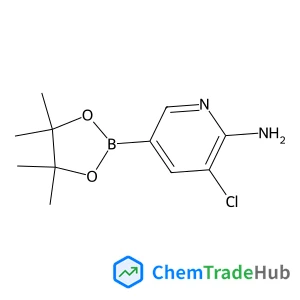
3-Chloro-5-(4,4,5,5-tetramethyl-1,3,2-dioxaborolan-2-yl)-2-pyridinamine
CAS Number:
1032758-99-8
Molecular Formula:
C11H16BClN2O2
Mohini Guleria, Rohit Sharma, Jeyachitra Amirdhanayagam, Haladhar D. Sarma, Venkatesh Rangarajan
Trastuzumab (Herceptin®) is an approved immunotherapeutic agent used for the treatment of metastatic breast cancer over-expressing HER2 antigen receptors. The aim of the present work is to standardize the formulation protocol of [177Lu]Lu-trastuzumab addressing various reaction parameters, evaluating the efficacy of the radiolabeled product by in vitro investigations, scaling-up the preparation for administration in patients and performing preliminary clinical studies in patients suffering from metastatic breast cancer. Trastuzumab was conjugated with a suitable bi-functional chelating agent namely, p-NCS-benzyl-DOTA. On average 6.15 ± 0.92 p-NCS-benzyl-DOTA molecules were observed to be attached to each trastuzumab moiety. [177Lu]Lu-trastuzumab could be prepared with >95% radiochemical purity (% RCP) employing the optimized radiolabeling procedure. In vitro studies revealed the affinity of [177Lu]Lu-trastuzumab towards HER2 +ve cancer cell lines as well as against HER2 protein (Kd = 13.61 nM and 11.36 nM, respectively). The value for percentage immunoreactive fraction (% IRF) for [177Lu]Lu-trastuzumab was observed to be 76.92 ± 2.80. Bio-distribution studies in Swiss mice revealed non-specific uptake in the blood, liver, lungs and heart followed by gradual clearance of activity predominantly through the hepatobiliary route. Preliminary clinical studies carried out in 8 cancer patients with immunohistochemically proven HER2 positive metastatic breast cancer revealed preferential localization of [177Lu]Lu-trastuzumab in breast cancer lesions, which was in concordance with [18F]FDG-PET scans recorded earlier in the same patient indicating the potential of the agent towards radioimmunotheranostic applications.
Zhijian Mei, Ruiqing Zhang, Zhemin Shen, Wenhua Wang
DOI: 10.1039/C4CP01362J
Qingzhong Li, Xin Guo, Xin Yang, Wenzuo Li, Jianbo Cheng, Hai-Bei Li
DOI: 10.1039/C4CP01209G
Z. Jurasekova, C. Domingo, J. V. Garcia-Ramos, S. Sanchez-Cortes
DOI: 10.1039/C4CP00864B
Harry Ramanantoanina, Fanica Cimpoesu, Claude Daul
DOI: 10.1039/C4CP01193G
Yi Yu, Baohua Mao, Aaron Geller, Rui Chang, Karen Gaskell, Zhi Liu, Bryan W. Eichhorn
DOI: 10.1039/C4CP01054J
Kang Guo, Huaihe Song, Xiaohong Chen, Xian Du, Liang Zhong
DOI: 10.1039/C4CP00592A
DOI: 10.1039/C4CP00502C
Khaoula Boukari, Eric Duverger, Louise Stauffer, Philippe Sonnet
DOI: 10.1039/C4CP00839A
Stine T. Olsen, Vaida Arcisauskaite, Jacob Kongsted, Kurt V. Mikkelsen
DOI: 10.1039/C4CP02055C
This compound is mainly used as an intermediate in the synthesis of antipsychoti...
Waste containing 1-(D-Ribofuranosyl)-1,4-dihydro-3-pyridinecarboxamide (CAS: 191...
2-Methyl-2-propanyl 3-bromo-3-(hydroxymethyl)-1-azetidinecarboxylate (CAS: 20079...
N-(4-Chloro-2-pyridinyl)acetamide (CAS: 245056-66-0) is a chemical compound with...
5-Chloro-2-hydroxybenzoic acid, also known as 5-chlorosalicylic acid, is an arom...
When handling 1,1-Dichloro-1-fluoroethane (CAS: 1717-00-6), it is important to u...
Fmoc-(2S,3R)-3-phenylpyrrolidine-2-carboxylic acid is a white crystalline solid ...
4-Amino-5-bromo-2-pyridinecarboxylic acid is primarily used as a precursor in th...
Handling this compound should be done with personal protective equipment (PPE) i...
When handling 8-bromo-2,2-dimethyl-3,4-dihydro-2H-1,4-benzoxazin-3-one, use prop...
![Methyl 4-({[(2-methyl-2-propanyl)oxy]carbonyl}amino)bicyclo[2.2.2]octane-1-carboxylate structure](https://static.chemtradehub.com/structs/943/943845-74-7-b7e5.webp "Methyl 4-({[(2-methyl-2-propanyl)oxy]carbonyl}amino)bicyclo[2.2.2]octane-1-carboxylate structure")





