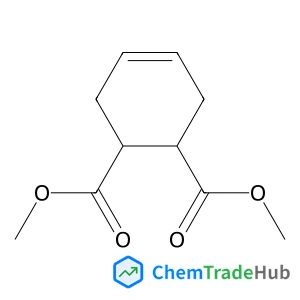
4-Cyclohexene-1,2-dicarboxylic acid, 1,2-dimethyl ester, (1R,2R)-rel-
CAS Number:
17673-68-6
Molecular Formula:
C10H14O4
Tongqing Long, Jun Cao
Correction for ‘Predictable spectroscopic properties of type-II ZnTe/CdSe nanocrystals and electron/hole quenching’ by Tongqing Long et al., Phys. Chem. Chem. Phys., 2019, 21, 5824–5833.
G. Saleh
DOI: 10.1039/C5CP06026E
Audrey Laventure, Guillaume De Grandpré, Armand Soldera, Olivier Lebel, Christian Pellerin
DOI: 10.1039/C5CP06630A
Biswajit Biswas, Prashant Chandra Singh
DOI: 10.1039/C5CP04744G
Manish Chopra, Niharendu Choudhury
DOI: 10.1039/C5CP90224J
DOI: 10.1039/C5CP05636E
Xi-Ling Xu, Xiao-Jiao Deng, Hong-Guang Xu, Wei-Jun Zheng
DOI: 10.1039/C5CP04482K
Min-Sik Park, Jeonghun Kim, Ki Jae Kim, Jong-Won Lee, Jung Ho Kim
DOI: 10.1039/C5CP05936D
S. Ali, V. S. Myasnichenko, E. C. Neyts
DOI: 10.1039/C5CP06153A
P. Antoniou, Z. Ma, P. Zhang
DOI: 10.1039/C5CP00610D
6-(3-Fluorophenyl)picolinic acid is generally considered safe for laboratory use...
(3R)-3-Pyrrolidinol is used in the pharmaceutical industry as a precursor for dr...
When handling (4R,5R)-4,5-Diethoxycarbonyl-2,2-dimethyldioxolane (CAS: 59779-75-...
1-(6-Chloroimidazo[1,2-b]pyridazin-3-yl)ethanone is often synthesized via a mult...
The market for N-Ethyl-3,4-dimethylbenzylamine (CAS: 39180-83-1) remains steady,...
Tert-butyl 3-(pyrrolidin-1-yl)azetidine-1-carboxylate is a chemical compound wit...
1-Bromo-3-chloro-2,4-dimethoxybenzene (CAS: 1228956-93-1) falls under the classi...
The safety of 8-Bromo-2-methyl-3,4-dihydroisoquinolin-1(2H)-one (CAS: 1368622-07...
Benzyl [(3S)-2,6-dioxo-3-piperidinyl]carbamate is generally safe when handled wi...
1-{[4-(4,4,5,5-Tetramethyl-1,3,2-dioxaborolan-2-yl)phenyl]sulfonyl}pyrrolidine s...

Physical Chemistry Chemical Physics (PCCP) is an international journal co-owned by 19 physical chemistry and physics societies from around the world. This journal publishes original, cutting-edge research in physical chemistry, chemical physics and biophysical chemistry. To be suitable for publication in PCCP, articles must include significant innovation and/or insight into physical chemistry; this is the most important criterion that reviewers and Editors will judge against when evaluating submissions. The journal has a broad scope and welcomes contributions spanning experiment, theory, computation and data science. Topical coverage includes spectroscopy, dynamics, kinetics, statistical mechanics, thermodynamics, electrochemistry, catalysis, surface science, quantum mechanics, quantum computing and machine learning. Interdisciplinary research areas such as polymers and soft matter, materials, nanoscience, energy, surfaces/interfaces, and biophysical chemistry are welcomed if they demonstrate significant innovation and/or insight into physical chemistry. Joined experimental/theoretical studies are particularly appreciated when complementary and based on up-to-date approaches.

![Benzyl spiro[indole-3,4'-piperidine]-1(2H)-carboxylate hydrochloride (1:1) structure](https://static.chemtradehub.com/structs/159/159635-46-8-8de0.webp "Benzyl spiro[indole-3,4'-piperidine]-1(2H)-carboxylate hydrochloride (1:1) structure")