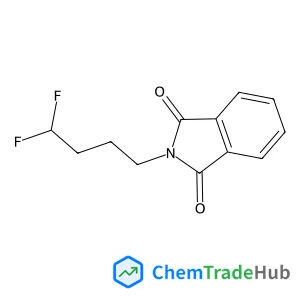
2-(4,4-Difluorobutyl)-1H-isoindole-1,3(2H)-dione
CAS Number:
1265341-14-7
Molecular Formula:
C12H11F2NO2
Dipak Mazumdar, I. Das
We have investigated the crystal structure and the nature of the magnetic ground state of the polycrystalline compound Pr2FeCrO6 (PFCO) through X-ray diffraction (XRD), magnetization, and magnetocaloric effect studies. Analysis of the XRD pattern reveals that the PFCO compound exhibits a B-site disordered orthorhombic crystal structure. The random distribution of Fe3+ and Cr3+ magnetic sublattices at the B-sites of the crystallographic unit cell helps to generate several fascinating magnetic properties. The compound exhibits three distinct anomalies in both the temperature dependence of the magnetization and the magnetic entropy change (−ΔS) curves, namely, (i) a G-type canted antiferromagnetic (AFM) ordering of the transition metal ions (TN1), (ii) a progressive spin reorientation (SR) transition (TSR), and (iii) an AFM ordering of Pr3+ sublattices at very low temperature (TN2). Surprisingly, a novel “diamagnetism-like” behavior appears in the low-temperature region for low applied field values. Moreover, we have also constructed the thermal evolution of the magnetic crystal structures in different transition regions with the help of irreducible representations of the crystal symmetry. Overall, our study of B-site disordered PFCO may help to encourage basic fundamental and applied research on disordered rare-earth and transition metal-based perovskite systems due to their interesting magnetic properties over a broad temperature range.
Mustafa Supur, Yuki Kawashima, Kei Ohkubo, Hayato Sakai, Taku Hasobe
DOI: 10.1039/C5CP01403D
Romain Gautier, Luc Bousset, Ronald Melki, Stefano Vanni
DOI: 10.1039/C5CP00244C
Yan Qian, Shaohua Lu, Erjun Kan, Ruifeng Lu, Kaiming Deng, Hui Wang, Yanming Ma
DOI: 10.1039/C5CP01601K
Junwei Lucas Bao, Prasenjit Seal, Donald G. Truhlar
DOI: 10.1039/C5CP01979F
Chengxiao Peng, Yuanxu Wang, Guangbiao Zhang, Chao Wang, Gui Yang
DOI: 10.1039/C5CP00364D
Wenxing Yang, Yan Hao, Gerrit Boschloo
DOI: 10.1039/C5CP01880C
K. V. Gataullina, M. A. Ziganshin, I. I. Stoikov, A. T. Gubaidullin, V. V. Gorbatchuk
DOI: 10.1039/C5CP02042E
Maria Fumanal, Jordi Ribas-Arino, Vincent Robert
DOI: 10.1039/C5CP02502H
Sten Sarman, Yong-Lei Wang, Aatto Laaksonen
DOI: 10.1039/C5CP02468D
Y. Berrueta Martínez, L. S. Rodríguez Pirani, M. F. Erben, C. G. Reuter, Y. V. Vishnevskiy, H. G. Stammler, N. W. Mitzel, C. O. Della Védova
DOI: 10.1039/C5CP01968K
Waste containing 6-Chloro-5-(2'-hydroxy-3'-methoxy-4-biphenylyl)-3-(3-methoxyphe...
(3alpha,5alpha)-3-Hydroxypregnane-11,20-dione is primarily used in the pharmaceu...
The market for 4-Amino-6-chloro-2-pyridinecarboxylic acid (CAS: 546141-56-4) is ...
Alternatives to (2-Benzoylethyl)trimethylammonium chloride (CAS: 24472-88-6) in ...
N-[4-Nitro-3-(trifluoromethyl)phenyl]acetamide (CAS: 393-12-4) is generally safe...
Alternative reagents such as other phosphates or similar functional groups can b...
There are alternatives to N,N'-Bis(3-aminopropyl)-1,3-propanediamine (CAS: 4605-...
When handling Aluminium trihexadecanoate, it is important to use appropriate per...
(1,1-Dioxido-3-oxo-1,2-benzothiazol-2(3H)-yl)acetic acid is a chemical compound ...
Several alternatives to 5,5-dimethyloxolan-2-one (CAS: 3123-97-5) can be used in...

Physical Chemistry Chemical Physics (PCCP) is an international journal co-owned by 19 physical chemistry and physics societies from around the world. This journal publishes original, cutting-edge research in physical chemistry, chemical physics and biophysical chemistry. To be suitable for publication in PCCP, articles must include significant innovation and/or insight into physical chemistry; this is the most important criterion that reviewers and Editors will judge against when evaluating submissions. The journal has a broad scope and welcomes contributions spanning experiment, theory, computation and data science. Topical coverage includes spectroscopy, dynamics, kinetics, statistical mechanics, thermodynamics, electrochemistry, catalysis, surface science, quantum mechanics, quantum computing and machine learning. Interdisciplinary research areas such as polymers and soft matter, materials, nanoscience, energy, surfaces/interfaces, and biophysical chemistry are welcomed if they demonstrate significant innovation and/or insight into physical chemistry. Joined experimental/theoretical studies are particularly appreciated when complementary and based on up-to-date approaches.
![1,10-bis(3,5-dimethylphenyl)-12-hydroxy-4,5,6,7-tetrahydroiindeno[7,1-de:1',7'-fg][1,3,2]dioxaphosphocine 12-oxide structure](https://static.chemtradehub.com/structs/141/1412439-82-7-b9a9.webp "1,10-bis(3,5-dimethylphenyl)-12-hydroxy-4,5,6,7-tetrahydroiindeno[7,1-de:1',7'-fg][1,3,2]dioxaphosphocine 12-oxide structure")