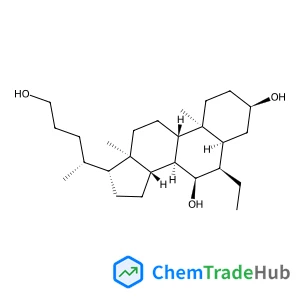
(3alpha,5beta,6alpha,7alpha)-6-Ethylcholane-3,7,24-triol
CAS Number:
1537866-49-1
Molecular Formula:
C26H46O3
The structural versatility of histone tails is one of the key elements in the organisation of chromatin, which allows for the compact storage of genomic information. However, this structural diversity also complicates experimental and computational studies. Here, the potential and free energy landscape for the isolated and bound H4 histone tail are explored. The landscapes exhibit a set of distinct structural ensembles separated by high energy barriers, with little difference between isolated and bound tails. This consistency is a desirable feature that facilitates the formation of transient interactions, which are required for the liquid-like chromatin organisation. The existence of multiple, distinct structures on a multifunnel energy landscape is likely to be associated with multifunctionality, i.e. a set of evolved, distinct functions. Contrasting it with previously reported results for other disordered peptides, this type of landscape may be associated with a conformational selection based binding mechanism. Given the similarity to other systems exhibiting similar multifunnel energy landscapes, the disorder in histone tails might be better described in context of multifunctionality.
François Lecolley, Lei Tao, Giuseppe Mantovani, Ian Durkin, Sylvie Lautru, David M. Haddleton
DOI: 10.1039/B407712A
Prasad V. Ganesan, Cameron J. Kepert
DOI: 10.1039/B409543J
Gertrudis Rodríguez-López, M. Dolores Marcos, Ramón Martínez-Máñez, Félix Sancenón, Juan Soto, Luis A. Villaescusa, Danile Beltrán, Pedro Amorós
DOI: 10.1039/B406611A
Agustino Zulys, Tarun K. Panda, Michael T. Gamer, Peter W. Roesky
DOI: 10.1039/B410918J
Eiji Shirakawa, Keijiro Ishii, Teruhisa Tsuchimoto
DOI: 10.1039/B411125G
Heinz-Bernhard Kraatz, Jeremy S. Lee
DOI: 10.1039/B406689H
Pier Giorgio Cozzi, Silvia Alesi
DOI: 10.1039/B408654F
Wai-Yeung Wong, Suk-Yue Poon, Albert W.-M. Lee, Jian-Xin Shi, Kok-Wai Cheah
DOI: 10.1039/B409580D
J.-F. Colomer, L. Henrard, P. Launois, G. Van Tendeloo, A. A. Lucas, Ph. Lambin
DOI: 10.1039/B410930A
Moon Gyu Han, Stephen H. Foulger
DOI: 10.1039/B409396H
N-(4-Methoxybenzyl)-2-pyridinamine (CAS: 52818-63-0) is increasingly being used ...
When handling Ethyl 4-(2-chlorophenyl)-1,3-thiazole-2-carboxylate, appropriate p...
Diethyldiselane (CAS: 628-39-7) is classified under the Globally Harmonized Syst...
The market for oxocopper (CAS: 12053-18-8) is primarily driven by its use in cat...
The market for 5-{[(2-Methyl-2-propanyl)oxy]carbonyl}-5-azaspiro[2.4]heptane-7-c...
2-(1-Pyrrolidinyl)-4-pyridinamine is a chemical compound with the CAS number 359...
2-(3-Pyridinyl)-1-azabicyclo[2.2.2]octane (CAS: 91556-75-1) is a crystalline sol...
(S)-Alpha-allyl-proline hydrochloride is usually synthesized via a Wittig reacti...
3-Methyl-1,2-oxazole-5-carboxylic acid (CAS: 4857-42-5) is an organic compound w...
Lys-SMCC-DM1 is synthesized via a multi-step process involving the coupling of S...

Physical Chemistry Chemical Physics (PCCP) is an international journal co-owned by 19 physical chemistry and physics societies from around the world. This journal publishes original, cutting-edge research in physical chemistry, chemical physics and biophysical chemistry. To be suitable for publication in PCCP, articles must include significant innovation and/or insight into physical chemistry; this is the most important criterion that reviewers and Editors will judge against when evaluating submissions. The journal has a broad scope and welcomes contributions spanning experiment, theory, computation and data science. Topical coverage includes spectroscopy, dynamics, kinetics, statistical mechanics, thermodynamics, electrochemistry, catalysis, surface science, quantum mechanics, quantum computing and machine learning. Interdisciplinary research areas such as polymers and soft matter, materials, nanoscience, energy, surfaces/interfaces, and biophysical chemistry are welcomed if they demonstrate significant innovation and/or insight into physical chemistry. Joined experimental/theoretical studies are particularly appreciated when complementary and based on up-to-date approaches.