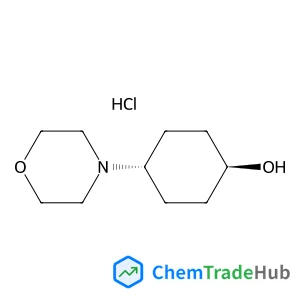
trans-4-(4-Morpholinyl)cyclohexanol hydrochloride (1:1)
CAS Number:
1588441-09-1
Molecular Formula:
C10H20ClNO2
Jian Zeng, Bojun Peng, Zongle Ma, Ling-Ling Wang, Youwen Yang
Searching for economical low-dimensional materials to construct the highly efficient type-II heterojunction photocatalysts for splitting water into hydrogen is very strategic. In this study, using the first-principles calculations, we construct a novel SiH/CeO2(111) type-II heterojunction with a very small lattice mismatch of less than 1%. Based on AIMD simulation and phonon dispersion calculations, the SiH/CeO2(111) heterojunction reveals sufficient stability, and is easy to synthesize. Due to the vdW interaction between SiH and CeO2(111) components, electron and hole accumulation regions form at the heterojunction interface, which is very conducive to the separation of photoexcited electron–hole pairs. Besides, the SiH/CeO2(111) heterojunction has good visible light response, and even a strong absorption peak of up to 8.7 × 105 cm−1 in the high-energy visible region. More importantly, the SiH/CeO2(111) heterojunction exhibits good OER and HER performance because its oxidation and reduction potentials well meet the requirements of water splitting. Consequently, SiH/CeO2(111) is a potential photocatalyst for splitting water to hydrogen.
Jesús García López, Ignacio Fernández, Manuel Serrano Ruiz, Fernando López Ortiz
DOI: 10.1039/B707320H
Thomas Stey, Julian Henn, Dietmar Stalke
DOI: 10.1039/B612247G
Robert G. Potter, Thomas S. Hughes
DOI: 10.1039/B706807G
Mohammed Ibrahim Shukoor, Filipe Natalio, Muhammad Nawaz Tahir, Vadim Ksenofontov, Helen Annal Therese, Patrick Theato, Heinz C. Schröder, Werner E. G. Müller, Wolfgang Tremel
DOI: 10.1039/B707978H
Kun Ha Park, Ji-Seok Lee, Hyunwook Park, Eun-Hye Oh, Jong-Man Kim
DOI: 10.1039/B615626F
Takashi Toraishi, Takaumi Kimura, Makoto Arisaka
DOI: 10.1039/B611573J
Ramon Pericet-Camara, Brian P. Cahill, Georg Papastavrou, Michal Borkovec
DOI: 10.1039/B612249C
Masami Sakamoto, Hiroya Kawanishi, Takashi Mino, Yoshio Kasashima, Tsutomu Fujita
DOI: 10.1039/B608513J
Jered C. Garrison, Matthew J. Panzner, Paul D. Custer, D. Venkat Reddy, Peter L. Rinaldi, Claire A. Tessier, Wiley J. Youngs
DOI: 10.1039/B608991G
Ethyl 4-chlorothieno[2,3-b]pyridine-5-carboxylate (CAS: 59713-58-5) can be synth...
5-Methyl-1H-indole-3-carbaldehyde (CAS: 52562-50-2) is subject to various regula...
(1,3-Dimethyl-2,4-dioxo-1,2,3,4-tetrahydro-5-pyrimidinyl)boronic acid is a white...
Waste containing Sulfocostunolide A (CAS: 1016983-51-9) should be handled with c...
When handling Murraxocin (CAS: 88478-44-8), ensure proper personal protective eq...
Formvar (CAS: 63148-64-1) is an alkyd resin characterized by a high molecular we...
(S)-4-benzyl-2-((benzyloxy)methyl)morpholine is generally safe when handled with...
Methyl 1-(5-bromo-2-pyrimidinyl)cyclopropanecarboxylate (CAS: 1447607-69-3) is p...
2-Methyl-1-phenyl-1-propanamine hydrochloride (CAS: 24290-47-9) is generally con...
3-(4-Bromophenyl)-2-methylpropanoic acid is synthesized through a multi-step pro...

Physical Chemistry Chemical Physics (PCCP) is an international journal co-owned by 19 physical chemistry and physics societies from around the world. This journal publishes original, cutting-edge research in physical chemistry, chemical physics and biophysical chemistry. To be suitable for publication in PCCP, articles must include significant innovation and/or insight into physical chemistry; this is the most important criterion that reviewers and Editors will judge against when evaluating submissions. The journal has a broad scope and welcomes contributions spanning experiment, theory, computation and data science. Topical coverage includes spectroscopy, dynamics, kinetics, statistical mechanics, thermodynamics, electrochemistry, catalysis, surface science, quantum mechanics, quantum computing and machine learning. Interdisciplinary research areas such as polymers and soft matter, materials, nanoscience, energy, surfaces/interfaces, and biophysical chemistry are welcomed if they demonstrate significant innovation and/or insight into physical chemistry. Joined experimental/theoretical studies are particularly appreciated when complementary and based on up-to-date approaches.