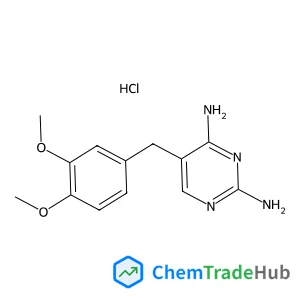
5-(3,4-Dimethoxybenzyl)-2,4-pyrimidinediamine hydrochloride (1:1)
CAS Number:
2507-23-5
Molecular Formula:
C13H17ClN4O2
Bastiaan J. Braams, Yafu Guan, Bina Fu, Dong H. Zhang
The fundamental invariant neural network (FI-NN) approach is developed to represent coupled potential energy surfaces in quasidiabatic representations with two-dimensional irreducible representations of the complete nuclear permutation and inversion (CNPI) group. The particular symmetry properties of the diabatic potential energy matrix of H3 for the 1A′ and 2A′ electronic states were resolved arising from the E symmetry in the D3h point group. This FI-NN framework with symmetry adaption is used to construct a new quasidiabatic representation of H3, which reproduces accurately the ab initio energies and derivative information with perfect symmetry behaviors and extremely small fitting errors. The quantum dynamics results on the new FI-NN diabatic PESs give rise to accurate oscillation patterns in the product state-resolved differential cross sections. These results strongly support the accuracy and efficiency of the FI-NN approach to construct reliable diabatic representations with complicated symmetry problems.
Lin Yang, Hua-Jie Wang, Hua-Yan Yang, Shan-Hu Liu, Bao-Fang Zhang, Kui Wang, Xiao-Ming Ma, Zhi Zheng
DOI: 10.1039/B804274H
Masilamani Jeganmohan, Chien-Hong Cheng
DOI: 10.1039/B800440D
Jen-Chieh Hsieh, Chien-Hong Cheng
DOI: 10.1039/B801870G
Jean-Philippe Goddard, Catherine Gomez, Franck Brebion, Sophie Beauvière, Louis Fensterbank, Max Malacria
DOI: 10.1039/B705284G
Xizhe Liu, Yanhong Luo, Hong Li, Yuzun Fan, Zhexun Yu, Yuan Lin, Liquan Chen, Qingbo Meng
DOI: 10.1039/B700472A
Richard J. Spandl, Hèléne Rudyk, David R. Spring
DOI: 10.1039/B807278G
Nans Roques, Daniel Maspoch, Inhar Imaz, Angela Datcu, Jean-Pascal Sutter, Concepció Rovira, Jaume Veciana
DOI: 10.1039/B802196A
Sophia A. Solomon, Christopher A. Muryn, Richard A. Layfield
DOI: 10.1039/B803364A
When considering alternatives to 1-(4-Chlorophenyl)-N-hydroxymethanimine (CAS: 3...
This compound should be stored in a cool, dry place away from direct sunlight. I...
3-(4-Bromophenyl)-5-(2-fluorophenyl)-1,2,4-oxadiazole is synthesized through a m...
5-Chloro-2-(4-chlorophenyl)-4-methyl-6-[3-(1-piperidinyl)propoxy]pyrimidine (CAS...
2-Chloro-4-(difluoromethoxy)pyridine is used in the pharmaceutical industry for ...
3-Chloro-6-methylpyridazine (CAS: 1121-79-5) is classified under the Globally Ha...
Several alternatives can be used in the synthesis of Methyl 4,5-dimethyl-2-nitro...
Alternatives to (2E,2'E)-3,3'-(1,4-Phenylene)bisacrylaldehyde include other acry...
3-Amino-5-chloropyridin-2-ol hydrochloride is an organic compound with the CAS n...
When handling 6,7-Difluoro-2,3-dihydro-4H-chromen-4-one, it is essential to wear...

Physical Chemistry Chemical Physics (PCCP) is an international journal co-owned by 19 physical chemistry and physics societies from around the world. This journal publishes original, cutting-edge research in physical chemistry, chemical physics and biophysical chemistry. To be suitable for publication in PCCP, articles must include significant innovation and/or insight into physical chemistry; this is the most important criterion that reviewers and Editors will judge against when evaluating submissions. The journal has a broad scope and welcomes contributions spanning experiment, theory, computation and data science. Topical coverage includes spectroscopy, dynamics, kinetics, statistical mechanics, thermodynamics, electrochemistry, catalysis, surface science, quantum mechanics, quantum computing and machine learning. Interdisciplinary research areas such as polymers and soft matter, materials, nanoscience, energy, surfaces/interfaces, and biophysical chemistry are welcomed if they demonstrate significant innovation and/or insight into physical chemistry. Joined experimental/theoretical studies are particularly appreciated when complementary and based on up-to-date approaches.