












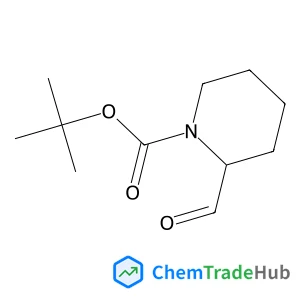
2-Methyl-2-propanyl (2R)-2-formyl-1-piperidinecarboxylate
CAS Number:
134526-69-5
Molecular Formula:
C11H19NO3
Debajyoti De, Nisha Pawar, Amar Nath Gupta
The formation of aggregates and amyloids, a hallmark of many protein misfolding diseases, depends on many intrinsic and extrinsic factors. Many approaches (in vitro, in vivo, and in silico) have been attempted to inhibit the aggregation process so that the progression of these diseases can be controlled. We investigate the effect of a static electric field (EF; 120 V cm−1 and 200 V cm−1) on the conformational change of elastin protein using light scattering, spectroscopy, and microscopy techniques. Laser light scattering and photoluminescence spectroscopy show the formation of fibrils of unexposed elastin with aging, whereas disruption of fibril formation with EF exposed elastin. The size of EF exposed elastin first increases and exhibits an apex, and subsequently decreases with an increasing time of exposure. We observed that a decrease in the size of EF exposed elastin depends on the strength of the EF, faster decrement at higher EF. FTIR data show that EF modifies elastin protein's secondary structures; it facilitates the interconversion of β-sheets and turns into α-helix structures. The SEM images of unexposed and EF exposed elastin confirms the observation through light scattering and PL techniques. The effect of an EF on protein conformation and amyloids is promising to treat Parkinson's disease, a protein misfolding disease.
Bogdan Frecus, N. Arul Murugan, Olav Vahtras, Jacob Kongsted, Hans Ågren
DOI: 10.1039/C2CP43951D
Jing-hua Guo, Hong Zhang, Yongjian Tang, Xinlu Cheng
DOI: 10.1039/C2CP44007E
Maximiliano A. Burgos Paci, Julian Few, Sarah Gowrie, Gus Hancock
DOI: 10.1039/C2CP43878J
Takamasa Momose, Yang Liu, Sida Zhou, Pavle Djuricanin, David Carty
DOI: 10.1039/C2CP43796A
Yi-Ge Zhou, Neil V. Rees, Richard G. Compton
DOI: 10.1039/C2CP43618C
Emiel J. M. Hensen, Rutger A. van Santen, Na Tian, Shi-Gang Sun, Payam Kaghazchi, Timo Jacob
DOI: 10.1039/C2CP44252C
Davide Ravelli, Daniele Dondi, Maurizio Fagnoni, Angelo Albini, Alessandro Bagno
DOI: 10.1039/C2CP43950F
Aninda Chatterjee, Banibrata Maity, Debabrata Seth
DOI: 10.1039/C2CP43483K
Alexander von Zastrow, Thorsten Best, Roland Wester
DOI: 10.1039/C2CP43186F
6-(3-Fluorophenyl)picolinic acid is generally considered safe for laboratory use...
(3R)-3-Pyrrolidinol is used in the pharmaceutical industry as a precursor for dr...
When handling (4R,5R)-4,5-Diethoxycarbonyl-2,2-dimethyldioxolane (CAS: 59779-75-...
1-(6-Chloroimidazo[1,2-b]pyridazin-3-yl)ethanone is often synthesized via a mult...
The market for N-Ethyl-3,4-dimethylbenzylamine (CAS: 39180-83-1) remains steady,...
Tert-butyl 3-(pyrrolidin-1-yl)azetidine-1-carboxylate is a chemical compound wit...
1-Bromo-3-chloro-2,4-dimethoxybenzene (CAS: 1228956-93-1) falls under the classi...
The safety of 8-Bromo-2-methyl-3,4-dihydroisoquinolin-1(2H)-one (CAS: 1368622-07...
Benzyl [(3S)-2,6-dioxo-3-piperidinyl]carbamate is generally safe when handled wi...
1-{[4-(4,4,5,5-Tetramethyl-1,3,2-dioxaborolan-2-yl)phenyl]sulfonyl}pyrrolidine s...

Physical Chemistry Chemical Physics (PCCP) is an international journal co-owned by 19 physical chemistry and physics societies from around the world. This journal publishes original, cutting-edge research in physical chemistry, chemical physics and biophysical chemistry. To be suitable for publication in PCCP, articles must include significant innovation and/or insight into physical chemistry; this is the most important criterion that reviewers and Editors will judge against when evaluating submissions. The journal has a broad scope and welcomes contributions spanning experiment, theory, computation and data science. Topical coverage includes spectroscopy, dynamics, kinetics, statistical mechanics, thermodynamics, electrochemistry, catalysis, surface science, quantum mechanics, quantum computing and machine learning. Interdisciplinary research areas such as polymers and soft matter, materials, nanoscience, energy, surfaces/interfaces, and biophysical chemistry are welcomed if they demonstrate significant innovation and/or insight into physical chemistry. Joined experimental/theoretical studies are particularly appreciated when complementary and based on up-to-date approaches.
![4-[(2,4-Dihydroxyphenyl)diazenyl]-5-hydroxy-2,7-naphthalenedisulfonic acid structure](https://static.chemtradehub.com/structs/362/3627-01-8-79ac.webp "4-[(2,4-Dihydroxyphenyl)diazenyl]-5-hydroxy-2,7-naphthalenedisulfonic acid structure")




