












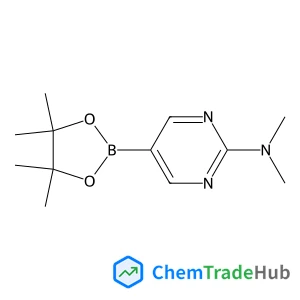
N,N-Dimethyl-5-(4,4,5,5-tetramethyl-1,3,2-dioxaborolan-2-yl)-2-pyrimidinamine
CAS Number:
1032759-30-0
Molecular Formula:
C12H20BN3O2
Zahra Hooshmand, Mark R. Pederson
[Mn3O(O2CMe)(dpd3/2)]2 is composed of two monomers each of which contain three Mn atoms at the vertices of an equilateral triangle. A full analysis of the electronic and magnetic structure of the dimer shows that each Mn atom carries a local spin of S = 2 while other spin states are energetically much higher. This result suggests application for conventional as well as quantum tasks. A detailed analysis of the electronic and magnetic structure of the monomer, on the other hand, suggests that there are three spin states of S = 1, S = 3/2 and S = 2 per monomer which are energetically competitive. We found that while monomer–monomer interactions are very weak, the coupling of monomers via covalent linkers affects both the magnetization and electronic energy levels of monomers. In particular, the isolated monomers prefer a ground state with local spin of S = 1 on Mn atoms and an antiferromagnetically ordered structure while the dimers possess a ground state with local spin of S = 2 on Mn atoms and a ferromagnetically ordered structure. The investigation of the polarizability of both monomer and dimer is examined for antiferromagnetically ordered structures which induces a high dipole moment of 0.08 (a.u.) and 0.16 (a.u.) for monomer and dimer, respectively. The energy of the antiferromagnetic structure is also high compared to other spin-electric molecules.
Amit Basak, Debarati Mitra, Moumita Kar, Kumar Biradha
DOI: 10.1039/B801644E
Sarita Sitaula, Marilyn R. Mackiewicz, Scott M. Reed
DOI: 10.1039/B801525B
Tetsuo Okujima, Noboru Ono
DOI: 10.1039/B719964C
Jean-Philippe Goddard, Catherine Gomez, Franck Brebion, Sophie Beauvière, Louis Fensterbank, Max Malacria
DOI: 10.1039/B705284G
Ning Du, Hui Zhang, Bingdi Chen, Xiangyang Ma, Deren Yang
DOI: 10.1039/B800401C
Lixia Sun, Qianwang Chen, Yan Tang, Ying Xiong
DOI: 10.1039/B704689H
Cristina Femoni, Maria Carmela Iapalucci, Giuliano Longoni, Stefano Zacchini
DOI: 10.1039/B803992E
Nans Roques, Daniel Maspoch, Inhar Imaz, Angela Datcu, Jean-Pascal Sutter, Concepció Rovira, Jaume Veciana
DOI: 10.1039/B802196A
P. Kanthi Senanayake, Alan M. Kenwright, David Parker, Susanna K. van der Hoorn
DOI: 10.1039/B705844F
When considering alternatives to 1-(4-Chlorophenyl)-N-hydroxymethanimine (CAS: 3...
This compound should be stored in a cool, dry place away from direct sunlight. I...
3-(4-Bromophenyl)-5-(2-fluorophenyl)-1,2,4-oxadiazole is synthesized through a m...
5-Chloro-2-(4-chlorophenyl)-4-methyl-6-[3-(1-piperidinyl)propoxy]pyrimidine (CAS...
2-Chloro-4-(difluoromethoxy)pyridine is used in the pharmaceutical industry for ...
3-Chloro-6-methylpyridazine (CAS: 1121-79-5) is classified under the Globally Ha...
Several alternatives can be used in the synthesis of Methyl 4,5-dimethyl-2-nitro...
Alternatives to (2E,2'E)-3,3'-(1,4-Phenylene)bisacrylaldehyde include other acry...
3-Amino-5-chloropyridin-2-ol hydrochloride is an organic compound with the CAS n...
When handling 6,7-Difluoro-2,3-dihydro-4H-chromen-4-one, it is essential to wear...

Physical Chemistry Chemical Physics (PCCP) is an international journal co-owned by 19 physical chemistry and physics societies from around the world. This journal publishes original, cutting-edge research in physical chemistry, chemical physics and biophysical chemistry. To be suitable for publication in PCCP, articles must include significant innovation and/or insight into physical chemistry; this is the most important criterion that reviewers and Editors will judge against when evaluating submissions. The journal has a broad scope and welcomes contributions spanning experiment, theory, computation and data science. Topical coverage includes spectroscopy, dynamics, kinetics, statistical mechanics, thermodynamics, electrochemistry, catalysis, surface science, quantum mechanics, quantum computing and machine learning. Interdisciplinary research areas such as polymers and soft matter, materials, nanoscience, energy, surfaces/interfaces, and biophysical chemistry are welcomed if they demonstrate significant innovation and/or insight into physical chemistry. Joined experimental/theoretical studies are particularly appreciated when complementary and based on up-to-date approaches.
![(2S)-2-{[(9H-Fluoren-9-ylmethoxy)carbonyl]amino}-4-(methylselanyl)butanoic acid structure](https://static.chemtradehub.com/structs/121/1217852-49-7-f252.webp "(2S)-2-{[(9H-Fluoren-9-ylmethoxy)carbonyl]amino}-4-(methylselanyl)butanoic acid structure")




