












First-principles investigation on the transport properties of quaternary CoFeRGa (R = Ti, V, Cr, Mn, Cu, and Nb) Heusler compounds
Literature Information
Publication Date
2020-09-17
DOI
10.1039/D0CP03226C
Impact Factor
3.676
Authors
Jingyu Li, Chi Zhang, Peng-Fei Liu
View Original
Abstract
The Heusler alloys CoFeRGa (R = Ti, V, Cr, Mn, Cu, and Nb) have similar chemical compositions, but exhibit remarkably distinct electronic structures, magnetism and transport properties. These structures cover an extensive range of spin gapless semiconductors, half-metals, semiconductors and metals with either ferromagnetic, ferrimagnetic, antiferromagnetic, or nonmagnetic states. The Heusler alloys have three types of structures, namely, type-I, type-II, and type-III. By means of first-principles calculation combined with the Boltzmann equation within the consideration of spin-freedom, we explore the transport feature of the most stable structure (type-I). In addition, we provide evidence that all the considered materials are mechanically and dynamically stable, possessing high strength and toughness to resist compression and tensile strain. Moreover, the distinct electronic (metallic, insulating, and half-metallic) properties and magnetic behaviors originate mainly from a cooperative electron transfer and electronic structures have been verified by our calculation. Finally, we found that the tunable electronic structure with varied atomic numbers has significant influence on the spin-Seebeck effect. Correspondingly, the calculated spin-Seebeck coefficient of CoFeCrGa is −60.29 μV K−1 at 300 K, which is larger than that of other quaternary Heusler compounds. Our results provide a band-engineering platform to design Heusler structures with different electronic behaviors in isomorphic compounds, which provide the way for accelerating the pre-screening of materials to advance and for using the quaternary Heusler compounds for potential applications in spin caloritronic devices.
Related Literature
Structural investigation of Au(111)/butylthiolate adsorption phases
A. Chaudhuri, D. C. Jackson, T. J. Lerotholi, Robert G. Jones, T.-L. Lee, B. Detlefs, D. P. Woodruff
2010-02-23
Paper
DOI: 10.1039/B921281G
Nanoporous Ni–Ce0.8Gd0.2O1.9−x thin film cermet SOFC anodes prepared by pulsed laser deposition
Anna Infortuna, Ashley S. Harvey, Ulrich P. Muecke, Ludwig J. Gauckler
2009-03-20
Paper
DOI: 10.1039/B821473E
Surface-enhanced IR–visible sum frequency generation vibrational spectroscopy
Qifeng Li, Chiung Wen Kuo, Zheng Yang, Peilin Chen, Keng C. Chou
2009-02-25
Paper
DOI: 10.1039/B821045D
Designing meso- and macropore architectures in hybrid organic–inorganic membranes by combining surfactant and breath figure templating (BFT)
Ozlem Sel, Christel Laberty-Robert, Thierry Azais, Clément Sanchez
2009-03-27
Paper
DOI: 10.1039/B821506E
On the use and influence of electron-blocking interlayers in polymer light-emitting diodes
Peter A. Levermore, Jingsong Huang, Xuhua Wang, Donal D. C. Bradley
2009-03-06
Paper
DOI: 10.1039/B819200F
Spectral shifts of matrix isolated species as criteria for acid–base interactions with solid Xe
Mark Rozenberg, Aharon Loewenschuss, Claus Jørgen Nielsen
2010-03-12
Paper
DOI: 10.1039/B922952C
The structure of oxotitanium phthalocyanine: a gas-phase electron diffraction and computational study
Alexander V. Zakharov, Sergei A. Shlykov, Yuriy A. Zhabanov, Georgy V. Girichev
2009-03-06
Paper
DOI: 10.1039/B820914F
Electrochemistry of LiMn2O4nanoparticles made by flame spray pyrolysis
R. Büchel, M. Nakayama, P. Novák
2009-03-25
Paper
DOI: 10.1039/B821572N
A combinatorial approach toward fabrication of surface-adsorbed metal nanoparticles for investigation of an enzyme reaction
H. Takei, T. Yamaguchi
2010-03-25
Paper
DOI: 10.1039/B924233N
You might also like
Compound Q&A
How should waste containing 2-Ethyl-4-Methyl-1H-Imidazole-5-Carbaldehyde (CAS: 88634-80-4) be handled?
Waste containing 2-Ethyl-4-Methyl-1H-Imidazole-5-Carbaldehyde (CAS: 88634-80-4) ...
88634-80-42-Ethyl-4-Methyl-1H-...
Compound Q&A
What industries use Triethoxy(octyl)silane (CAS: 1385031-14-0)?
Triethoxy(octyl)silane (CAS: 1385031-14-0) is widely used in the pharmaceuticals...
1385031-14-0Triethoxy(octyl)sila...
Compound Q&A
Are there alternatives to 3-iodo-7-nitro-1H-indazole (CAS: 864724-64-1) in synthesis?
Several alternatives to 3-iodo-7-nitro-1H-indazole (CAS: 864724-64-1) exist in t...
864724-64-13-iodo-7-nitro-1H-in...
Compound Q&A
Are there alternatives to Benzene, bis[(trimethoxysilyl)ethyl] (CAS: 266317-71-9) in synthesis?
Yes, there are alternatives to Benzene, bis[(trimethoxysilyl)ethyl] (CAS: 266317...
266317-71-9Benzene, bis[(trimet...
Compound Q&A
Is Isothiazole-3-carbonitrile (CAS: 1452-17-1) safe?
Isothiazole-3-carbonitrile (CAS: 1452-17-1) is generally considered safe when us...
1452-17-1Isothiazole-3-carbon...
Compound Q&A
Is (3-Chlorophenyl)methanol (CAS: 873-63-2) safe?
(3-Chlorophenyl)methanol (CAS: 873-63-2) is considered low to moderately toxic. ...
873-63-2(3-Chlorophenyl)meth...
Compound Q&A
How is (2S,3S)-2-Hydroxy-3-({[(2-methyl-2-propanyl)oxy]carbonyl}amino)-3-(2-naphthyl)propanoic acid (CAS: 959583-98-3) typically synthesized?
(2S,3S)-2-Hydroxy-3-({[(2-methyl-2-propanyl)oxy]carbonyl}amino)-3-(2-naphthyl)pr...
959583-98-3(2S,3S)-2-Hydroxy-3-...
Compound Q&A
What precautions should be taken when handling Methyl 2-(bromomethyl)-5-methoxybenzoate (CAS: 788081-99-2)?
Proper handling of methyl 2-(bromomethyl)-5-methoxybenzoate requires the use of ...
788081-99-2Methyl 2-(bromomethy...
Compound Q&A
What is 6,8-Dibromoimidazo[1,2-a]pyridine-2-carboxylic acid (CAS: 904805-36-3)?
6,8-Dibromoimidazo[1,2-a]pyridine-2-carboxylic acid (CAS: 904805-36-3) is an aro...
904805-36-36,8-Dibromoimidazo[1...
Compound Q&A
Is 3-Amino-5-bromo-2-pyridinecarbonitrile (CAS: 573675-27-1) safe?
3-Amino-5-bromo-2-pyridinecarbonitrile is considered safe when handled under pro...
573675-27-13-Amino-5-bromo-2-py...
Source Journal
Physical Chemistry Chemical Physics

CiteScore:
5.5
Self-citation Rate:
10.3%
Articles per Year:
3036
Physical Chemistry Chemical Physics (PCCP) is an international journal co-owned by 19 physical chemistry and physics societies from around the world. This journal publishes original, cutting-edge research in physical chemistry, chemical physics and biophysical chemistry. To be suitable for publication in PCCP, articles must include significant innovation and/or insight into physical chemistry; this is the most important criterion that reviewers and Editors will judge against when evaluating submissions. The journal has a broad scope and welcomes contributions spanning experiment, theory, computation and data science. Topical coverage includes spectroscopy, dynamics, kinetics, statistical mechanics, thermodynamics, electrochemistry, catalysis, surface science, quantum mechanics, quantum computing and machine learning. Interdisciplinary research areas such as polymers and soft matter, materials, nanoscience, energy, surfaces/interfaces, and biophysical chemistry are welcomed if they demonstrate significant innovation and/or insight into physical chemistry. Joined experimental/theoretical studies are particularly appreciated when complementary and based on up-to-date approaches.
Recommended Compounds
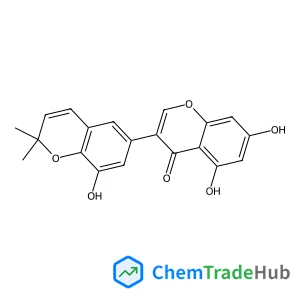
5,7,8'-Trihydroxy-2',2'-dimethyl-2'H,4H-3,6'-bichromen-4-one
CAS Number:
129280-33-7
Molecular Formula:
C20H16O6

Recommended Suppliers





Disclaimer
This page provides academic journal information for reference and research purposes only. We are not affiliated with any journal publishers and do not handle publication submissions. For publication-related inquiries, please contact the respective journal publishers directly.
If you notice any inaccuracies in the information displayed, please contact us at support@chemtradehub.com. We will promptly review and address your concerns.