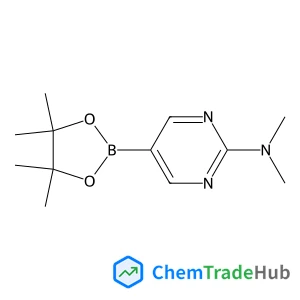
N,N-Dimethyl-5-(4,4,5,5-tetramethyl-1,3,2-dioxaborolan-2-yl)-2-pyrimidinamine
CAS Number:
1032759-30-0
Molecular Formula:
C12H20BN3O2
Hao Ren, Kaikun Niu, Siliang Wang, Zhixiang Huang, Xianliang Wu
Metal nanoparticles associated with local surface plasmon (LSP) resonance, i.e. highly confined electric field and large scattering cross-sections (σ), have been widely used to enhance the light-harvesting of solar cells toward high optoelectronic performance. However, the metal nanoparticles embedded into the solar cells suffer from parasitic ohmic loss that subsequently causes the local temperature to rise, which, in turn, reduces the photoelectric conversion efficiency and stability of solar cells. Previous studies on plasmon-enhanced solar cells have rarely considered the negative effects of metal nanoparticles’ ohmic losses and temperature rise on solar cell performance optimization. Therefore, it is of great interest to alleviate the ohmic loss and temperature rise that are critical for high-performance solar cells. Herein, we propose a model to comprehensively study and optimize the performance of plasmon-enhanced perovskite solar cells (PSCs) from simultaneous optical-electrical-thermal aspects. First, the optical simulation results indicated that the geometric tuning of metal nanoparticles can make full use of the plasmonic effect and significantly improve PSCs’ light absorption. The analysis showed that the embedded nanoparticles with optimal geometry in PSC devices can significantly increase the optical absorption by 17% (41%) compared to non-optimal nanostructures (devices without nanoparticles). Then, we explored the influence of the temperature-dependent carrier mobility on PSC performance from the coupled electrical and thermal studies. Our results indicated that the optimization of the geometrical parameters of metal nanoparticles can minimize energy dissipation, thereby redusing the heat loss and then lowering the local cell temperature. Interestingly, PSCs’ electrical properties such as carrier transportation significantly improved. Consequently, the PSC performance improved with increment in the short-circuit current by 23% and the power conversion efficiency by 38%.

Organic Preparations and Procedures International

Israel Journal of Chemistry

Pharmacological Reviews

Science

Fibre Chemistry

Pure and Applied Chemistry

Journal of Heterocyclic Chemistry

Journal of Medicinal Chemistry

Kinetics and Catalysis

Proceedings of the National Academy of Sciences of the United States of America
N. D. Koromilas, G. Vasilopoulos, A. Vantarakis
DOI: 10.1039/C6PY00553E
Fanny Coumes, Aurélie Malfait, Marc Bria, Joël Lyskawa, Patrice Woisel, David Fournier
DOI: 10.1039/C6PY00738D
Bo Zhang, Hui Tang, Peiyi Wu
DOI: 10.1039/C4PY00653D
Qiao Song, Fei Li, Xinxin Tan, Liulin Yang, Zhiqiang Wang, Xi Zhang
DOI: 10.1039/C4PY00942H
Xiaofu Wu, Hui Tong, Lixiang Wang
DOI: 10.1039/C4PY00592A
Mingming Zuo, Tianqing Liu, Jingjing Han
DOI: 10.1039/C4PY00616J
Bing Han, Li Zhang, Hongye Zhang, Huining Ding, Binyuan Liu, Xianhong Wang
DOI: 10.1039/C6PY00563B
Laura Zepeda-Velazquez, Benjamin Macphail, Michael A. Brook
DOI: 10.1039/C6PY00492J
When considering alternatives to 1-(4-Chlorophenyl)-N-hydroxymethanimine (CAS: 3...
This compound should be stored in a cool, dry place away from direct sunlight. I...
3-(4-Bromophenyl)-5-(2-fluorophenyl)-1,2,4-oxadiazole is synthesized through a m...
5-Chloro-2-(4-chlorophenyl)-4-methyl-6-[3-(1-piperidinyl)propoxy]pyrimidine (CAS...
2-Chloro-4-(difluoromethoxy)pyridine is used in the pharmaceutical industry for ...
3-Chloro-6-methylpyridazine (CAS: 1121-79-5) is classified under the Globally Ha...
Several alternatives can be used in the synthesis of Methyl 4,5-dimethyl-2-nitro...
Alternatives to (2E,2'E)-3,3'-(1,4-Phenylene)bisacrylaldehyde include other acry...
3-Amino-5-chloropyridin-2-ol hydrochloride is an organic compound with the CAS n...
When handling 6,7-Difluoro-2,3-dihydro-4H-chromen-4-one, it is essential to wear...

Physical Chemistry Chemical Physics (PCCP) is an international journal co-owned by 19 physical chemistry and physics societies from around the world. This journal publishes original, cutting-edge research in physical chemistry, chemical physics and biophysical chemistry. To be suitable for publication in PCCP, articles must include significant innovation and/or insight into physical chemistry; this is the most important criterion that reviewers and Editors will judge against when evaluating submissions. The journal has a broad scope and welcomes contributions spanning experiment, theory, computation and data science. Topical coverage includes spectroscopy, dynamics, kinetics, statistical mechanics, thermodynamics, electrochemistry, catalysis, surface science, quantum mechanics, quantum computing and machine learning. Interdisciplinary research areas such as polymers and soft matter, materials, nanoscience, energy, surfaces/interfaces, and biophysical chemistry are welcomed if they demonstrate significant innovation and/or insight into physical chemistry. Joined experimental/theoretical studies are particularly appreciated when complementary and based on up-to-date approaches.