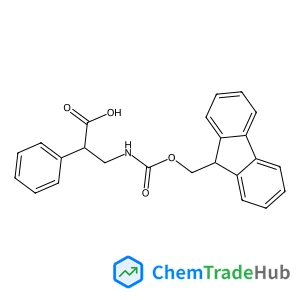
(S)-3-((((9H-Fluoren-9-yl)methoxy)carbonyl)amino)-2-phenylpropanoic acid
CAS Number:
1217663-60-9
Molecular Formula:
C24H21NO4
Bo Zhang, Hui Tang, Peiyi Wu
Dynamic thermal phase transition behavior of a well-defined poly(N-isopropylacrylamide)–poly(2-hydroxyethyl methacrylate) (PNIPAM–PHEMA) interpenetrating polymer network (IPN) microgel in D2O synthesized by two-step precipitation polymerization was studied by means of IR spectroscopy in combination with the perturbation correlation moving window (PCMW) technique and two-dimensional correlation spectroscopy (2Dcos) analysis. Due to the hydrophobic and non-thermo-responsive properties of PHEMA and the special IPN structure, the IPN microgel exhibited an unusual thermally induced collapse process. The introduction of PHEMA would lower the volume phase transition temperature (VPTT) and the volume phase transition degree. 2Dcos was finally employed to discern the sequence order of all the group motion during heating and cooling processes. PHEMA plays different roles in different stages during the volume phase transition. Additionally, as PHEMA exhibits only a slight response to temperature, it would provide the PNIPAM–PHEMA IPN microgel with good reversibility.
Iakov Polyak, Eliot Boulanger, Kakali Sen, Walter Thiel
DOI: 10.1039/C3CP51669E
Chia-Shing Wu, Szu-Wen Fang, Yun Chen
DOI: 10.1039/C3CP52087K
Cristina Greco, Geoffrey R. Luckhurst, Alberta Ferrarini
DOI: 10.1039/C3CP52222A
Franziska Buchner, Hans-Hermann Ritze, Jan Lahl, Andrea Lübcke
DOI: 10.1039/C3CP51057C
Tetsuhiro Kudo, Hajime Ishihara
DOI: 10.1039/C3CP51969D
Juraj Sibik, Evgenyi Y. Shalaev, J. Axel Zeitler
DOI: 10.1039/C3CP51936H
David P. Anderson, Jason F. Alvino, Oliver Shipper, Baira Donoeva, Jan-Yves Ruzicka, Hassan Al Qahtani, Hugh H. Harris, Bruce Cowie, Jade B. Aitken, Vladimir B. Golovko, Gregory F. Metha, Gunther G. Andersson
DOI: 10.1039/C3CP52497C
DOI: 10.1039/C3CP51743H
Izabela Czekaj, Katarzyna A. Kacprzak, John Mantzaras
DOI: 10.1039/C3CP51085A
Li-Lin Tan, Hong-Yan Chen, Li-Feng Hao, Yong Shen, Li-Min Xiao, Jun-Min Liu, Dai-Bin Kuang, Cheng-Yong Su
DOI: 10.1039/C3CP51633D
When considering alternatives to 1-(4-Chlorophenyl)-N-hydroxymethanimine (CAS: 3...
This compound should be stored in a cool, dry place away from direct sunlight. I...
3-(4-Bromophenyl)-5-(2-fluorophenyl)-1,2,4-oxadiazole is synthesized through a m...
5-Chloro-2-(4-chlorophenyl)-4-methyl-6-[3-(1-piperidinyl)propoxy]pyrimidine (CAS...
2-Chloro-4-(difluoromethoxy)pyridine is used in the pharmaceutical industry for ...
3-Chloro-6-methylpyridazine (CAS: 1121-79-5) is classified under the Globally Ha...
Several alternatives can be used in the synthesis of Methyl 4,5-dimethyl-2-nitro...
Alternatives to (2E,2'E)-3,3'-(1,4-Phenylene)bisacrylaldehyde include other acry...
3-Amino-5-chloropyridin-2-ol hydrochloride is an organic compound with the CAS n...
When handling 6,7-Difluoro-2,3-dihydro-4H-chromen-4-one, it is essential to wear...

Polymer Chemistry welcomes submissions in all areas of polymer science that have a strong focus on macromolecular chemistry. Manuscripts may cover a broad range of fields, yet no direct application focus is required.