


Supramolecular polymerization of supramonomers: a way for fabricating supramolecular polymers
Literature Information
Publication Date
2014-07-16
DOI
10.1039/C4PY00942H
Impact Factor
5.582
Authors
Qiao Song, Fei Li, Xinxin Tan, Liulin Yang, Zhiqiang Wang, Xi Zhang
View Original
Abstract
This communication describes a new method of fabricating supramolecular polymers through supramolecular polymerization of supramonomers. To mix building blocks of Phe-Gly-Gly linked with an azobenzene group and cucurbit[8]uril (CB[8]) in a molar ratio of 2 : 1 in aqueous solutions, supramonomers were obtained by host–guest interaction between tripeptide and CB[8]. Then supramolecular polymers were formed spontaneously by mixing the supramonomers with bis-β-cyclodextrins in a molar ratio of 1 : 1 in an aqueous solution through noncovalent host–guest complexation of the azobenzene group and β-cyclodextrin. Considering that various noncovalent interactions can be used to drive the formation of supramonomers and the supramolecular polymerization of the supramonomers, this study can enrich the methodology of fabricating supramolecular polymers.
Recommended Journals

Current Opinion in Colloid & Interface Science

Drug Discovery Today

Russian Chemical Bulletin

Journal of Saudi Chemical Society

Russian Journal of Bioorganic Chemistry

Acta Materialia

Chemistry Education Research and Practice

Chemical Communications

Russian Journal of General Chemistry

Journal of Natural Medicines
Related Literature
The exciton dynamics in tetracene thin films
Murad J. Y. Tayebjee, Raphaël G. C. R. Clady, Timothy W. Schmidt
2013-07-19
Paper
DOI: 10.1039/C3CP52609G
Assessment of femtosecond laser induced periodic surface structures on polymer films
Esther Rebollar, Javier R. Vázquez de Aldana, Ignacio Martín-Fabiani, Margarita Hernández, Daniel R. Rueda, Tiberio A. Ezquerra, Concepción Domingo, Pablo Moreno, Marta Castillejo
2013-05-13
Paper
DOI: 10.1039/C3CP51523K
Extending the distance range accessed with continuous wave EPR with Gd3+spin probes at high magnetic fields
Devin T. Edwards, Zhidong Ma, Daniella Goldfarb
2013-05-15
Paper
DOI: 10.1039/C3CP43787F
Transport properties of binuclear metal complexes of the VIII group using a simplified NEGF-DFT approach
Vincenzo Barone, Ivo Cacelli, Alessandro Ferretti
2013-05-10
Paper
DOI: 10.1039/C3CP50974E
Introducing a standard method for experimental determination of the solvent response in laser pump, X-ray probe time-resolved wide-angle X-ray scattering experiments on systems in solution
Tim B. van Driel, Jan Kehres, Kristoffer Haldrup, Dmitry Khakhulin, Klaus Bechgaard, Marco Cammarata, Michael Wulff, Thomas Just Sørensen, Martin M. Nielsen
2013-06-24
Paper
DOI: 10.1039/C3CP50751C
Effect of the state of distribution of supported Pt nanoparticles on effective Pt utilization in polymer electrolyte fuel cells
Makoto Uchida, Young-Chul Park, Katsuyoshi Kakinuma, Hiroshi Yano, Donald A. Tryk, Takeo Kamino, Hiroyuki Uchida, Masahiro Watanabe
2013-05-29
Paper
DOI: 10.1039/C3CP51801A
An in situXAFS study—the formation mechanism of gold nanoparticles from X-ray-irradiated ionic liquid
2013-05-21
Paper
DOI: 10.1039/C3CP51743H
Resonance optical manipulation of nano-objects based on nonlinear optical response
Tetsuhiro Kudo, Hajime Ishihara
2013-07-08
Perspective
DOI: 10.1039/C3CP51969D
Interactions of platinum clusters with a graphite substrate
G. Ramos-Sanchez, P. B. Balbuena
2013-05-31
Paper
DOI: 10.1039/C3CP51791H
Propagation of nanopores during anodic etching of n-InP in KOH
Robert P. Lynch, Nathan Quill, Shohei Nakahara, D. Noel Buckley
2013-07-31
Paper
DOI: 10.1039/C3CP52253A
You might also like
Compound Q&A
Are there alternatives to 1-(4-Chlorophenyl)-N-hydroxymethanimine (CAS: 3848-36-0) in synthesis?
When considering alternatives to 1-(4-Chlorophenyl)-N-hydroxymethanimine (CAS: 3...
3848-36-01-(4-Chlorophenyl)-N...
Compound Q&A
How should (1R,9S,10S,12S,14E,16S,19R,20R,21S,22R)-3,9,21-Trihydroxy-5,10,12,14,16,20,22-heptamethyl-23,24-dioxatetracyclo[17.3.1.1~6,9~.0~2,7~]tetracosa-2,5,7,14-tetraen-4-one (CAS: 183202-73-5) be stored?
This compound should be stored in a cool, dry place away from direct sunlight. I...
183202-73-5(1R,9S,10S,12S,14E,1...
Compound Q&A
How is 3-(4-Bromophenyl)-5-(2-fluorophenyl)-1,2,4-oxadiazole (CAS: 419553-16-5) typically synthesized?
3-(4-Bromophenyl)-5-(2-fluorophenyl)-1,2,4-oxadiazole is synthesized through a m...
419553-16-53-(4-Bromophenyl)-5-...
Compound Q&A
How is 5-Chloro-2-(4-chlorophenyl)-4-methyl-6-[3-(1-piperidinyl)propoxy]pyrimidine (CAS: 1639220-19-1) typically synthesized?
5-Chloro-2-(4-chlorophenyl)-4-methyl-6-[3-(1-piperidinyl)propoxy]pyrimidine (CAS...
1639220-19-15-Chloro-2-(4-chloro...
Compound Q&A
What industries use 2-Chloro-4-(difluoromethoxy)pyridine (CAS: 1206978-15-5)?
2-Chloro-4-(difluoromethoxy)pyridine is used in the pharmaceutical industry for ...
1206978-15-52-Chloro-4-(difluoro...
Compound Q&A
What regulatory guidelines apply to 3-Chloro-6-methylpyridazine (CAS: 1121-79-5)?
3-Chloro-6-methylpyridazine (CAS: 1121-79-5) is classified under the Globally Ha...
1121-79-53-Chloro-6-methylpyr...
Compound Q&A
Are there alternatives to Methyl 4,5-dimethyl-2-nitrobenzoate in synthesis?
Several alternatives can be used in the synthesis of Methyl 4,5-dimethyl-2-nitro...
90922-74-0Methyl 4,5-dimethyl-...
Compound Q&A
Are there alternatives to (2E,2'E)-3,3'-(1,4-Phenylene)bisacrylaldehyde in synthesis?
Alternatives to (2E,2'E)-3,3'-(1,4-Phenylene)bisacrylaldehyde include other acry...
63405-68-5(2E,2'E)-3,3'-(1,4-P...
Compound Q&A
What is 3-Amino-5-chloropyridin-2-ol hydrochloride (CAS: 1261906-29-9)?
3-Amino-5-chloropyridin-2-ol hydrochloride is an organic compound with the CAS n...
1261906-29-93-Amino-5-chloropyri...
Compound Q&A
What precautions should be taken when handling 6,7-Difluoro-2,3-dihydro-4H-chromen-4-one (CAS: 1092349-93-3)?
When handling 6,7-Difluoro-2,3-dihydro-4H-chromen-4-one, it is essential to wear...
1092349-93-36,7-Difluoro-2,3-dih...
Source Journal
Polymer Chemistry

CiteScore:
8.6
Self-citation Rate:
7.3%
Articles per Year:
457
Polymer Chemistry welcomes submissions in all areas of polymer science that have a strong focus on macromolecular chemistry. Manuscripts may cover a broad range of fields, yet no direct application focus is required.
Recommended Compounds
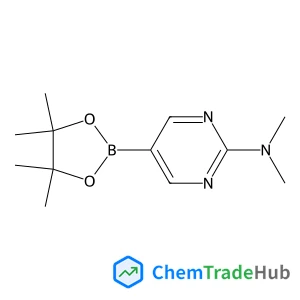
N,N-Dimethyl-5-(4,4,5,5-tetramethyl-1,3,2-dioxaborolan-2-yl)-2-pyrimidinamine
CAS Number:
1032759-30-0
Molecular Formula:
C12H20BN3O2
![4-[(3-Chloro-2-fluorophenyl)amino]-7-methoxy-6-quinazolinyl acetate structure](https://static.chemtradehub.com/structs/740/740081-22-5-f58f.webp "4-[(3-Chloro-2-fluorophenyl)amino]-7-methoxy-6-quinazolinyl acetate structure")
4-[(3-Chloro-2-fluorophenyl)amino]-7-methoxy-6-quinazolinyl acetate
CAS Number:
740081-22-5
Molecular Formula:
C17H13ClFN3O3
Recommended Suppliers






Disclaimer
This page provides academic journal information for reference and research purposes only. We are not affiliated with any journal publishers and do not handle publication submissions. For publication-related inquiries, please contact the respective journal publishers directly.
If you notice any inaccuracies in the information displayed, please contact us at support@chemtradehub.com. We will promptly review and address your concerns.