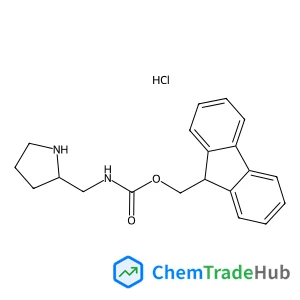
(S)-(9H-Fluoren-9-yl)methyl (pyrrolidin-2-ylmethyl)carbamate hydrochloride
CAS Number:
1217813-15-4
Molecular Formula:
C20H23ClN2O2
Alexander S. Tygesen, Nicolai R. Mathiesen, Jin Hyun Chang, Juan María García-Lastra
The orientation of diatomic molecular impurities in crystals is a classic problem in physics, whose analysis started in the early 1930s with Pauling's pioneering studies and has extended to the present day. In the present work, we investigate the orientation of a superoxide ion (O2−), which is known to be oriented in the 〈1 1 0〉 direction when replacing a halide ion in alkali halide rock salt lattices. The unpaired electron of the superoxide, whose ground state is degenerate (2Πg), is oriented in the 〈0 0 1〉 direction for sodium halides while it is oriented in the 〈1 0〉 direction for potassium and rubidium halides. We performed density functional theory (DFT) calculations to describe the full adiabatic potential energy surface (APES) of this complex system for the first time with ab initio methods. We are focused on four alkali halide lattices, namely NaCl, NaBr, KCl, and KBr. We show that DFT, at the generalized gradient approximation (GGA) and meta-GGA levels, is able to reproduce all the experimental features for potassium halides. However, for sodium halides, although the DFT predicts the correct unpaired electron orientation, the forecasted APES energy minimum for the molecular orientation is found to be close to the 〈1 1 3/4〉 orientation, in contrast to the experimental 〈1 1 0〉 orientation. The difference in energy between the 〈1 1 3/4〉 and 〈1 1 0〉 orientation is less than 10 meV, which points out the subtleness of the considered problem. In addition to assessing the DFT accuracy and limitations to treat these systems, we also paid special attention to analyze the geometry distortions of the host lattice for the high symmetry orientations of the superoxide ion, i.e., 〈1 0 0〉, 〈1 1 0〉 and 〈1 1 1〉. In the case of the 〈1 1 0〉 molecular orientation, we find a strong dependence on the distance between the alkali ions in the 〈0 0 1〉 direction and the superoxide ion upon the unpaired electron orientation. This fact explains why the orientation of the unpaired electron is different in sodium vs. potassium halides. In the case of the 〈1 0 0〉 and 〈1 1 1〉 molecular orientations, we analyze the Jahn–Teller vibronic coupling to find an unusually large vibronic centrifugal term in the latter.
Antonius Indarto, Anna Giordana, Giovanni Ghigo, Andrea Maranzana, Glauco Tonachini
DOI: 10.1039/C000491J
Chuan-Pei Lee, Po-Yen Chen, R. Vittal
DOI: 10.1039/B923477B
Ce Hao, Zhilong Xiu, Jieshan Qiu
DOI: 10.1039/B927049C
Graham Hungerford, Marion Toury, David McLoskey, Scott Finnigan, Shaun Gellie, A. Sheila Holmes-Smith
DOI: 10.1039/C0CP01081B
Krzysztof Pachucki, Jacek Komasa
DOI: 10.1039/C0CP00209G
María Paz Fernández-García, Pedro Gorria, Marta Sevilla, Antonio B. Fuertes, Roberto Boada, Jesús Chaboy, Giuliana Aquilanti, Jesús A. Blanco
DOI: 10.1039/C0CP00396D
Chunhui Xiao, Jinhua Chen, Bo Liu, Xiaochen Chu, Liang Wu, Shouzhuo Yao
DOI: 10.1039/C0CP00980F
Waste containing N-Methoxy-N-methyl-1,3-thiazole-5-carboxamide (CAS: 898825-89-3...
N-(4-Biphenylyl)dibenzo[b,d]furan-4-amine should be stored in a tightly sealed c...
The market for 3-Acetamido-5-amino-2,4,6-triiodobenzoic acid (CAS: 1713-07-1) is...
Benzyl 2-O-acetyl-3,4,6-tri-O-benzyl-beta-D-galactopyranoside (CAS: 61820-03-9) ...
2-Ethylpiperazine dihydrochloride (CAS: 438050-52-3) is regulated under the Glob...
1,1'-[1,3-Phenylenebis(methylene)]bis(3-methyl-1H-pyrrole-2,5-dione) (CAS: 11946...
Several alternatives can be used in the synthesis of 5-Fluoro-2-(1-pyrrolidinyl)...
Proper personal protective equipment (PPE) must be worn when handling this compo...
When handling 6-Bromoimidazo[1,2-a]pyridin-8-amine, it is important to wear appr...
Alternatives to (2S,4R)-4-(4-Nitrobenzyl)pyrrolidine-2-carboxylic acid hydrochlo...

Physical Chemistry Chemical Physics (PCCP) is an international journal co-owned by 19 physical chemistry and physics societies from around the world. This journal publishes original, cutting-edge research in physical chemistry, chemical physics and biophysical chemistry. To be suitable for publication in PCCP, articles must include significant innovation and/or insight into physical chemistry; this is the most important criterion that reviewers and Editors will judge against when evaluating submissions. The journal has a broad scope and welcomes contributions spanning experiment, theory, computation and data science. Topical coverage includes spectroscopy, dynamics, kinetics, statistical mechanics, thermodynamics, electrochemistry, catalysis, surface science, quantum mechanics, quantum computing and machine learning. Interdisciplinary research areas such as polymers and soft matter, materials, nanoscience, energy, surfaces/interfaces, and biophysical chemistry are welcomed if they demonstrate significant innovation and/or insight into physical chemistry. Joined experimental/theoretical studies are particularly appreciated when complementary and based on up-to-date approaches.
![4-[(2-{2-[2-(2-Aminoethoxy)ethoxy]ethoxy}ethyl)amino]-2-(2,6-dioxo-3-piperidinyl)-1H-isoindole-1,3(2H)-dione structure](https://static.chemtradehub.com/structs/209/2093416-31-8-3162.webp "4-[(2-{2-[2-(2-Aminoethoxy)ethoxy]ethoxy}ethyl)amino]-2-(2,6-dioxo-3-piperidinyl)-1H-isoindole-1,3(2H)-dione structure")