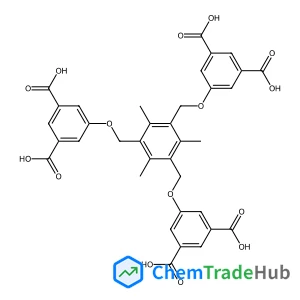
5,5',5''-(((2,4,6-Trimethylbenzene-1,3,5-triyl)tris(methylene))tris(oxy))triisophthalic acid
CAS Number:
1159974-70-5
Molecular Formula:
C36H30O15
Chunhui Xiao, Jinhua Chen, Bo Liu, Xiaochen Chu, Liang Wu, Shouzhuo Yao
A novel one-dimensional (1-D) caterpillar-like manganese dioxide–carbon (MnO2–C) nanocomposite has been synthesized by a direct redox reaction between carbon nanotubes (CNTs) and permanganate ions for the first time. The as-prepared nanostructured MnO2–C composite mainly consisting of ε-MnO2 nanoflakes had a unique microstructure, high specific surface area (200 m2 g−1) and favourable conductivity. The nanostructured MnO2–C composite, added as a modification to the glassy carbon (GC) electrode via a direct electrochemical co-deposition process with a chitosan hydrogel, was found to exhibit excellent catalytic activity toward L-cysteine electro-oxidation because the specific interaction between the –SH group of L-cysteine and solid MnO2 occurred to form surface complexes. A determination of L-cysteine at the MnO2–C/chitosan/GC (MnO2–C/chit/GC) electrode was carried out by amperometric measurement. Under the optimum experimental conditions, the detection response for L-cysteine was fast (within 7 s). The logarithm of catalytic currents shows a good linear relationship with that of the L-cysteine concentration in the range of 0.5–680 μM (R = 0.9986), with a low detection limit of 22 nM. The MnO2–C/Chit/GC electrode exhibited excellent stability (without any decrease of the response signal after 1 month) and admirable resistance against interference like glutathione and other oxidizable amino acids (tryptophan, tyrosine, L-lysine and methionine).
Shan Ping Liu, Ming Zhao, Guo En Sun, Wang Gao, Qing Jiang
DOI: 10.1039/C8CP00035B
Benjamin D. Datko, Maksim Y. Livshits, Zhen Zhang, Dana Portlock, Yang Qin, Jeffrey J. Rack, John K. Grey
DOI: 10.1039/C8CP04061C
Matthias Grünbacher, Lukas Schlicker, Maged F. Bekheet, Aleksander Gurlo, Bernhard Klötzer, Simon Penner
DOI: 10.1039/C8CP04350G
Sesha Vempati
DOI: 10.1039/C7CP08334C
Papri Chakraborty, Ananya Baksi, Sathish Kumar Mudedla, Abhijit Nag, Ganesan Paramasivam, Venkatesan Subramanian, Thalappil Pradeep
DOI: 10.1039/C7CP08181B
Xinghua Liu, Alexis Vazquez, Daxi Wang
DOI: 10.1039/C8CP02626B
Victor Gray, Betül Küçüköz, Fredrik Edhborg, Maria Abrahamsson, Kasper Moth-Poulsen, Bo Albinsson
DOI: 10.1039/C8CP00884A
Luke R. Anderson, Andrew M. Ediger
DOI: 10.1039/C8CP02829J
Waste containing N-Methoxy-N-methyl-1,3-thiazole-5-carboxamide (CAS: 898825-89-3...
N-(4-Biphenylyl)dibenzo[b,d]furan-4-amine should be stored in a tightly sealed c...
The market for 3-Acetamido-5-amino-2,4,6-triiodobenzoic acid (CAS: 1713-07-1) is...
Benzyl 2-O-acetyl-3,4,6-tri-O-benzyl-beta-D-galactopyranoside (CAS: 61820-03-9) ...
2-Ethylpiperazine dihydrochloride (CAS: 438050-52-3) is regulated under the Glob...
1,1'-[1,3-Phenylenebis(methylene)]bis(3-methyl-1H-pyrrole-2,5-dione) (CAS: 11946...
Several alternatives can be used in the synthesis of 5-Fluoro-2-(1-pyrrolidinyl)...
Proper personal protective equipment (PPE) must be worn when handling this compo...
When handling 6-Bromoimidazo[1,2-a]pyridin-8-amine, it is important to wear appr...
Alternatives to (2S,4R)-4-(4-Nitrobenzyl)pyrrolidine-2-carboxylic acid hydrochlo...

Physical Chemistry Chemical Physics (PCCP) is an international journal co-owned by 19 physical chemistry and physics societies from around the world. This journal publishes original, cutting-edge research in physical chemistry, chemical physics and biophysical chemistry. To be suitable for publication in PCCP, articles must include significant innovation and/or insight into physical chemistry; this is the most important criterion that reviewers and Editors will judge against when evaluating submissions. The journal has a broad scope and welcomes contributions spanning experiment, theory, computation and data science. Topical coverage includes spectroscopy, dynamics, kinetics, statistical mechanics, thermodynamics, electrochemistry, catalysis, surface science, quantum mechanics, quantum computing and machine learning. Interdisciplinary research areas such as polymers and soft matter, materials, nanoscience, energy, surfaces/interfaces, and biophysical chemistry are welcomed if they demonstrate significant innovation and/or insight into physical chemistry. Joined experimental/theoretical studies are particularly appreciated when complementary and based on up-to-date approaches.