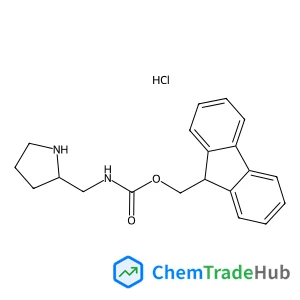
(S)-(9H-Fluoren-9-yl)methyl (pyrrolidin-2-ylmethyl)carbamate hydrochloride
CAS Number:
1217813-15-4
Molecular Formula:
C20H23ClN2O2
Ce Hao, Zhilong Xiu, Jieshan Qiu
An intermolecular coexistent hydrogen bond and a dihydrogen bond of a novel phenol-H2O-diethylmethylsilane (DEMS) complex in the electronically excited states were studied using the time-dependent density functional theory (TDDFT) method. Frontier molecular orbitals analysis revealed that the S2 state of the dihydrogen-bonded phenol-H2O-DEMS complex is a locally excited state in which only the phenol site is electronically excited. Upon electronic excitation, the O–H and H–Si vibrational modes are red shifted compared with those calculated for the ground state. The O–H and H–Si bonds involved in the dihydrogen bond O–H⋯H–Si and hydrogen bond O–H⋯O are longer in the S2 state than in the ground state. The H⋯H and H⋯O distances significantly shorten in the S2 state. Thus, both the intermolecular dihydrogen bond and the hydrogen bond of the phenol-H2O-DEMS complex are stronger in the electronically excited state than in the ground state. In addition, the hydrogen bonding is favorable for the formation of the intermolecular dihydrogen bond in the ground state. However, they are competitive with each other in the electronically excited state.
Zicheng Wang, Shuzhou Li, Yaping Zhang, Huaizhe Xu
DOI: 10.1039/C7CP07960E
Yong-Jun Liu, Lei Jia, Wei Huang
DOI: 10.1039/C8CP02296H
DOI: 10.1039/C8CP00261D
N. Molinari, A. P. Sutton
DOI: 10.1039/C8CP03281E
Luke R. Anderson, Andrew M. Ediger
DOI: 10.1039/C8CP02829J
Mohit Chawla, Pau Besalú-Sala, Kanav Kalra, Romina Oliva, Luigi Cavallo
DOI: 10.1039/C7CP07656H
DOI: 10.1039/C8CP02814A
Jesper Norell, Gilbert Grell, Oliver Kühn, Michael Odelius, Sergey I. Bokarev
DOI: 10.1039/C8CP02530D
Hung Tan Pham, Thi Tuyet Mai Dang, Long Van Duong
DOI: 10.1039/C8CP00380G
Waste containing N-Methoxy-N-methyl-1,3-thiazole-5-carboxamide (CAS: 898825-89-3...
N-(4-Biphenylyl)dibenzo[b,d]furan-4-amine should be stored in a tightly sealed c...
The market for 3-Acetamido-5-amino-2,4,6-triiodobenzoic acid (CAS: 1713-07-1) is...
Benzyl 2-O-acetyl-3,4,6-tri-O-benzyl-beta-D-galactopyranoside (CAS: 61820-03-9) ...
2-Ethylpiperazine dihydrochloride (CAS: 438050-52-3) is regulated under the Glob...
1,1'-[1,3-Phenylenebis(methylene)]bis(3-methyl-1H-pyrrole-2,5-dione) (CAS: 11946...
Several alternatives can be used in the synthesis of 5-Fluoro-2-(1-pyrrolidinyl)...
Proper personal protective equipment (PPE) must be worn when handling this compo...
When handling 6-Bromoimidazo[1,2-a]pyridin-8-amine, it is important to wear appr...
Alternatives to (2S,4R)-4-(4-Nitrobenzyl)pyrrolidine-2-carboxylic acid hydrochlo...

Physical Chemistry Chemical Physics (PCCP) is an international journal co-owned by 19 physical chemistry and physics societies from around the world. This journal publishes original, cutting-edge research in physical chemistry, chemical physics and biophysical chemistry. To be suitable for publication in PCCP, articles must include significant innovation and/or insight into physical chemistry; this is the most important criterion that reviewers and Editors will judge against when evaluating submissions. The journal has a broad scope and welcomes contributions spanning experiment, theory, computation and data science. Topical coverage includes spectroscopy, dynamics, kinetics, statistical mechanics, thermodynamics, electrochemistry, catalysis, surface science, quantum mechanics, quantum computing and machine learning. Interdisciplinary research areas such as polymers and soft matter, materials, nanoscience, energy, surfaces/interfaces, and biophysical chemistry are welcomed if they demonstrate significant innovation and/or insight into physical chemistry. Joined experimental/theoretical studies are particularly appreciated when complementary and based on up-to-date approaches.