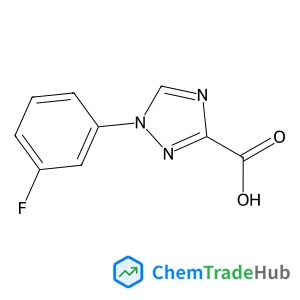
1-(3-Fluorophenyl)-1H-1,2,4-triazole-3-carboxylic acid
CAS Number:
1292369-51-7
Molecular Formula:
C9H6FN3O2
Antonius Indarto, Anna Giordana, Giovanni Ghigo, Andrea Maranzana, Glauco Tonachini
The synthesis of polycyclic aromatic hydrocarbons (PAHs) and the formation of soot platelets occur both during combustion at relatively low [O2], or under pyrolysis conditions. When the PAH size grows beyond the number of three-four condensed cycles, the partitioning of PAHs between the gas and particle phases favours the latter (i.e. adsorption). This study aims to assess which role the soot particle plays during PAH synthesis, in particular if catalytic or template effects of some sort can be exerted by the soot platelet on the adsorbed growing PAH-like radical. Our theoretical calculations indicate that chain elongation by ethyne addition cannot compete with cyclization when both can take place in the growing PAH-like radical, already in the gas phase. When it is adsorbed, cyclization is found to become easier than in the gas phase (more so, in terms of Gibbs free energy barriers, at higher temperatures), hinting at some sort of template effect, while chain elongation by ethyne addition becomes somewhat more difficult. The underlying soot platelet can assist (at lower temperatures) the formation of a larger aromatic hydrocarbon, by a final hydrogen abstraction from that endocyclic saturated carbon the newly formed cycle still bears. As an alternative (at higher temperature), a spontaneous hydrogen atom loss can take place. Finally, at rather low temperatures, the addition of the growing radical to the underlying soot platelet might occur and cause some reticulation, form more disordered structures, i.e. soot precursors instead of PAHs.
DOI: 10.1039/C7CP06621J
Juan Li, Shuqi Zheng, Teng Fang, Luo Yue, Shuai Zhang, Guiwu Lu
DOI: 10.1039/C7CP08680F
DOI: 10.1039/C8CP02814A
Agustín Lorenzo, Waldemar A. Marmisollé, Marcelo Ceolín, Omar Azzaroni
DOI: 10.1039/C7CP08139A
Yun Kyung Shin, A. S. M. Jonayat, Wonho Lee, Clive A. Randall, Adri C. T. van Duin
DOI: 10.1039/C8CP03586E
Leonardo A. Cunha, Luiz F. A. Ferrão, Francisco B. C. Machado, Max Pinheiro, Jr
DOI: 10.1039/C8CP03286F
Jose J. Plata, Francisca Romero-Sarria, Javier Amaya Suárez, Antonio M. Márquez, Óscar H. Laguna, José A. Odriozola, Javier Fdez Sanz
DOI: 10.1039/C8CP03706J
Nicolai Ree, Cecilie Lindholm Andersen, Martin Drøhse Kilde, Ole Hammerich, Mogens Brøndsted Nielsen, Kurt V. Mikkelsen
DOI: 10.1039/C7CP08687C
Marcelo Goulart, Lorenz Kranabetter, Martin Kuhn, Paul Martini, Paul Scheier
DOI: 10.1039/C8CP00486B
Waste containing N-Methoxy-N-methyl-1,3-thiazole-5-carboxamide (CAS: 898825-89-3...
N-(4-Biphenylyl)dibenzo[b,d]furan-4-amine should be stored in a tightly sealed c...
The market for 3-Acetamido-5-amino-2,4,6-triiodobenzoic acid (CAS: 1713-07-1) is...
Benzyl 2-O-acetyl-3,4,6-tri-O-benzyl-beta-D-galactopyranoside (CAS: 61820-03-9) ...
2-Ethylpiperazine dihydrochloride (CAS: 438050-52-3) is regulated under the Glob...
1,1'-[1,3-Phenylenebis(methylene)]bis(3-methyl-1H-pyrrole-2,5-dione) (CAS: 11946...
Several alternatives can be used in the synthesis of 5-Fluoro-2-(1-pyrrolidinyl)...
Proper personal protective equipment (PPE) must be worn when handling this compo...
When handling 6-Bromoimidazo[1,2-a]pyridin-8-amine, it is important to wear appr...
Alternatives to (2S,4R)-4-(4-Nitrobenzyl)pyrrolidine-2-carboxylic acid hydrochlo...

Physical Chemistry Chemical Physics (PCCP) is an international journal co-owned by 19 physical chemistry and physics societies from around the world. This journal publishes original, cutting-edge research in physical chemistry, chemical physics and biophysical chemistry. To be suitable for publication in PCCP, articles must include significant innovation and/or insight into physical chemistry; this is the most important criterion that reviewers and Editors will judge against when evaluating submissions. The journal has a broad scope and welcomes contributions spanning experiment, theory, computation and data science. Topical coverage includes spectroscopy, dynamics, kinetics, statistical mechanics, thermodynamics, electrochemistry, catalysis, surface science, quantum mechanics, quantum computing and machine learning. Interdisciplinary research areas such as polymers and soft matter, materials, nanoscience, energy, surfaces/interfaces, and biophysical chemistry are welcomed if they demonstrate significant innovation and/or insight into physical chemistry. Joined experimental/theoretical studies are particularly appreciated when complementary and based on up-to-date approaches.
![[(5-Methyl-1,3,4-thiadiazol-2-yl)sulfanyl]acetic acid structure](https://static.chemtradehub.com/structs/509/50918-26-8-4ce8.webp "[(5-Methyl-1,3,4-thiadiazol-2-yl)sulfanyl]acetic acid structure")

![2-Methyl-2-propanyl {3-[4-(4,4,5,5-tetramethyl-1,3,2-dioxaborolan-2-yl)phenyl]-3-oxetanyl}carbamate structure](https://static.chemtradehub.com/structs/127/1279090-25-3-1b84.webp "2-Methyl-2-propanyl {3-[4-(4,4,5,5-tetramethyl-1,3,2-dioxaborolan-2-yl)phenyl]-3-oxetanyl}carbamate structure")