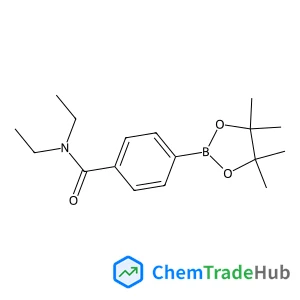
N,N-Diethyl-4-(4,4,5,5-tetramethyl-1,3,2-dioxaborolan-2-yl)benzamide
CAS Number:
325142-99-2
Molecular Formula:
C17H26BNO3
Zhixiao Liu, Wangyu Hu, Shiguo Zhang, Perla B. Balbuena, Partha P. Mukherjee
Using Li2S as an active material and designing nanostructured cathode hosts are considered as promising strategies to improve the performance of lithium–sulfur (Li–S) batteries. In this study, the reaction mechanisms during the delithiation of nanoconfined Li2S as an active material, represented by a Li20S10 cluster, are examined by first-principles based calculations and analysis. Local reduction and disproportionation reactions can be observed although the overall delithiation process is an oxidation reaction. Long-chain polysulfides can form as intermediate products; however they may bind to insoluble S2−via Li atoms as mediators. Activating the charging process only requires an overpotential of 0.37 V if using Li20S10 as the active material. Sulfur allotropes longer than cyclo-S8 are observed at the end of the charge process. Although the discharge voltage of Li20S10 is only 1.27 V, it can still deliver an appreciable theoretical energy density of 1480 W h kg−1. This study also suggests that hole polarons, in Li20S10 and intermediate products, can serve as carriers to facilitate charge transport. This work provides new insights toward revealing the detailed reaction mechanisms of nanoconfined Li2S as an active material in the Li–S battery cathode.
Longteng Tang, Yanli Wang, Liangdong Zhu, Karen Kallio, S. James Remington, Chong Fang
DOI: 10.1039/C8CP01907J
M. A. B. Larsen, A. B. Stephansen, E. Alarousu, M. Pittelkow, O. F. Mohammed, T. I. Sølling
DOI: 10.1039/C8CP00235E
Ziling Ding, Yan Xiong
DOI: 10.1039/C7CP07491C
Bing Bai, Hui Bai, Hao-Jie Cao, Zhi-Hua Gao, Zhi-Jun Zuo, Wei Huang
DOI: 10.1039/C8CP02000K
Joseph Czekner, Craig A. Taatjes, David L. Osborn, Giovanni Meloni
DOI: 10.1039/C7CP08221E
Tsukuru Ohwaki, Taisuke Ozaki, Yukihiro Okuno, Hideto Imai, Minoru Otani
DOI: 10.1039/C7CP08569A
DOI: 10.1039/C7CP06431D
This compound is mainly used as an intermediate in the synthesis of antipsychoti...
Waste containing 1-(D-Ribofuranosyl)-1,4-dihydro-3-pyridinecarboxamide (CAS: 191...
2-Methyl-2-propanyl 3-bromo-3-(hydroxymethyl)-1-azetidinecarboxylate (CAS: 20079...
N-(4-Chloro-2-pyridinyl)acetamide (CAS: 245056-66-0) is a chemical compound with...
5-Chloro-2-hydroxybenzoic acid, also known as 5-chlorosalicylic acid, is an arom...
When handling 1,1-Dichloro-1-fluoroethane (CAS: 1717-00-6), it is important to u...
Fmoc-(2S,3R)-3-phenylpyrrolidine-2-carboxylic acid is a white crystalline solid ...
4-Amino-5-bromo-2-pyridinecarboxylic acid is primarily used as a precursor in th...
Handling this compound should be done with personal protective equipment (PPE) i...
When handling 8-bromo-2,2-dimethyl-3,4-dihydro-2H-1,4-benzoxazin-3-one, use prop...

Physical Chemistry Chemical Physics (PCCP) is an international journal co-owned by 19 physical chemistry and physics societies from around the world. This journal publishes original, cutting-edge research in physical chemistry, chemical physics and biophysical chemistry. To be suitable for publication in PCCP, articles must include significant innovation and/or insight into physical chemistry; this is the most important criterion that reviewers and Editors will judge against when evaluating submissions. The journal has a broad scope and welcomes contributions spanning experiment, theory, computation and data science. Topical coverage includes spectroscopy, dynamics, kinetics, statistical mechanics, thermodynamics, electrochemistry, catalysis, surface science, quantum mechanics, quantum computing and machine learning. Interdisciplinary research areas such as polymers and soft matter, materials, nanoscience, energy, surfaces/interfaces, and biophysical chemistry are welcomed if they demonstrate significant innovation and/or insight into physical chemistry. Joined experimental/theoretical studies are particularly appreciated when complementary and based on up-to-date approaches.