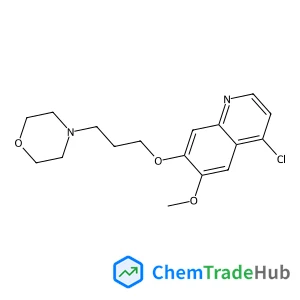
4-(3-((4-Chloro-6-methoxyquinolin-7-yl)oxy)propyl)morpholine
CAS Number:
205448-32-4
Molecular Formula:
C17H21ClN2O3
Junjian Xie, Xiangwen Zhang, Chengxiang Shi, Lun Pan, Fang Hou, Genkuo Nie, Jiawei Xie, Qing Liu, Ji-Jun Zou
Hydrocarbons with a highly strained four-membered ring are synthesized via self-photosensitized [2 + 2] cycloaddition and hydrodeoxygenation using cyclohexene and isophorone as feedstocks, which show high density and high heat values. Photoreaction can take place selectively with isophorone as a self-sensitizer and a reactant. Isophorone/cyclohexene co-cycloaddition has a much faster reaction rate than self-cycloaddition of isophorone, and both DFT calculations and photochemical kinetics show that the energy barrier for the former is much lower than that for the latter. Under optimal conditions, the selectivity of co-cycloaddition and self-cycloaddition can reach 93.3% and 94.9%, with isophorone conversion of 95.4% and 68.8%, respectively. In addition, a series of olefins can undergo self-photosensitized [2 + 2] cycloaddition with isophorone smoothly in high selectivity. After hydrodeoxygenation, hydrocarbons derived from isophorone/cyclohexene mixture and pure isophorone (with an overall yield of 82.1% and 61.3%) have high densities of 0.903 g mL−1 and 0.892 g mL−1, respectively, along with good cryogenic properties. Especially, the hydrocarbons synthesized through photosensitized cycloaddition show considerably higher density and heat values compared with those derived from a common C–C coupling route, which is attributed to the constructed strained cyclic structures. This work provides a new way for photosynthesis of high-energy-density hydrocarbons.
M. V. Pavliuk, A. M. Cieślak, A. Budinská, S. Pullen, K. Sokołowski, D. L. A. Fernandes, J. Szlachetko, E. L. Bastos, S. Ott, L. Hammarström, T. Edvinsson
DOI: 10.1039/C6SE00066E
Wim P. M. van Swaaij, Guido Mul, Sascha R. A. Kersten
DOI: 10.1039/D0SE00731E
Abida Naemat, Hany M. Elsheikha, Alaa Al-sandaqchi, Kenny Kong, Adrian Ghita, Ioan Notingher
DOI: 10.1039/C4AN01810A
Albert Sickmann, Martin Blüggel, Michael Kulke, Holger Kremmin, Alexandra Marx, Konrad Reske, Helmut E. Meyer
DOI: 10.1039/A909229C
Rodolfo L. Coppo, Byron H. Farnum, Benjamin D. Sherman, Neyde Y. Murakami Iha, Thomas J. Meyer
DOI: 10.1039/C6SE00022C
Marion André, Jean-Nicolas Dumez
DOI: 10.1039/C5AN00653H
Kazunari Miyazaki, Hiroki Muroyama, Toshiaki Matsui, Koichi Eguchi
DOI: 10.1039/D0SE00841A
2-(2-Chloroacetamido)-3-phenylpropanoic acid (CAS: 7765-11-9) is generally consi...
2-(Benzyloxy)-5-bromobenzoic acid can be handled safely if appropriate precautio...
(4-Methyl-1,2,5-oxadiazol-3-yl)methanamine hydrochloride is a chemical compound ...
2-(5-Hexylthiophen-2-yl)-4,4,5,5-tetramethyl-1,3,2-dioxaborolane (CAS: 917985-54...
While 4-(8-Methyl-9H-1,3-dioxolo[4,5-h][2,3]benzodiazepin-5-yl)benzenamine (CAS:...
The market for tert-butyl 3-hydroxy-4,5,7,8-tetrahydro-2H-pyrazolo[3,4-d]azepine...
Waste containing 3,5-Diamino-1H-pyrazole-4-carbonitrile (CAS: 6844-58-2) should ...
(6-Fluoro-3-pyridinyl)boronic acid can be synthesized through the reaction of 6-...
Dibenzyl carbonimidoylbiscarbamate (CAS: 10065-79-9) finds applications in vario...
The market for (beta,beta,2,3,4,5,6-~2~H_7_)Phenylalanine (CAS: 74228-83-4) is g...