













Selective hydrogenation of furfural to tetrahydrofurfuryl alcohol over a Rh-loaded carbon catalyst in aqueous solution under mild conditions
Literature Information
Publication Date
2019-11-04
DOI
10.1039/C9SE00681H
Impact Factor
6.367
Authors
Babasaheb M. Matsagar, Chang-Yen Hsu, Season S. Chen, Tansir Ahamad, Saad M. Alshehri, Daniel C. W. Tsang
View Original
Abstract
We describe the selective hydrogenation of furfural (FAL) into tetrahydrofurfuryl alcohol (THFA) under mild conditions (30 °C) in aqueous media using an Rh-loaded carbon (Rh/C) catalyst in a one-pot fashion. In FAL hydrogenation, the Rh/C catalyst showed a high THFA yield (92%) with 93% selectivity in aqueous media within 12 h, whereas the use of a dimethylacetamide (DMA) solvent system resulted in a 95% THFA yield within 32 h at 30 °C. The study of the effect of the solvent on FAL hydrogenation reveals that polar solvents showed higher THFA yields than a toluene solvent. The Rh/C catalyst used in this study exhibited higher activity compared to Ru/C, Pd/C, Ni/C derived from Ni-based metal–organic framework (Ni-MOF), and Ni-loaded carbon black (Ni/CB) catalysts in FAL-to-THFA hydrogenation. The Rh/C catalyst is characterized in detail using various characterization techniques such as TEM, XRD, N2-adsorption–desorption, XPS, and ICP-OES to understand its physicochemical properties. The Rh/C catalyst shows similar high THFA yields in the recycling experiment of FAL hydrogenation under ambient conditions.
Related Literature
Enhanced electrochemical activity of perforated graphene in nickel-oxide-based supercapacitors and fabrication of potential asymmetric supercapacitors
Qi Xun Xia, Je Moon Yun, Rajaram S. Mane, Lei Li, Jianjian Fu, Jae Hong Lim
2017-02-03
Paper
DOI: 10.1039/C6SE00085A
An integrated closed-tube 2-plex PCR amplification and hybridization assay with switchable lanthanide luminescence based spatial detection
Susanne Lahdenperä, Anni Spangar, Anna-Maija Lempainen, Laura Joki, Tero Soukka
2015-04-07
Paper
DOI: 10.1039/C5AN00253B
Improving the activity of CoxP nanoparticles for the electrochemical hydrogen evolution by hydrogenation
James Murowchick, Xiaobo Chen
2017-01-05
Communication
DOI: 10.1039/C6SE00058D
Magnetic energy harvesting with magnetoelectrics: an emerging technology for self-powered autonomous systems
Venkateswarlu Annapureddy, Haribabu Palneedi, Geon-Tae Hwang, Mahesh Peddigari, Dae-Yong Jeong, Woon-Ha Yoon, Kwang-Ho Kim, Jungho Ryu
2017-10-03
Review Article
DOI: 10.1039/C7SE00403F
Characterization of a new rechargeable Zn/PVA-KOH/Bi2O3 battery: structural changes of the Bi2O3 electrode
Sebastián Lorca, Florencio Santos, José Abad, Yves Huttel, Antonio Urbina, Antonio J. Fernández Romero
2020-06-08
Paper
DOI: 10.1039/D0SE00551G
Plasma assisted fabrication of a NaTi2(PO4)3@Gr nanocomposite for high-rate and long cycle-life sodium-ion batteries
Zhong-Yue Wang, Rui Zheng, Wen-Jun Li, Yu-Jie Ma, Ke-Han Yu, Peng Lv, Wei Wei
2020-06-22
Paper
DOI: 10.1039/D0SE00347F
An arginine-functionalized stationary phase for hydrophilic interaction liquid chromatography
Shengjie Wu, Feifang Zhang, Ge Jiang, Bingcheng Yang
2015-04-23
Communication
DOI: 10.1039/C5AN00570A
Trade-off between oxygen reduction reaction activity and CO2 stability in a cation doped Ba0.9Co0.7Fe0.3O3−δ perovskite cathode for solid oxide fuel cells
Zhihong Wang
2020-08-28
Paper
DOI: 10.1039/D0SE00878H
Increased hydrogen partial pressure suppresses and reverses hydrogen evolution during Pd catalysed electrolysis of CO2
Wim P. M. van Swaaij, Guido Mul, Sascha R. A. Kersten
2020-06-30
Communication
DOI: 10.1039/D0SE00731E
Bifunctional catalytic activity of Ni–Co layered double hydroxide for the electro-oxidation of water and methanol
Komal Patil, Pravin Babar, Dong Min Lee, Vijay Karade, Eunae Jo, Jin Hyeok Kim
2020-08-15
Paper
DOI: 10.1039/D0SE00899K
You might also like
Compound Q&A
Is 2-(2-chloroacetamido)-3-phenylpropanoic acid (CAS: 7765-11-9) safe?
2-(2-Chloroacetamido)-3-phenylpropanoic acid (CAS: 7765-11-9) is generally consi...
7765-11-92-(2-chloroacetamido...
Compound Q&A
Is 2-(Benzyloxy)-5-bromobenzoic acid (CAS: 62176-31-2) safe?
2-(Benzyloxy)-5-bromobenzoic acid can be handled safely if appropriate precautio...
62176-31-22-(Benzyloxy)-5-brom...
Compound Q&A
What is (4-Methyl-1,2,5-oxadiazol-3-yl)methanamine hydrochloride (CAS: 1159825-48-5)?
(4-Methyl-1,2,5-oxadiazol-3-yl)methanamine hydrochloride is a chemical compound ...
1159825-48-5(4-Methyl-1,2,5-oxad...
Compound Q&A
What is 2-(5-Hexylthiophen-2-yl)-4,4,5,5-tetramethyl-1,3,2-dioxaborolane (CAS: 917985-54-7)?
2-(5-Hexylthiophen-2-yl)-4,4,5,5-tetramethyl-1,3,2-dioxaborolane (CAS: 917985-54...
917985-54-72-(5-Hexylthiophen-2...
Compound Q&A
Are there alternatives to 4-(8-Methyl-9H-1,3-dioxolo[4,5-h][2,3]benzodiazepin-5-yl)benzenamine (CAS: 102771-26-6) in synthesis?
While 4-(8-Methyl-9H-1,3-dioxolo[4,5-h][2,3]benzodiazepin-5-yl)benzenamine (CAS:...
102771-26-64-(8-Methyl-9H-1,3-d...
Compound Q&A
What is the market or research trend for tert-butyl 3-hydroxy-4,5,7,8-tetrahydro-2H-pyrazolo[3,4-d]azepine-6-carboxylate (CAS: 851376-80-2)?
The market for tert-butyl 3-hydroxy-4,5,7,8-tetrahydro-2H-pyrazolo[3,4-d]azepine...
851376-80-2tert-butyl 3-hydroxy...
Compound Q&A
How should waste containing 3,5-Diamino-1H-pyrazole-4-carbonitrile (CAS: 6844-58-2) be handled?
Waste containing 3,5-Diamino-1H-pyrazole-4-carbonitrile (CAS: 6844-58-2) should ...
6844-58-23,5-Diamino-1H-pyraz...
Compound Q&A
How is (6-Fluoro-3-pyridinyl)boronic acid (CAS: 351019-18-6) typically synthesized?
(6-Fluoro-3-pyridinyl)boronic acid can be synthesized through the reaction of 6-...
351019-18-6(6-Fluoro-3-pyridiny...
Compound Q&A
What industries use Dibenzyl carbonimidoylbiscarbamate (CAS: 10065-79-9)?
Dibenzyl carbonimidoylbiscarbamate (CAS: 10065-79-9) finds applications in vario...
10065-79-9Dibenzyl carbonimido...
Compound Q&A
What is the market or research trend for (beta,beta,2,3,4,5,6-~2~H_7_)Phenylalanine (CAS: 74228-83-4)?
The market for (beta,beta,2,3,4,5,6-~2~H_7_)Phenylalanine (CAS: 74228-83-4) is g...
74228-83-4(beta,beta,2,3,4,5,6...
Source Journal
Recommended Compounds
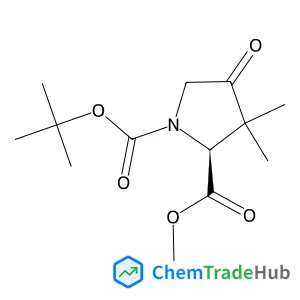
2-Methyl 1-(2-methyl-2-propanyl) (2S)-3,3-dimethyl-4-oxo-1,2-pyrrolidinedicarboxylate
CAS Number:
478698-30-5
Molecular Formula:
C13H21NO5
![[3-Fluoro-4-(1-pyrrolidinylcarbonyl)phenyl]boronic acid structure](https://static.chemtradehub.com/structs/874/874289-09-5-e3d4.webp "[3-Fluoro-4-(1-pyrrolidinylcarbonyl)phenyl]boronic acid structure")
[3-Fluoro-4-(1-pyrrolidinylcarbonyl)phenyl]boronic acid
CAS Number:
874289-09-5
Molecular Formula:
C11H13BFNO3
![2-(5-Bromo-1H-pyrrolo[2,3-B]pyridin-3-YL)acetic acid structure](https://static.chemtradehub.com/structs/106/1060795-03-0-0589.webp "2-(5-Bromo-1H-pyrrolo[2,3-B]pyridin-3-YL)acetic acid structure")
2-(5-Bromo-1H-pyrrolo[2,3-B]pyridin-3-YL)acetic acid
CAS Number:
1060795-03-0
Molecular Formula:
C9H7BrN2O2
Recommended Suppliers






Disclaimer
This page provides academic journal information for reference and research purposes only. We are not affiliated with any journal publishers and do not handle publication submissions. For publication-related inquiries, please contact the respective journal publishers directly.
If you notice any inaccuracies in the information displayed, please contact us at support@chemtradehub.com. We will promptly review and address your concerns.