













Tuning the surface segregation composition of a PdCo alloy by the atmosphere for increasing electrocatalytic activity
Literature Information
Publication Date
2019-10-16
DOI
10.1039/C9SE00620F
Impact Factor
6.367
Authors
Tongtong Li, Rong Wang, Minghe Yang, Shuaishuai Zhao, Zhijie Li, Junjian Miao, Zhi-Da Gao, Yan-Yan Song
View Original
Abstract
The rational design of active sites for electrocatalysts is crucial for achieving high efficiency of electrochemical reactions. Contrary to the shape-controlled method, herein, we reported a selective segregation-etching strategy to highly increase the active sites of a bimetallic alloy as a high-performance electrocatalyst. The surface composition of the PdCo alloy was manipulated by its preferential segregation in the atmosphere according to the predictions of the density functional theory (DFT). By leaching Co atoms from the surface having a balanced composition with consecutive potential cycling in an acid solution, the surface reconstructed to show a high density of high-index Pd facets identified by Cs-corrected transmission electron microscopy. Using hydrogen evolution as a model reaction, the resulting catalyst exhibited enhanced electrocatalytic activity and outstanding long-term stability. This study provides a general principle to design a transition metal alloy with highly active sites, which has a great potential in broad areas such as batteries, fuel cells, and beyond.
Related Literature
Non-enzymatic glucose sensing by enhanced Raman spectroscopy on flexible ‘as-grown’ CVD graphene
Mau-Shiun Li, Pradip Kumar Roy, C. T. Wu
2015-04-24
Communication
DOI: 10.1039/C5AN00546A
Carbon-based materials as heterogeneous antioxidants for biodiesel: efficiency and synergy with soluble antioxidants
Tais da C. Soares, Paulo R. M. Silva, Gilberto A. Romeiro, Mauricio G. Fonseca, Luciano N. Batista
2017-01-06
Communication
DOI: 10.1039/C6SE00017G
Carbon onion–sulfur hybrid cathodes for lithium–sulfur batteries
Simon Fleischmann, Petr Formanek, Lars Borchardt
2017-01-03
Paper
DOI: 10.1039/C6SE00034G
Synergetic FeCo nanorods embedded in nitrogen-doped carbon nanotubes with abundant metal–NCNT heterointerfaces as efficient air electrocatalysts for rechargeable zinc–air batteries
Hao Hu, Yuhua Xie, Farhad M. D. Kazim, Konggang Qu, Min Li, Zehui Yang
2020-08-10
Paper
DOI: 10.1039/D0SE01023E
Drop-by-drop chemical reaction and sample introduction for capillary electrophoresis
Ying Rang, Ying Weng, Luyao Lin, Hulie Zeng, Hizuru Nakajim, Jin-Ming Lin, Katsumi Uchiyama
2015-02-05
Paper
DOI: 10.1039/C5AN00040H
The development of “fab-chips” as low-cost, sensitive surface-enhanced Raman spectroscopy (SERS) substrates for analytical applications
Ashley M. Robinson, Lili Zhao, Marwa Y. Shah Alam, Paridhi Bhandari, Scott G. Harroun, Dhananjaya Dendukuri, Jonathan Blackburn, Christa L. Brosseau
2014-11-24
Paper
DOI: 10.1039/C4AN01633E
Effect of partial pressure on product selectivity in Cu-catalyzed electrochemical reduction of CO2
Mozhgan Moradzaman, Carlos Sánchez Martínez, Guido Mul
2020-08-17
Paper
DOI: 10.1039/D0SE00865F
A novel bifunctional microencapsulated phase change material loaded with ZnO for thermal energy storage and light–thermal energy conversion
Chaowei Huang, Qiuting Li, Yubin Yang, Sheng Wei, Rong Ji, Qingfeng Zhang, Yucao Zhu, Yongpeng Xia
2020-07-25
Paper
DOI: 10.1039/D0SE00718H
Plasma assisted fabrication of a NaTi2(PO4)3@Gr nanocomposite for high-rate and long cycle-life sodium-ion batteries
Zhong-Yue Wang, Rui Zheng, Wen-Jun Li, Yu-Jie Ma, Ke-Han Yu, Peng Lv, Wei Wei
2020-06-22
Paper
DOI: 10.1039/D0SE00347F
Rock ‘n’ use of CO2: carbon footprint of carbon capture and utilization by mineralization
Hesam Ostovari, André Sternberg
2020-04-30
Paper
DOI: 10.1039/D0SE00190B
You might also like
Compound Q&A
Is 2-(2-chloroacetamido)-3-phenylpropanoic acid (CAS: 7765-11-9) safe?
2-(2-Chloroacetamido)-3-phenylpropanoic acid (CAS: 7765-11-9) is generally consi...
7765-11-92-(2-chloroacetamido...
Compound Q&A
Is 2-(Benzyloxy)-5-bromobenzoic acid (CAS: 62176-31-2) safe?
2-(Benzyloxy)-5-bromobenzoic acid can be handled safely if appropriate precautio...
62176-31-22-(Benzyloxy)-5-brom...
Compound Q&A
What is (4-Methyl-1,2,5-oxadiazol-3-yl)methanamine hydrochloride (CAS: 1159825-48-5)?
(4-Methyl-1,2,5-oxadiazol-3-yl)methanamine hydrochloride is a chemical compound ...
1159825-48-5(4-Methyl-1,2,5-oxad...
Compound Q&A
What is 2-(5-Hexylthiophen-2-yl)-4,4,5,5-tetramethyl-1,3,2-dioxaborolane (CAS: 917985-54-7)?
2-(5-Hexylthiophen-2-yl)-4,4,5,5-tetramethyl-1,3,2-dioxaborolane (CAS: 917985-54...
917985-54-72-(5-Hexylthiophen-2...
Compound Q&A
Are there alternatives to 4-(8-Methyl-9H-1,3-dioxolo[4,5-h][2,3]benzodiazepin-5-yl)benzenamine (CAS: 102771-26-6) in synthesis?
While 4-(8-Methyl-9H-1,3-dioxolo[4,5-h][2,3]benzodiazepin-5-yl)benzenamine (CAS:...
102771-26-64-(8-Methyl-9H-1,3-d...
Compound Q&A
What is the market or research trend for tert-butyl 3-hydroxy-4,5,7,8-tetrahydro-2H-pyrazolo[3,4-d]azepine-6-carboxylate (CAS: 851376-80-2)?
The market for tert-butyl 3-hydroxy-4,5,7,8-tetrahydro-2H-pyrazolo[3,4-d]azepine...
851376-80-2tert-butyl 3-hydroxy...
Compound Q&A
How should waste containing 3,5-Diamino-1H-pyrazole-4-carbonitrile (CAS: 6844-58-2) be handled?
Waste containing 3,5-Diamino-1H-pyrazole-4-carbonitrile (CAS: 6844-58-2) should ...
6844-58-23,5-Diamino-1H-pyraz...
Compound Q&A
How is (6-Fluoro-3-pyridinyl)boronic acid (CAS: 351019-18-6) typically synthesized?
(6-Fluoro-3-pyridinyl)boronic acid can be synthesized through the reaction of 6-...
351019-18-6(6-Fluoro-3-pyridiny...
Compound Q&A
What industries use Dibenzyl carbonimidoylbiscarbamate (CAS: 10065-79-9)?
Dibenzyl carbonimidoylbiscarbamate (CAS: 10065-79-9) finds applications in vario...
10065-79-9Dibenzyl carbonimido...
Compound Q&A
What is the market or research trend for (beta,beta,2,3,4,5,6-~2~H_7_)Phenylalanine (CAS: 74228-83-4)?
The market for (beta,beta,2,3,4,5,6-~2~H_7_)Phenylalanine (CAS: 74228-83-4) is g...
74228-83-4(beta,beta,2,3,4,5,6...
Source Journal
Recommended Compounds
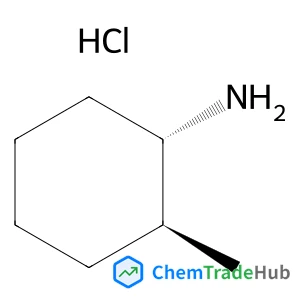
(1R,2R)-2-Methylcyclohexanamine hydrochloride (1:1)
CAS Number:
39558-31-1
Molecular Formula:
C7H16ClN
Recommended Suppliers







Disclaimer
This page provides academic journal information for reference and research purposes only. We are not affiliated with any journal publishers and do not handle publication submissions. For publication-related inquiries, please contact the respective journal publishers directly.
If you notice any inaccuracies in the information displayed, please contact us at support@chemtradehub.com. We will promptly review and address your concerns.