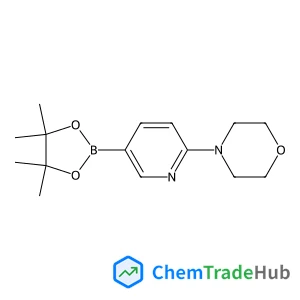
4-(5-(4,4,5,5-tetramethyl-1,3,2-dioxaborolan-2-yl)pyridin-2-yl)morpholine
CAS Number:
485799-04-0
Molecular Formula:
C15H23BN2O3
Wenbo Ma, Nikolaos Kaplaneris, Xinyue Fang, Linghui Gu, Ruhuai Mei, Lutz Ackermann
The development of convenient and mild chalcogenylation reactions for the preparation of unsymmetrical diaryl sulfides and diaryl selenides has received significant attention in recent years due to their prevalence in natural products, organic molecular syntheses, catalysis, drug candidates and functional materials. In contrast with conventional organic transformations which largely rely on the inherent reactivity of functional groups, transition metal-catalysed direct C–H functionalizations have emerged as a powerful strategy that eliminates prefunctionalised starting materials and thus leads to more atom- and step-economical processes. This review summarizes the recent advances in C–S and C–Se formations via transition metal-catalyzed C–H functionalization utilizing directing groups to control the site-selectivity until autumn 2019. Typical examples are listed and mechanistic aspects are discussed in detail.
Yufei Shan
DOI: 10.1039/C8AN00456K
Robert A. Hill, Marie Claire Parker
DOI: 10.1039/B307118A
Hugo Knobel, Hans Weda, Lieuwe D. Bos, Tamara M. E. Nijsen, Royston Goodacre
DOI: 10.1039/C8AN00759D
Chengxin Luan
DOI: 10.1039/C9AN00733D
Yuqing Hou, Wen Zhang, Shengtao Li, Zhen Wang, Huiqing Zhong, Zhiming Liu, Zhouyi Guo
DOI: 10.1039/C8AN00405F
(1R,3S)-1,3-Cyclopentanediol finds applications in various industries. In the ph...
When handling N'-[4-(Dimethylamino)phenyl]-N,N-dimethyl-1,4-benzenediamine, it i...
There are several alternatives to 5-(2,4-Difluorophenyl)-2-methoxypyrimidine in ...
1-(3-Methoxyphenoxy)propan-2-ol (CAS: 382141-68-6) must comply with the Globally...
Tetrodotoxin Citrate is extremely dangerous and should be handled with extreme c...
2-Methyl-2-propanyl [(1R,3S)-3-hydroxycyclopentyl]carbamate (CAS: 225641-84-9) i...
Waste containing 4-(2-Hydroxyhexafluoroisopropyl)Benzoic Acid (CAS: 16261-80-6) ...
2-Methyl-2-proanyl {(2S)-1-[(benzyloxy)amino]-3-hydroxy-3-methyl-1-oxo-2-butanyl...
Benzeneethanamine, α-ethyl-, hydrochloride (1:1) is an organic compound with the...
In the synthesis of compounds similar to 3-{(E)-[4-(Dimethylamino)phenyl]diazeny...

Organic Chemistry Frontiers publishes high-quality research from across organic chemistry. Emphases are placed on studies that make significant contributions to the field of organic chemistry by reporting either new or significantly improved protocols or methodologies. Topics include, but are not limited to the following: Organic synthesis Development of synthetic methodologies Catalysis Natural products Functional organic materials Supramolecular and macromolecular chemistry Physical and computational organic chemistry
![N-[(1S,2R,4S)-2-Amino-4-(dimethylcarbamoyl)cyclohexyl]-N'-(5-chloro-2-pyridinyl)ethanediamide structure](https://static.chemtradehub.com/structs/480/480452-37-7-0898.webp "N-[(1S,2R,4S)-2-Amino-4-(dimethylcarbamoyl)cyclohexyl]-N'-(5-chloro-2-pyridinyl)ethanediamide structure")