












Volatile organic compound signature from co-culture of lung epithelial cell line with Pseudomonas aeruginosa
Literature Information
Publication Date
2018-06-01
DOI
10.1039/C8AN00759D
Impact Factor
4.616
Authors
Hugo Knobel, Hans Weda, Lieuwe D. Bos, Tamara M. E. Nijsen, Royston Goodacre
View Original
Abstract
Bacteria are found ubiquitously within and on nearly every site within humans, including the airways. Microbes interact with airway epithelial cells in lung infections such as ventilator-associated pneumonia (VAP). Development of infection results in the production of oxidants such as hydrogen peroxide that may further damage the epithelium. VAP is difficult to diagnose and associated with significant mortality. Current methods are invasive and time consuming impacting on appropriate therapy, antimicrobial resistance and financial costs. Volatile organic compound (VOC) analysis in exhaled breath is proposed as a tool for early detection due to its non-invasive property and potential to facilitate timely diagnosis. To investigate potential early VOC markers, A549 epithelial cells that were originally isolated from human alveoli were cultured with and without Pseudomonas aeruginosa, and the headspace of the culture vessel analysed using sorbent-based capture of VOCs followed by thermal desorption-gas chromatography-mass spectrometry (TD-GC-MS) in order to identify potential discriminatory VOCs. A549 cells were also cultured with hydrogen peroxide to induce oxidative stress in order to investigate potential biomarkers of epithelial cell damage. Previously reported VOCs including acetone and ethanol were observed from the infection experiment along with novel bacterial markers, which we identified as mostly ether based compounds. Alkanes such as decane and octane were also found to be elevated after hydrogen peroxide treatment of A549 cells, likely as a result of peroxidation of oleic acids.
Recommended Journals
Related Literature
Hidden complexities in the reaction of H2O2 and HNO revealed by ab initio quantum chemical investigations
Daniel Beckett, Marc Edelmann, Jonathan D. Raff, Krishnan Raghavachari
2017-10-16
Paper
DOI: 10.1039/C7CP05883G
Noncovalent interactions underlying binary mixtures of amino acid based ionic liquids: insights from theory
Soniya S. Rao, Libero J. Bartolotti, Shridhar P. Gejji
2017-10-17
Paper
DOI: 10.1039/C7CP04323F
Scaling relations for the interactions between curved graphene sheets in water
Sonal Kumar, Prasad Rama, Ajay Singh Panwar
2017-10-17
Paper
DOI: 10.1039/C7CP05005D
Distribution of aluminum over different T-sites in ferrierite zeolites studied with aluminum valence to core X-ray emission spectroscopy
R. Bohinc, J. Hoszowska, J.-Cl. Dousse, W. Błachucki, F. Zeeshan, Y. Kayser, M. Nachtegaal, A. B. Pinar
2017-10-11
Paper
DOI: 10.1039/C7CP05001A
Effect of donor to acceptor ratio on electrochemical and spectroscopic properties of oligoalkylthiophene 1,3,4-oxadiazole derivatives
Aleksandra Kurowska, Pawel Zassowski, Tatyana Yu. Zheleznova, Kseniya V. Andryukhova, Adam Pron, Wojciech Domagala
2017-10-18
Paper
DOI: 10.1039/C7CP05155G
Effect of cooling on droplet size in supersaturation-induced emulsions
Shirui Luo, Jarrod Schiffbauer
2017-10-18
Paper
DOI: 10.1039/C7CP05905A
Asymmetric vanadium flow batteries: long lifespan via an anolyte overhang strategy
Di Mu, Yang Zhao, Liwei Yu, Le Liu, Jingyu Xi
2017-10-09
Paper
DOI: 10.1039/C7CP06249D
You might also like
Compound Q&A
What industries use (1R,3S)-1,3-Cyclopentanediol (CAS: 16326-97-9)?
(1R,3S)-1,3-Cyclopentanediol finds applications in various industries. In the ph...
16326-97-9(1R,3S)-1,3-Cyclopen...
Compound Q&A
What precautions should be taken when handling N'-[4-(Dimethylamino)phenyl]-N,N-dimethyl-1,4-benzenediamine (CAS: 637-31-0)?
When handling N'-[4-(Dimethylamino)phenyl]-N,N-dimethyl-1,4-benzenediamine, it i...
637-31-0N'-[4-(Dimethylamino...
Compound Q&A
Are there alternatives to 5-(2,4-Difluorophenyl)-2-methoxypyrimidine (CAS: 1352318-16-1) in synthesis?
There are several alternatives to 5-(2,4-Difluorophenyl)-2-methoxypyrimidine in ...
1352318-16-15-(2,4-Difluoropheny...
Compound Q&A
What regulatory guidelines apply to 1-(3-Methoxyphenoxy)propan-2-ol (CAS: 382141-68-6)?
1-(3-Methoxyphenoxy)propan-2-ol (CAS: 382141-68-6) must comply with the Globally...
382141-68-61-(3-Methoxyphenoxy)...
Compound Q&A
Is Tetrodotoxin Citrate (CAS: 18660-81-6) safe?
Tetrodotoxin Citrate is extremely dangerous and should be handled with extreme c...
18660-81-6Tetrodotoxin Citrate
Compound Q&A
What are the main uses of 2-Methyl-2-propanyl [(1R,3S)-3-hydroxycyclopentyl]carbamate (CAS: 225641-84-9)?
2-Methyl-2-propanyl [(1R,3S)-3-hydroxycyclopentyl]carbamate (CAS: 225641-84-9) i...
225641-84-92-Methyl-2-propanyl ...
Compound Q&A
How should waste containing 4-(2-Hydroxyhexafluoroisopropyl)Benzoic Acid (CAS: 16261-80-6) be handled?
Waste containing 4-(2-Hydroxyhexafluoroisopropyl)Benzoic Acid (CAS: 16261-80-6) ...
16261-80-64-(2-Hydroxyhexafluo...
Compound Q&A
How is 2-Methyl-2-proanyl {(2S)-1-[(benzyloxy)amino]-3-hydroxy-3-methyl-1-oxo-2-butanyl}carbamate (CAS: 102507-19-7) typically synthesized?
2-Methyl-2-proanyl {(2S)-1-[(benzyloxy)amino]-3-hydroxy-3-methyl-1-oxo-2-butanyl...
102507-19-72-Methyl-2-propanyl ...
Compound Q&A
What is Benzeneethanamine, α-ethyl-, hydrochloride (1:1) (CAS: 20735-15-3)?
Benzeneethanamine, α-ethyl-, hydrochloride (1:1) is an organic compound with the...
20735-15-3Benzeneethanamine, α...
Compound Q&A
Are there alternatives to 3-{(E)-[4-(Dimethylamino)phenyl]diazenyl}benzoic acid (CAS: 20691-84-3) in synthesis?
In the synthesis of compounds similar to 3-{(E)-[4-(Dimethylamino)phenyl]diazeny...
20691-84-33-{(E)-[4-(Dimethyla...
Source Journal
Analyst

CiteScore:
7.8
Self-citation Rate:
5.6%
Articles per Year:
653
Analyst publishes analytical and bioanalytical research that reports premier fundamental discoveries and inventions, and the applications of those discoveries, unconfined by traditional discipline barriers.
Recommended Compounds
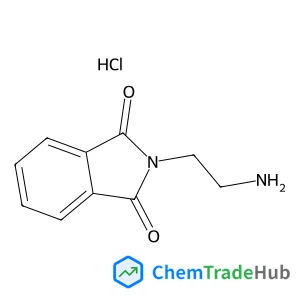
2-(2-Aminoethyl)-1H-isoindole-1,3(2H)-dione hydrochloride (1:1)
CAS Number:
30250-67-0
Molecular Formula:
C10H11ClN2O2
Recommended Suppliers





Disclaimer
This page provides academic journal information for reference and research purposes only. We are not affiliated with any journal publishers and do not handle publication submissions. For publication-related inquiries, please contact the respective journal publishers directly.
If you notice any inaccuracies in the information displayed, please contact us at support@chemtradehub.com. We will promptly review and address your concerns.