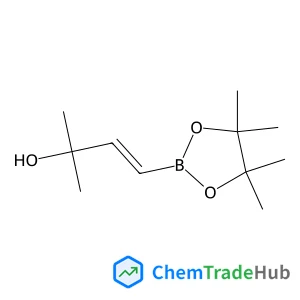
(E)-2-methyl-4-(4,4,5,5-tetramethyl-1,3,2-dioxaborolan-2-yl)but-3-en-2-ol
CAS Number:
581802-26-8
Molecular Formula:
C11H21BO3
Roberta Teta, Gerardo Della Sala, Germana Esposito, Christopher W. Via, Carmela Mazzoccoli, Matthew J. Bertin, Valeria Costantino, Alfonso Mangoni
The bloom-forming cyanobacterium Trichodesmium sp. has been recently shown to produce some of the chlorinated peptides/polyketides previously isolated from the marine sponge Smenospongia aurea. A comparative analysis of extracts from S. aurea and Trichodesmium sp. was performed using tandem mass spectrometry-based molecular networking. The analysis, specifically targeted to chlorinated metabolites, showed that many of them are common to the two organisms, but also that some general differences exist between the two metabolomes. Following this analysis, six new chlorinated metabolites were isolated and their structures were elucidated: four polyketides, smenolactones A–D (1–4) from S. aurea, and two new conulothiazole analogues, isoconulothiazole B (5) and conulothiazole C (6) from Trichodesmium sp. The absolute configuration of smenolactone C (3) was determined by taking advantage of the conformational rigidity of open 1,3-disubstituted alkyl chains. The antiproliferative activity of smenolactones was evaluated on three tumor cell lines, and they were active at low-micromolar or sub-micromolar concentrations.

Critical Reviews in Solid State and Materials Sciences

Electroanalysis

Heteroatom Chemistry

Main Group Chemistry

NDT & E International

Journal of Chemical Sciences

Bioorganic & Medicinal Chemistry Letters

Acta Metallurgica Sinica-English Letters

Herald of the Russian Academy of Sciences

Chinese Journal of Chemistry
Bader S. Ghanem
DOI: 10.1039/C1PY00423A
Nathan R. B. Boase, Idriss Blakey, Kristofer J. Thurecht
DOI: 10.1039/C2PY20132A
Junjie Qi, Weipeng Lv, Guoliang Zhang, Fengbao Zhang, Xiaobin Fan
DOI: 10.1039/C2PY00577H
Tzu-Chun Yeh, Tsao-Cheng Huang, Hsiu-Ying Huang, Yu-Pei Huang, Yu-Ting Cai, Shih-Ting Lin, Yen Wei, Jui-Ming Yeh
DOI: 10.1039/C2PY20061A
Xiaolong Wang, Feng Zhou
DOI: 10.1039/C2PY20148H
Denis Damiron, Jérôme Mazzolini, Fabrice Cousin, Christophe Boisson, Franck D'Agosto, Eric Drockenmuller
DOI: 10.1039/C1PY00459J
Daisuke Abe, Yuji Sasanuma
DOI: 10.1039/C2PY20118F
Yukiya Kitayama, Hirotaka Moribe, Kazuya Kishida
DOI: 10.1039/C2PY20105D
Harry R. Allcock, Nicole L. Morozowich
DOI: 10.1039/C1PY00468A
Lionel Petton, Andrés E. Ciolino, Bart Dervaux, Filip E. Du Prez
DOI: 10.1039/C2PY00444E
When considering alternatives to 1-(4-Chlorophenyl)-N-hydroxymethanimine (CAS: 3...
This compound should be stored in a cool, dry place away from direct sunlight. I...
3-(4-Bromophenyl)-5-(2-fluorophenyl)-1,2,4-oxadiazole is synthesized through a m...
5-Chloro-2-(4-chlorophenyl)-4-methyl-6-[3-(1-piperidinyl)propoxy]pyrimidine (CAS...
2-Chloro-4-(difluoromethoxy)pyridine is used in the pharmaceutical industry for ...
3-Chloro-6-methylpyridazine (CAS: 1121-79-5) is classified under the Globally Ha...
Several alternatives can be used in the synthesis of Methyl 4,5-dimethyl-2-nitro...
Alternatives to (2E,2'E)-3,3'-(1,4-Phenylene)bisacrylaldehyde include other acry...
3-Amino-5-chloropyridin-2-ol hydrochloride is an organic compound with the CAS n...
When handling 6,7-Difluoro-2,3-dihydro-4H-chromen-4-one, it is essential to wear...

Organic Chemistry Frontiers publishes high-quality research from across organic chemistry. Emphases are placed on studies that make significant contributions to the field of organic chemistry by reporting either new or significantly improved protocols or methodologies. Topics include, but are not limited to the following: Organic synthesis Development of synthetic methodologies Catalysis Natural products Functional organic materials Supramolecular and macromolecular chemistry Physical and computational organic chemistry