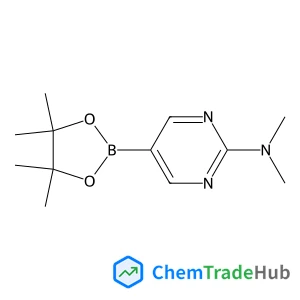
N,N-Dimethyl-5-(4,4,5,5-tetramethyl-1,3,2-dioxaborolan-2-yl)-2-pyrimidinamine
CAS Number:
1032759-30-0
Molecular Formula:
C12H20BN3O2
Tzu-Chun Yeh, Tsao-Cheng Huang, Hsiu-Ying Huang, Yu-Pei Huang, Yu-Ting Cai, Shih-Ting Lin, Yen Wei, Jui-Ming Yeh
In this study, electrochemical investigation of corrosion protection and electrochromic properties of aniline-pentamer-based electroactive polyurea (EPU) coating prepared by oxidative coupling polymerization is presented. Monitoring of the in situ chemical oxidation process for the reduced form of soluble EPU in N-methyl-2-pyrrolidone (NMP) by the incorporation of an oxidant was performed by measuring UV-Visible absorption spectra. Moreover, the electroactivity of EPU was evaluated by performing electrochemical cyclic voltammetry (CV) studies. The EPU coating was found to exhibit enhanced corrosion protection effect on cold-rolled steel (CRS) electrodes as compared to a corresponding non-electroactive polyurea (NEPU) coating based on a series of electrochemical measurements in 3.5 wt% NaCl electrolyte. The electrochromic performance of EPU was investigated by measuring electrochromic photographs and UV absorption spectra.
Anna Isakova, Christian Burton, Daniel J. Nowakowski, Paul D. Topham
DOI: 10.1039/C7PY00394C
Yangqing Tao, Fengkai He, Kaikai Jin, Jiajia Wang, Yuanqiang Wang, Junfeng Zhou, Jing Sun, Qiang Fang
DOI: 10.1039/C7PY00047B
Marc Guerre, Mona Semsarilar, Franck Godiard, Bruno Améduri, Vincent Ladmiral
DOI: 10.1039/C6PY02203K
Wei Wu, Qiujing Zhang, Jiantao Wang, Miao Chen, Shuai Li, Zaifu Lin, Jianshu Li
DOI: 10.1039/C4PY00575A
Christophe Detrembleur, Marie Hurtgen, Antoine Debuigne, Marie-Claire De Pauw-Gillet, Stéphane Mornet, Etienne Duguet, Christine Jérôme
DOI: 10.1039/C4PY00352G
Ruixue Chang, Heng An, Xu Li, Ruyi Zhou, Jianglei Qin, Yuelan Tian, Kuilin Deng
DOI: 10.1039/C6PY02122K
Yuanfeng Gao
DOI: 10.1039/C6PY01929C
Xue Jiang, Guolin Lu, Huang Xiaoyu
DOI: 10.1039/C6PY02004F
Marco Albuszis, Peter J. Roth, Werner Pauer, Hans-Ulrich Moritz
DOI: 10.1039/C4PY00709C
When considering alternatives to 1-(4-Chlorophenyl)-N-hydroxymethanimine (CAS: 3...
This compound should be stored in a cool, dry place away from direct sunlight. I...
3-(4-Bromophenyl)-5-(2-fluorophenyl)-1,2,4-oxadiazole is synthesized through a m...
5-Chloro-2-(4-chlorophenyl)-4-methyl-6-[3-(1-piperidinyl)propoxy]pyrimidine (CAS...
2-Chloro-4-(difluoromethoxy)pyridine is used in the pharmaceutical industry for ...
3-Chloro-6-methylpyridazine (CAS: 1121-79-5) is classified under the Globally Ha...
Several alternatives can be used in the synthesis of Methyl 4,5-dimethyl-2-nitro...
Alternatives to (2E,2'E)-3,3'-(1,4-Phenylene)bisacrylaldehyde include other acry...
3-Amino-5-chloropyridin-2-ol hydrochloride is an organic compound with the CAS n...
When handling 6,7-Difluoro-2,3-dihydro-4H-chromen-4-one, it is essential to wear...

Polymer Chemistry welcomes submissions in all areas of polymer science that have a strong focus on macromolecular chemistry. Manuscripts may cover a broad range of fields, yet no direct application focus is required.