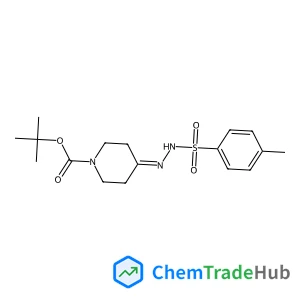
tert-Butyl 4-(2-(p-Tolylsulfonyl)hydrazono)piperidine-1-carboxylate
CAS Number:
1046478-89-0
Molecular Formula:
C17H25N3O4S
Xiao-Wen Zhang, Di Wu, Zheng-Hui Guan, Wen-Bo Liu
Azo-disubstituted derivatives with electron-withdrawing groups, such as acyl, alkoxycarbonyl and nitrile, are widely used as reagents in organic synthesis. Dialkyl azodicarboxylates are the most readily available reagents among them. This review summarizes the utility of dialkyl azodicarboxylates as versatile reagents and essential building blocks for the synthesis of complex molecules. Applications of dialkyl azodicarboxylates in the Mitsunobu reaction, as oxidants in the oxidation of aldehydes, hydrazines, alcohols, hydroxylamines and thiols, and in photocatalytic C–C bond cleavage and C–H bond amination reactions are discussed. In synthetic chemistry, a large number of synthetic procedures use azodicarboxylates as electrophiles. The discussion is also extended toward the enantioselective α-amination of carbonyl, cyanoacetate and heterocycle derivatives. In addition, mechanistic insights are also briefly reviewed.
Nathan R. B. Boase, Idriss Blakey, Kristofer J. Thurecht
DOI: 10.1039/C2PY20132A
Maria Beny Pinto Zakia, José Godoy Filho, João Sinezio de Carvalho Campos
DOI: 10.1039/C2PY00003B
Bader S. Ghanem
DOI: 10.1039/C1PY00423A
Jingjing Zhang, Ying Niu, Caili Huang, Liping Xiao, Zhongtao Chen, Keke Yang, Yuzhong Wang
DOI: 10.1039/C2PY20028G
Xiaolong Wang, Feng Zhou
DOI: 10.1039/C2PY20148H
Donghun Koo, An Du, Giuseppe R. Palmese, Richard A. Cairncross
DOI: 10.1039/C2PY00549B
Derek L. Patton, Kirt A. Page, Emily A. Hoff, Michael J. Fasolka, Kathryn L. Beers
DOI: 10.1039/C2PY20023F
Hou Chien Chang, Hung Tse Lin, Ching Hsuan Lin
DOI: 10.1039/C2PY00528J
When considering alternatives to 1-(4-Chlorophenyl)-N-hydroxymethanimine (CAS: 3...
This compound should be stored in a cool, dry place away from direct sunlight. I...
3-(4-Bromophenyl)-5-(2-fluorophenyl)-1,2,4-oxadiazole is synthesized through a m...
5-Chloro-2-(4-chlorophenyl)-4-methyl-6-[3-(1-piperidinyl)propoxy]pyrimidine (CAS...
2-Chloro-4-(difluoromethoxy)pyridine is used in the pharmaceutical industry for ...
3-Chloro-6-methylpyridazine (CAS: 1121-79-5) is classified under the Globally Ha...
Several alternatives can be used in the synthesis of Methyl 4,5-dimethyl-2-nitro...
Alternatives to (2E,2'E)-3,3'-(1,4-Phenylene)bisacrylaldehyde include other acry...
3-Amino-5-chloropyridin-2-ol hydrochloride is an organic compound with the CAS n...
When handling 6,7-Difluoro-2,3-dihydro-4H-chromen-4-one, it is essential to wear...

Organic Chemistry Frontiers publishes high-quality research from across organic chemistry. Emphases are placed on studies that make significant contributions to the field of organic chemistry by reporting either new or significantly improved protocols or methodologies. Topics include, but are not limited to the following: Organic synthesis Development of synthetic methodologies Catalysis Natural products Functional organic materials Supramolecular and macromolecular chemistry Physical and computational organic chemistry